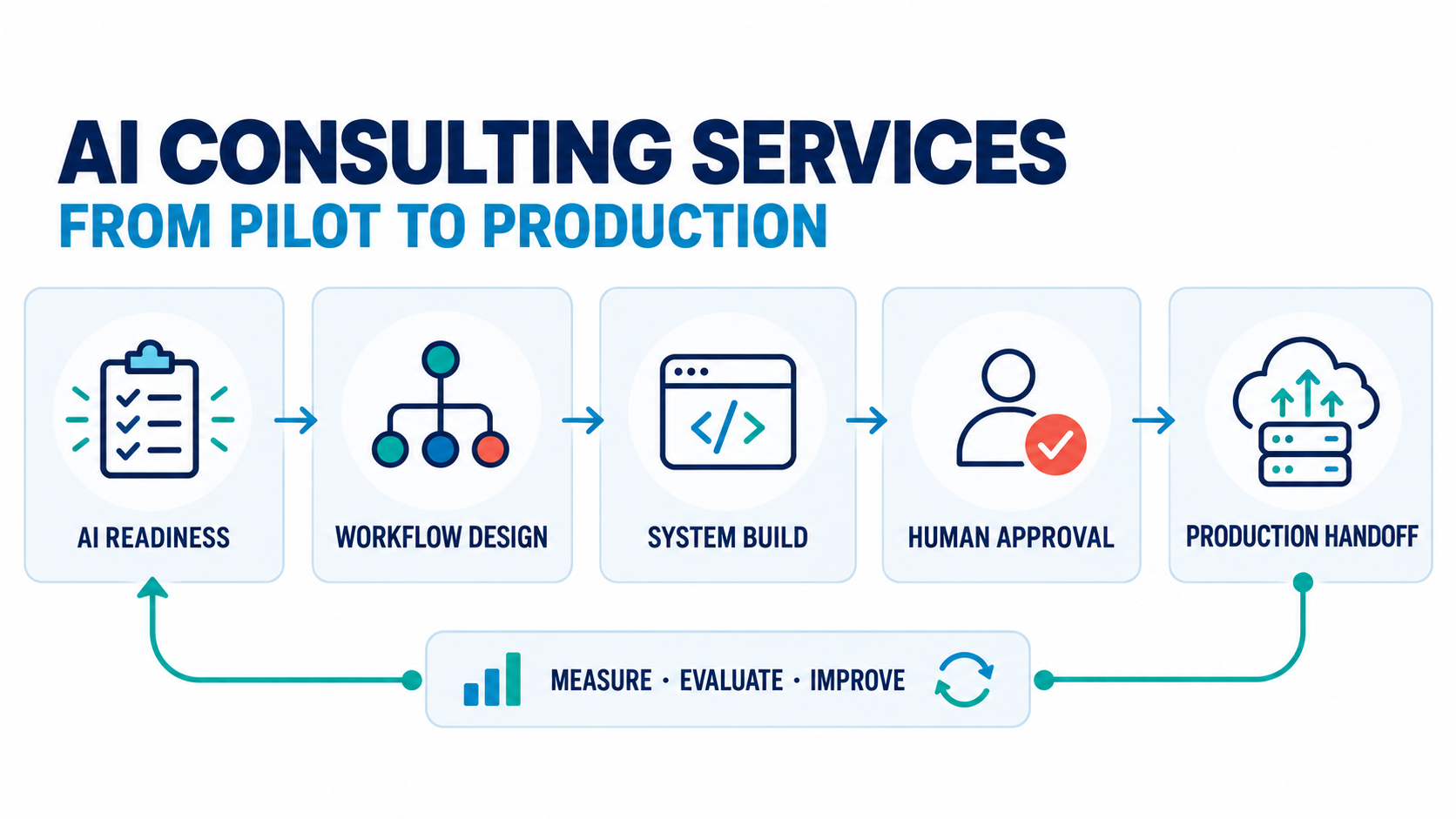
Most AI pilots produce a demo. We build AI systems designed to operate in production, owned by you, integrated with your systems, with a named owner on both sides from day one.
BOLD Precious Metals |
AI in production since 2021 |
|---|---|
MineralView |
AI in production since 2019 |
Named production systems |
6 across both platforms |
Engineering findings triaged |
500+, including critical security issues |
The Gap between Pilots and Production
AI is currently used in at least one commercial function by 88% of businesses. Just 6% estimate it has an impact on EBIT of more than 5% (McKinsey, The State of AI 2026).
There isn't always a technological issue with that gap. Instead of just introducing a model to a process that was not intended to employ AI, organizations reporting greater commercial effect are frequently adopting a different strategy: they rebuild the workflow the AI enters (McKinsey, The State of AI: How Organizations Are Rewiring to Capture Value, March 2025).
An AI pilot can face predictable challenges when moving into production:
- Instead of using the real-time data that the workflow relies on, it was constructed using carefully selected data.
- It got around the integration, authentication, and compliance requirements that control actual operations.
- After the pilot crew moved on to the next project, no one was identified as the owner.
- Moving from experiment to deployment lacked a clear foundation because no quantifiable business objective had been established prior to the first run.
This reflects a pattern we have observed when supporting projects that stalled, and it is why every engagement we run starts with a written scope, a defined success gate, and a named owner on both sides before a line of code is written.
What Our AI Consulting Covers
We do not produce AI strategy roadmaps without implementation. Everything we scope is intended to end in a working system or a clear decision not to build.
Discovery and AI Readiness
Before scoping any build, we evaluate the workflow, the data at its disposal, the integration points, and the measurement baseline. A system constructed on the wrong basis may be less useful than a readiness evaluation that identifies a blocking issue in the first week.
Architecture and System Design
We build the AI architecture based on your real context, which includes your current systems, data boundaries, governance needs, and team's ability to run the outcome. Before the build begins, we document this and receive approval.
Custom AI Application Development
We create retrieval systems, agentic workflows, and LLM-powered apps that work with your current stack. The objective is not only a prototype but a system that your team can operate, keep an eye on, and provide to a new hire together with supporting documentation.
Integration and Workflow Redesign
When a model is added to an unaltered process, the results may just slightly change. We map the entire workflow, determine where AI may alter the task rather than just speed it up, and then rebuild the exception paths, approval gates, and handoffs appropriately.
Evaluation, Governance, and Risk Controls
An assessment set, specified quality levels, monitoring, and a documented incident path are all included in every commercial AI system we develop. The governance baseline for systems that interact with actual people or operations is NIST's AI Risk Management Framework.
Handoff and Documentation
You get the system, the source code, the architecture documentation, the evaluation set, and the operating runbook at the conclusion of each engagement. Our goal is not to foster dependency. You depart with the ability to operate and expand upon what we created.
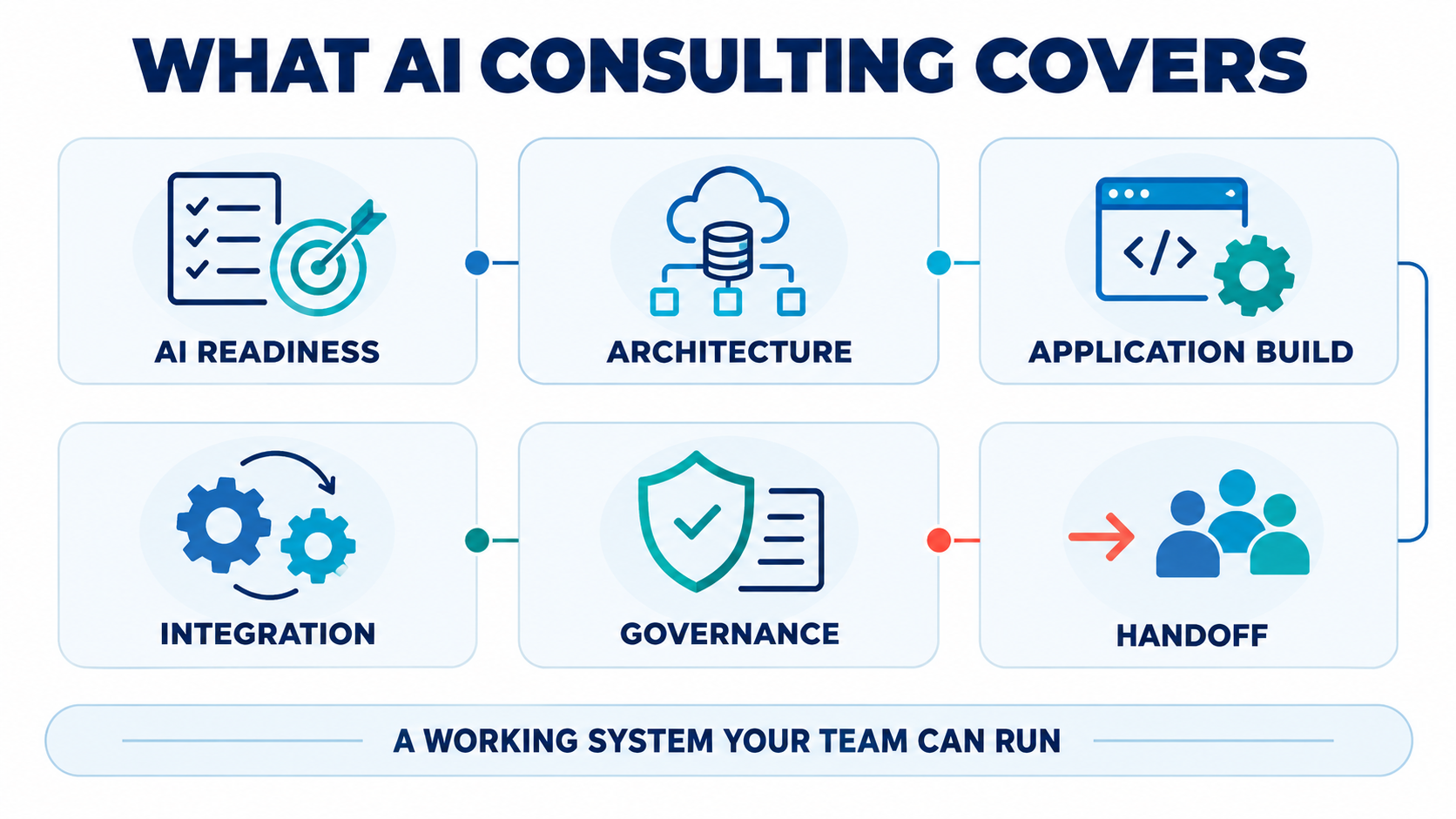
Strategy without implementation is a slide deck. We build both and hand off the running system.
Production AI We Have Built and Shipped
These are not case studies about what AI could do. They are systems running in production for named clients, with outcomes that can be measured.
Stella
BOLD Precious Metals' AI CRM Before sending any messages, Stella drafts outreach for human approval and models a customer re-engagement opportunity. based on 30,800 client records that have expired. modeled a cart-recovery possibility of $1.79 million. A holdout comparison against a control group shows that the sending cost is about ten times cheaper than the previous channel.
Pursuit
AI Outreach CRM Pursuit operates as a job-queue runner and daily cron agent, chooses the outreach channel and feature for each lead, and stops when a lead responds. The system runs on a factory scale. Before a message can be sent, it must be approved by a human.
Trendelier
Before anything is published, Trendelier, an agentic content engine, goes from trend recognition to platform-ready material with a human approval stage. designed and run for a large-scale publishing content company.
Pulse
We created the Team AI-adoption platform Pulse to handle our own AI adoption, which includes consent-based adoption metrics, multi-provider LLM routing, and RAG question-answering across a curated knowledge source. Today, our 50-person engineering team uses the same system.
AISEO Manager
SEO activities involving many agents An approval-gated task queue, diagnosis, and draft repair are all part of AISEO Manager's multi-agent process. designed with BOLD's SEO activities in mind. Before each change is put into production, it must be approved by a person.
Teams Profit Agent
AI assistant for Microsoft Teams A production AI assistant for BOLD Precious Metals within Microsoft Teams, managing real-time pricing inquiries and profit computations in the channel where choices are made.
Engineering Audits We have detected and resolved Core Web Vitals concerns on BOLD's top four pages, and we have prioritized more than 500 engineering discoveries across both client platforms, including serious security issues.
Since 2019 and 2021, respectively, both client platforms (BOLD and Mineral View) have been completely redesigned using AI-first engineering.
Want to see the architecture behind any of these systems? Talk to Sachin
How an AI Consulting Engagement Runs
We do not publish delivery timelines or price models. Engagements are scoped per client because the work, the data environment, and the organizational readiness are different in every case. What we do publish is the process, because the process is where many AI projects encounter challenges.
Written Scope Before Any Build
We write down what the system will do, what it will not do, and what a successful outcome looks like. You sign off on this before we start. If we cannot agree on the scope, we do not start.
Named Owner on both Sides
Every engagement has a named lead on the Realisier side and a named decision-maker on your side. Clear ownership helps prevent ambiguity about who can approve a change.
Weekly Demo of Working Software
Not a slide deck. Not a status update. Every week you see running software. If something is wrong, we aim to identify it early rather than after the build is substantially complete.
Approval Gates before Any Deployment
No code goes to your production environment without your explicit sign-off. Every agentic system we build includes a human review step at the point where it matters.
Clean Handoff with Full Documentation
You receive the source code, the architecture documentation, the evaluation set, and the operating runbook. We train your team to run what we built, and we document the decisions we made so the next engineer does not have to reverse-engineer them.
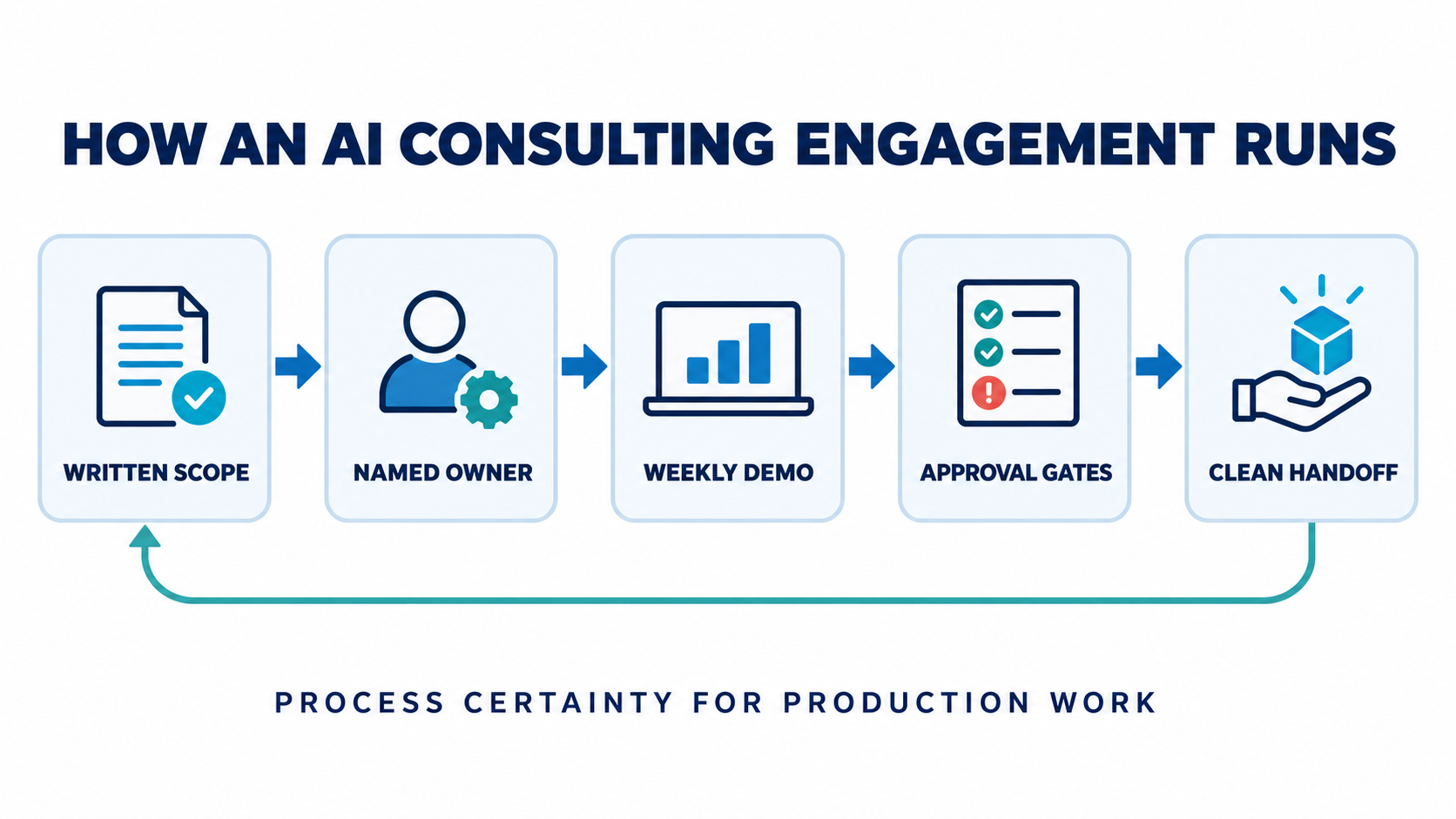
Written scope. Named owner. Weekly demo. Approval gates. Clean handoff. This is process certainty, not timeline certainty, and it provides a structured path for engagements that need to move from development to production.
How We Measure Success
We define success before the build starts, not after the demo. Every engagement has a documented outcome gate: the workflow change we are trying to produce, the quality threshold the system must stay inside, and the measurement method we will use to confirm the result.
What we measure depends on the workflow:
Workflow Type |
What We Measure |
|---|---|
Customer outreach |
Reply rate, opt-out rate, cost per qualified reply |
Content production |
Accepted output rate, publication volume, rework rate |
Engineering operations |
Findings triaged, time to resolution, escaped defects |
Internal knowledge operations |
Resolution rate, escalation rate, query volume handled without human intervention |
SEO operations |
Changes shipped, quality review pass rate, ranking movement over 90 days |
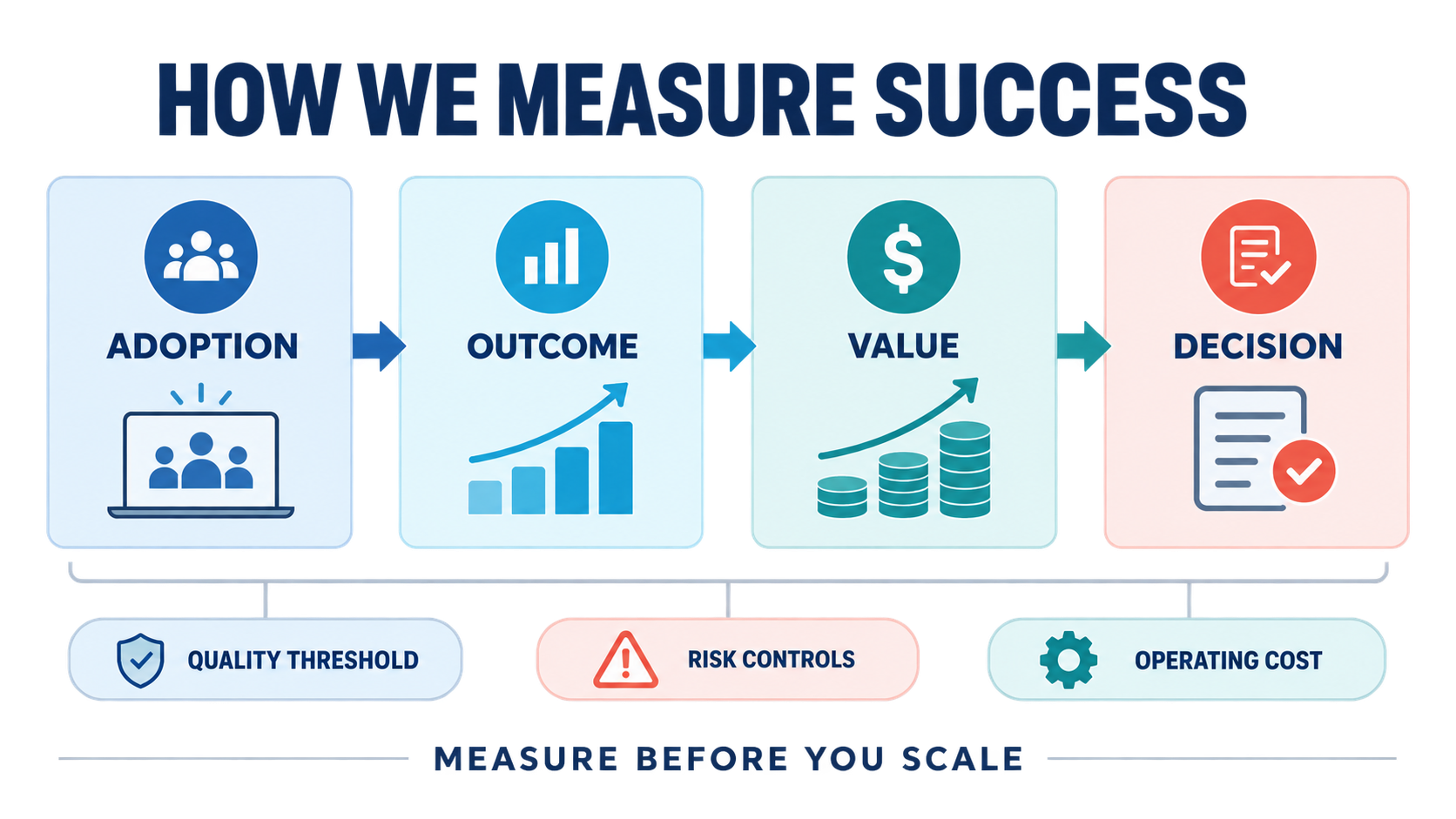
We separate adoption (did users use it) from outcome (did the workflow change) from value (did the business result change). A report that counts only prompts or active users tells you about activity, not return.
We also define what a "stop" decision looks like before we start. If the workflow is not ready, the data is not ready, or the outcome gate cannot be met, the right result is a clear recommendation not to build rather than a system that may not scale.
We define what a stop decision looks like before the build starts. Sometimes the most valuable thing an AI consultant can deliver is a clear recommendation not to proceed.
Agentic AI Consulting
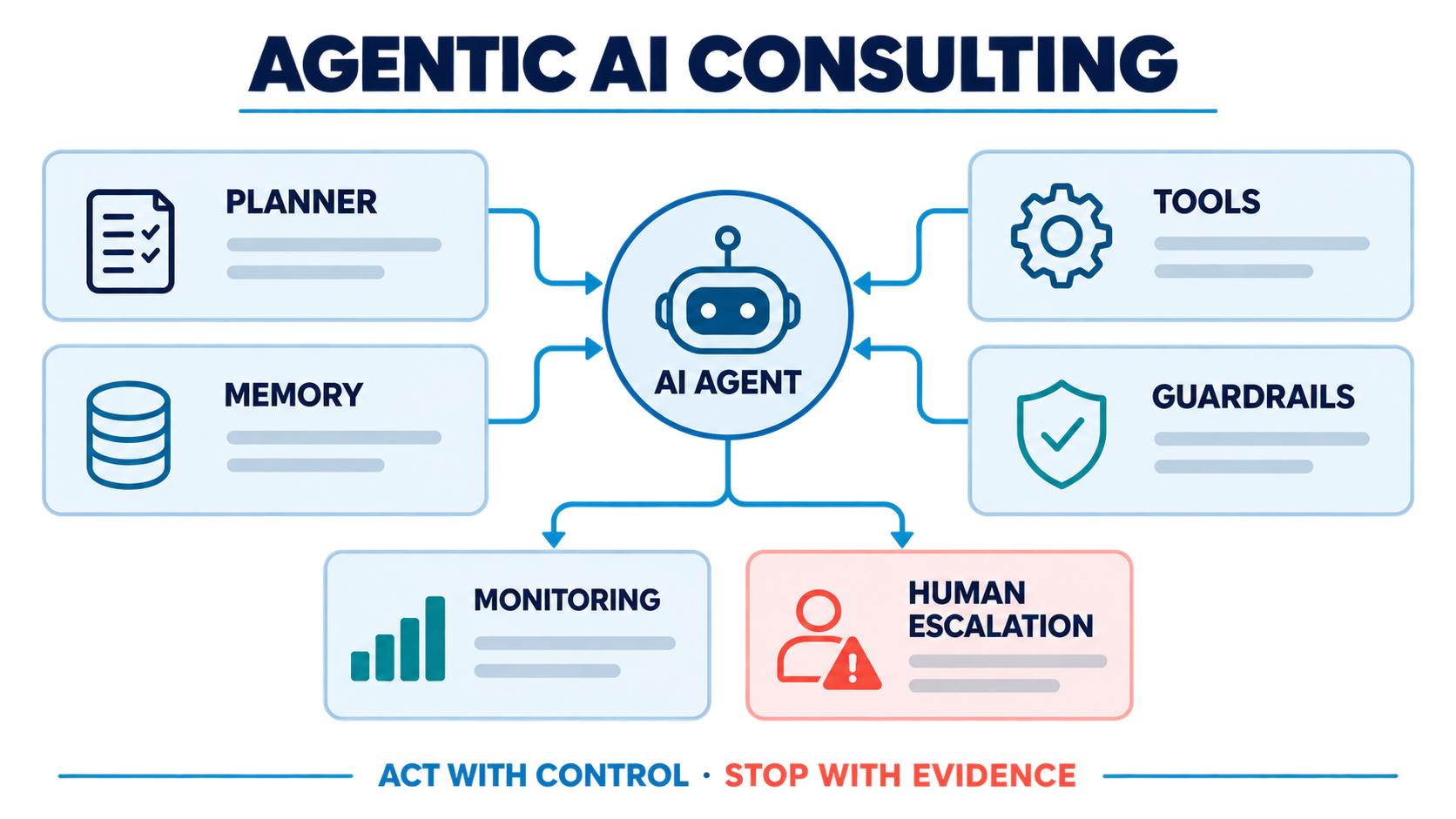
Agentic AI is not a chatbot with a longer prompt. It is a system where one or more AI agents decompose a goal into steps, call external tools or APIs, maintain state across multiple interactions, and handle failures without stopping the workflow.
In 2026, a key differentiator among AI consulting firms is the ability to design and build agentic AI systems that can operate at production scale. Many firms describe this capability. We have delivered systems using it.
Pursuit runs as a job-queue runner and daily cron agent that selects, sequences, and delivers outreach without continuous human instruction. It halts and surfaces for review when a lead responds. AISEO Manager orchestrates multiple agents across a diagnose, draft, and approve workflow. Both systems run in production today.
What a production agentic system requires that a prototype does not:
- A planner that decomposes the goal into steps the agent can execute reliably
- Tool calls that integrate with your actual systems, not a sandbox
- Memory that persists state across sessions and users
- Feedback loops that detect failures and route exceptions to a human
- Guardrails that constrain the agent to the actions it is authorized to take
We design these properties in from the start, rather than after a demo encounters production challenges.
Ask any AI consulting firm to walk you through a production agentic system they delivered in the last 12 months, the architecture, how it handles failure, and how it is monitored. If they cannot answer with specifics, it may be difficult to assess their production experience.
AI Consulting Versus Building Internally
Both paths can work. The question is which one is right for where you are now.
Question |
Hire a Consulting Firm |
Build an Internal Team |
|---|---|---|
Speed to first production system |
Faster — bring deployment and integration experience from prior builds |
Slower — the team learns as it builds, which is valuable but requires greater early investment |
Cost structure |
Project or engagement-based — easier to scope and bound |
Ongoing salary, benefits, recruiting, and ramp time |
Ownership of the result |
You own the code, the system, and the documentation at handoff |
You own everything from day one |
Strategic fit |
Right when the use case is defined, the business case is clear, and speed matters |
Right when AI is central to the product and you want the capability in-house long-term |
Knowledge transfer |
Depends on quality of handoff documentation — specify this upfront |
Depends on internal knowledge management and team continuity |
Most companies we work with use both: a consulting engagement to build and ship the first production system, followed by use of the handoff documentation and evaluation set to hire or develop the internal team that operates it.
What does not work: hiring a consultant to work within a process the organization is not ready to change. If the workflow will not be redesigned, the AI may not materially change the outcome.
Industries where We have Delivered
We are not an industry-vertical firm. We follow the workflow, not the sector. That said, the patterns that make AI consulting work in production are consistent: clear workflow ownership, measurable quality threshold, and integration with the system of record.We have delivered production AI in the following environments:
- Precious Metals E-Commerce (BOLD Precious Metals):
Customer re-engagement, pricing intelligence, SEO operations, engineering audits
- Oil and Gas Mineral Rights (Mineral View):
Outreach automation, CRM operations, AI-assisted engineering delivery
- Content and Media Operations (Trendelier):
Agentic content pipeline from trend to platform-ready output
- Internal Software Teams (Pulse):
AI-adoption infrastructure, RAG knowledge operations, adoption analytics
The common thread is not the industry. It is that the client had a workflow with a measurable outcome and was willing to redesign the workflow to pursue the result.
If your workflow has a measurable outcome and your organization is willing to change how the work is done, the sector may not be the primary constraint.
Who this is For
The Right Fit
You are a CTO, VP Engineering, or technical founder at a US company with 50 to 1,000 employees. Your team has run an AI pilot (or you have watched others run them) and you know that getting to a demo is not the same as getting to production. You want a working system, owned by your team, with documentation your engineers can use without calling us.
You are evaluating whether to bring in outside expertise or build the capability internally. You want to see what we have actually shipped before you decide.
We work with CTOs who have already discovered that AI pilots do not necessarily scale themselves. If you are still looking for a pilot, we may not be the right starting point.
We have also delivered for companies that are not yet running AI and want to start with a production-grade engagement from day one rather than a proof-of-concept that they may need to rebuild later.
We are Probably not the Right Fit If:
You need a strategy roadmap with no implementation attached. We produce working systems. If the engagement ends at a presentation, we may be the wrong choice.
You are looking for offshore development rates. We are a 50-person engineering team with US business hours and a decade of production delivery. We are not positioned as the lowest-cost option in every search.
What to Ask any AI Consulting Firm before Hiring
These questions can help distinguish firms with production AI experience from firms focused primarily on pilots.
- Walk me through a production agentic system you completed in the last 12 months: the architecture, the orchestration layer, how it handles failure, and how it is monitored.
- Who owns the system at the end of the engagement? Do we get the source code, the evaluation set, and the operating documentation?
- What does the handoff look like, and how do you train our team to operate what you built?
- How do you define a successful outcome, and when do you agree on that definition?
- What is your process for integrating with our existing systems: our data sources, our authentication layer, our deployment environment?
- What would cause you to recommend not building, and have you ever made that recommendation?
If a firm cannot answer the first question with a specific architecture, it may be difficult to evaluate its production experience.
FAQs
What do AI Consulting Services Include?
AI consulting services cover the full lifecycle of building AI into a business workflow: readiness assessment, architecture design, custom application development, integration with existing systems, evaluation and governance, and handoff to the team that will operate the result. A firm that covers only strategy without implementation produces a roadmap, not a system.
A firm that builds without governance may create additional operational considerations as it scales. The quality test is whether the firm can show you a named production system and the workflow they redesigned to make it work.
How is AI Consulting Different from Hiring an AI Development Agency?
The distinction matters less than whether the firm can show you a production system they built and the workflow they redesigned to make it deliver. A consulting firm that does not implement is primarily a strategy firm. A development agency that does not assess the workflow may produce software that does not materially change outcomes. Ask for the architecture of a production system they delivered in the last 12 months. That answer can tell you more than the label.
What does a Production-Ready AI System Require that a Pilot does Not?
A pilot may run against curated data in a controlled environment with limited legacy system dependencies and no named owner for what happens when it fails. A production system runs against live data, integrates with your authentication and compliance layer, has a defined exception path, operates within quality thresholds that are measured continuously, and has a named owner who can act when something goes wrong. The engineering work to cross that gap can be substantially larger than the work to build the pilot.
What Makes an Enterprise AI Pilot Fail to Reach Production?
The model is not always the primary issue. Common causes include: the pilot was built against data that does not reflect production conditions; there was no measurable success gate defined before the first run; no one was named as the owner once the pilot team moved on; and the workflow the AI entered was not redesigned to accommodate the new decision points. Addressing these areas is a program management and workflow design challenge as well as a technology consideration.
What is Agentic AI Consulting?
Agentic AI consulting covers the design, build, integration, and operation of AI systems where one or more agents decompose goals into steps, call external tools, maintain state across interactions, and handle failures without stopping. The difference from standard AI consulting is that agentic systems can take actions in your environment: sending messages, updating records, and calling APIs. That means the governance requirements, failure handling, and authorization design are more demanding. A consultant with limited experience building and operating production agentic systems may not be equipped to address these requirements.
How do You Measure the Success of an AI Consulting Engagement?
Success is defined before the build starts, not after the demo. The engagement document specifies the workflow outcome, the quality threshold, and the measurement method. We separate adoption (did users use the system), outcome (did the workflow change), and value (did the business result change). A system that is used but does not change the workflow has not demonstrated a return. The measurement plan is part of the scope agreement, not an afterthought.
Should We Build an Internal AI Team or Hire Consultants?
Both can be the right answer. Hire consultants when speed matters and the use case is defined: you can apply production experience from prior builds directly to your problem. Build internally when AI is central to your product and you want the capability in-house long-term. The two are not mutually exclusive. A consulting engagement that ends with a clean handoff, full documentation, and a trained internal team can be a practical path to building internal capability.
What Questions should We Ask an AI Consulting Firm before Signing?
Ask them to walk you through a production agentic system they delivered in the last 12 months: the architecture, how it handles failure, and how it is monitored. Ask who owns the code and documentation at handoff. Ask how they define success and when that definition is agreed. Ask what would cause them to recommend not building. If they cannot answer the first question with specifics, it may be difficult to assess their production experience.
You have an AI problem worth solving.We will tell you honestly whether what you want to build is the right problem to solve first, and what it would take to solve it properly.
A founder replies within one US business day.