

Key Takeaways:
- AI sales agents fail on operational design, not model quality: unclear ownership, no human approval, and no stop condition.
- The highest-return pattern pairs an agent that handles research, drafting, and timing with a human who owns the relationship and the close.
- A production-grade agent needs four controls: per-lead context, a human approval gate, hard stop conditions, and graceful failure.
The first lesson is straightforward: an AI agent does not fail a sales team because the model writes poor emails. It fails because no one defined who owns the lead, what actions the agent can take without human approval, and when it must stop. Address these three areas, and a sales agent becomes a valuable business asset. Overlook them, and you create a faster way to damage your sales pipeline.
AI agents for sales are receiving significant attention. Every vendor offers one. Many demonstrate impressive capabilities but fail within weeks of the pilot. This guide explains the difference, based on experience building an AI sales agent that operates successfully in production.
What an AI Agent for Sales Actually is
An AI sales agent is software that goes beyond responding to prompts. It evaluates real customer signals, determines the next action, drafts outreach, and moves leads through email, SMS, call scripts, and voicemail. The defining characteristic is the word agent. It performs a sequence of actions independently to achieve a business objective.
That autonomy is both its greatest advantage and its greatest responsibility. A chatbot that suggests a reply presents minimal risk. An agent that sends the reply, schedules a meeting, and initiates a follow-up sequence is performing customer-facing activities under your brand. The primary design question is not, "Can the model write an email?" It is, "What happens when the model is incorrect, and who is responsible for reviewing the outcome?"
The State of AI Sales Agents in 2026
The reality is that most enterprise AI initiatives never reach production.
A 2025 MIT study found that 95% of enterprise generative AI pilots delivered no measurable P&L impact.
(MIT NANDA, The GenAI Divide: State of AI in Business 2025)
Gartner predicted that at least 30% of generative AI projects would be abandoned after the proof-of-concept stage by the end of 2025.
(Gartner, 2024)
IDC found that 88% of AI proof-of-concept initiatives never reach production, approximately 4 out of every 33.
(IDC, via CIO, 2025)
The pattern across all of these findings is consistent. The model is rarely the problem. The surrounding system is not designed to handle real-world inputs, operational workflows, and business accountability. AI sales agents fail for the same reasons, often more quickly, because they interact directly with customers.
Where AI Agents Create Real Value in Sales
When implemented with the right controls, AI sales agents deliver value in four key areas.
1Lead Generation and Enrichment
The agent monitors behavioral signals, browsing activity, form submissions, and product usage to identify the leads that deserve a sales representative's attention. This is the foundation of AI agents for lead generation, not collecting more names, but prioritizing the existing leads based on genuine buying intent.
2Personalized Outreach at Scale
Many B2B sales sequences feel generic because the same template is distributed across an entire segment. An AI agent can create an original message for each lead using that lead's actual history instead of relying on simple mail-merge fields. This is where AI agents for B2B sales provide a meaningful advantage over traditional sequencing platforms.
3Qualification and Routing
The agent manages the initial conversations, captures the information that matters, and routes qualified, context-rich leads to the appropriate sales representative. The representative begins the conversation with the relevant background already available.
4Follow-up that does not Become Outdated
A significant amount of revenue is lost between customer interactions. An AI agent maintains consistent follow-up until meaningful human engagement begins, then steps aside at the appropriate time.
Notice what none of these examples suggest. None of them are intended to replace the sales representative. The highest-value approach is an agent that handles repetitive research, drafting, and timing, while the sales representative remains responsible for the customer relationship and closing the opportunity.
Why Most AI Sales Agents Fail
Four common failure patterns consistently prevent successful deployment.
1No Ownership
The pilot has no business owner, only an enthusiastic engineering team. Both MIT and Gartner identify unclear ownership and undefined business value as major reasons AI initiatives fail to progress. Without ownership, no one is responsible for improving the agent, maintaining it, or preventing poor customer experiences.
2Notebook Architecture
The solution performs well during demonstrations using clean data. In production, it encounters incomplete records, provider outages, and API rate limits without an effective fallback strategy. An AI sales agent without a model fallback mechanism can stop functioning in the middle of a campaign.
3No Workflow Home
Daily sales activities remain unchanged, making the agent optional rather than essential. If sales representatives do not perform their work within the system, the agent becomes an unused proof of concept.
4No Stop Condition
This is one of the most damaging failures. An agent that continues sending follow-up messages after a lead has replied, converted, or opted out creates a poor customer experience.
The difficult part of building a sales agent is not enabling it to send messages, it is ensuring that it knows when to stop.
What a Production-Grade AI Sales Agent Looks Like
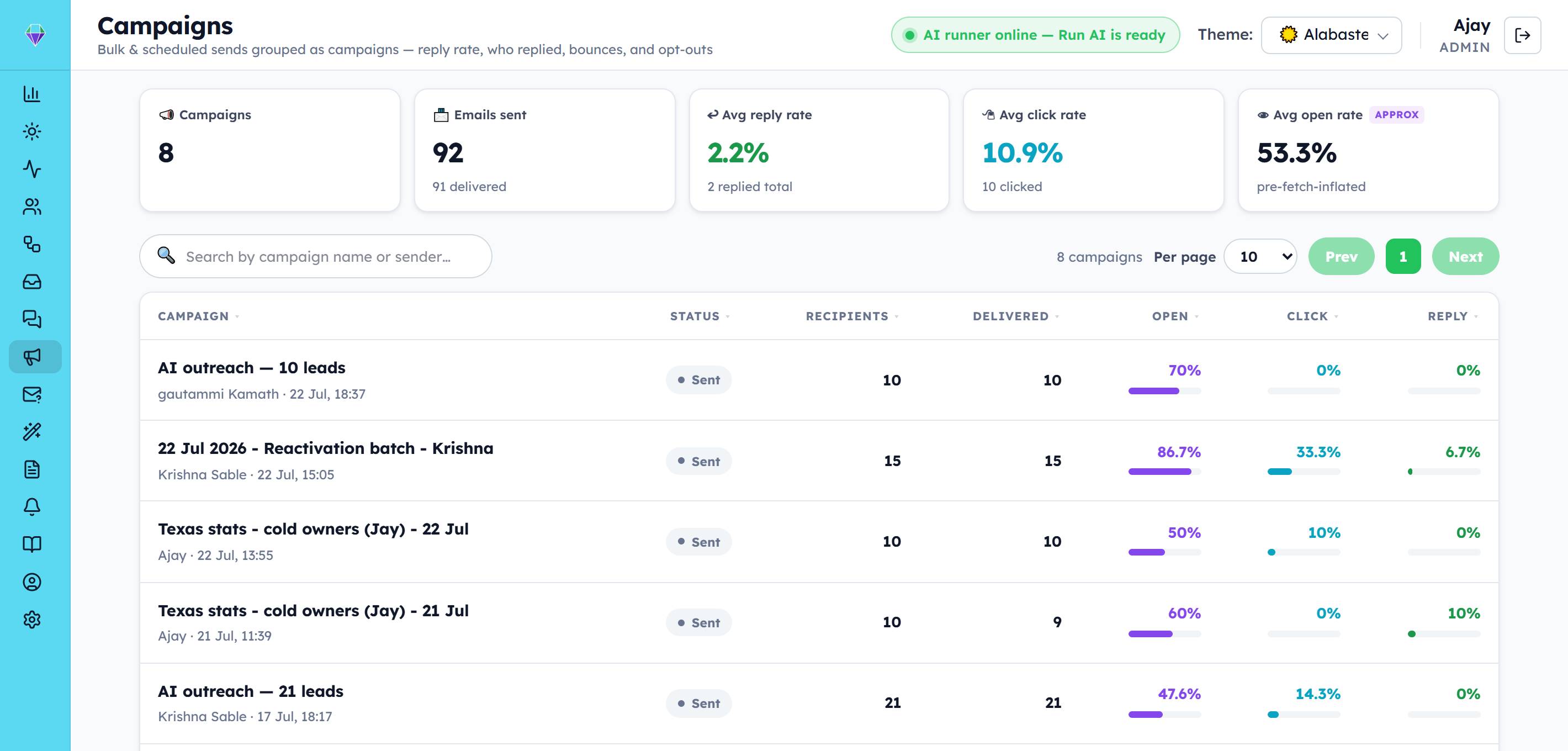
When we built Pursuit, our AI acquisition platform currently operating in production, the greatest engineering challenge was never content generation. The challenge was designing the operational controls around it. Four characteristics distinguish a production-ready sales agent from a demonstration.
1Per-Lead Context, not Templates
Every message is generated using the individual lead's history, activity, status, and previous interactions. As a result, each message reads as genuine communication between people rather than a template sent to a marketing segment.
2A Human Approval Gate
No customer communication is sent until it has been reviewed and approved by a person. The agent prepares the recommendation, a person approves it, and the system executes the action. Separating these responsibilities makes the entire process auditable, controlled, and suitable for production. Reviewers receive complete context for every draft, allowing approvals to be completed efficiently.
3Hard Stop Conditions
Communication sequences are limited and stop immediately after a reply, conversion, or opt-out. These controls are enforced automatically by the workflow rather than relying on manual processes. The agent is designed to avoid interrupting an active human conversation.
4Graceful Failure
A fallback model strategy keeps message generation available during provider outages, while a deterministic scoring process continues lead prioritization even when AI services are temporarily unavailable. A production system must continue operating even under adverse conditions.
That is the difference between the small percentage of systems that successfully reach production and the majority that do not.
The Core PrincipleThe difference is not a better model. It is a better production system.
A Checklist Before You Buy or Build One
Answer these questions before investing in an AI sales agent.
- Who owns the agent's output, and can they disable it immediately if necessary?
- Does a person approve customer-facing communications, or does the agent send them automatically?
- What specifically causes the agent to stop after a lead replies or opts out?
- What happens if the model or a system integration becomes unavailable during an active campaign?
- Do sales representatives already work within the platform where the agent operates, or is it another application they are unlikely to use consistently?
If any of these questions cannot be answered clearly, the pilot may perform well during demonstrations but is unlikely to succeed in production. That is not an assumption. It is the pattern observed across enterprise AI deployments.
The Takeaway
AI agents for sales are a practical reality, and they deliver value when they are designed as production systems with clear ownership, human approval, and defined stop conditions, rather than as demonstrations built around a capable model. The organizations achieving success are not the ones with the best prompts. They are the ones that treat the agent as production software that interacts directly with customers, because that is exactly what it is.
At Realisier Labs, we build AI systems that operate successfully in production, not pilot projects that end after the demonstration. Pursuit is one example: an AI acquisition agent that generates individualized outreach for every lead, requires human approval before every communication, and immediately stops when a prospect responds.
If you are evaluating whether to buy or build an AI sales agent, speak with Sachin.