
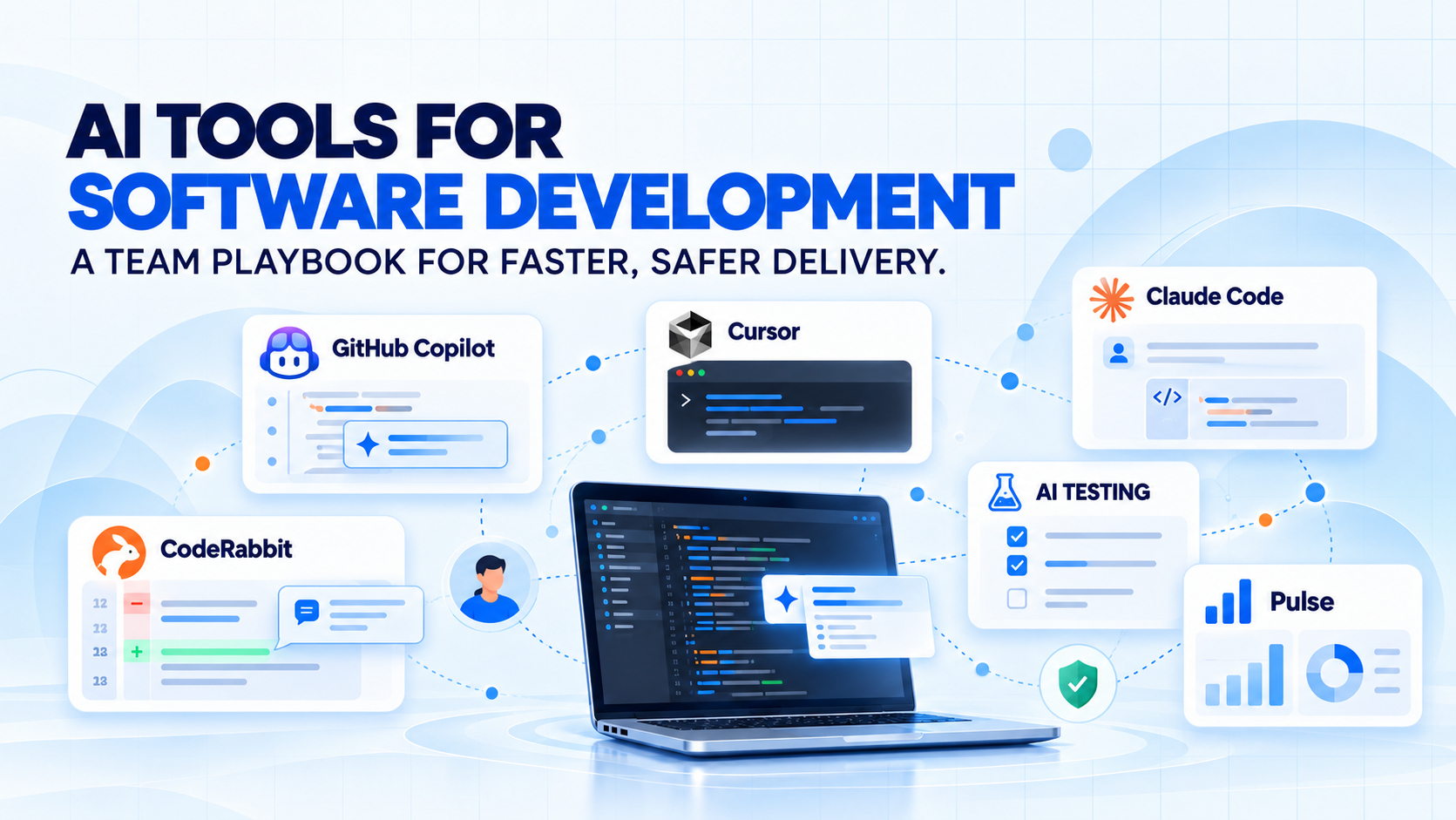
AI tools for software development work best as a governed stack of coding assistance, testing, review, documentation, and measurement. Context and approval gates determine whether faster code leads to better delivery. JetBrains reported that 90 percent of professional developers regularly use at least one AI tool at work, while Stack Overflow found that 46 % distrust AI output accuracy.
At Realisier Labs, our 50+ engineer team runs this model through Pulse, our internal adoption platform. This article shows what the evidence supports, how our AI-assisted systems work, and how to measure adoption without confusing it with productivity.
What are AI Tools for Software Development and How do they Work?
AI tools for software development use large language models to assist with specific parts of the software lifecycle. Common layers include an in-editor coding assistant, an agentic terminal tool, test generation, code review, documentation, and an operations or measurement layer. Each layer addresses a different problem, so a team should evaluate the workflow rather than choose one tool as a universal solution.
The underlying mechanism is context retrieval and generation. A tool may use the current file, repository conventions, documentation, pull-request diff, test output, or connected knowledge base to produce code, a review comment, a test case, or a documentation block. Better context can improve relevance, but it does not remove the need for review. Retrieval-augmented generation, or RAG, is useful when the tool needs access to internal knowledge, while CI/CD checks and human approval remain the controls that determine what reaches production.
JetBrains reported that 74 % of professional developers in its January 2026 AI Pulse survey had adopted specialized developer AI tools such as coding assistants, editors, or agents, rather than relying only on general-purpose chatbots. The result reflects a shift from “ask AI about a function” to “place AI inside the engineering workflow.”
How much do AI Tools Actually Improve Developer Productivity?
AI tools can make bounded coding tasks faster, but the size of the gain depends on the task, developer experience, codebase complexity, and the quality controls around the work. Controlled task studies report larger improvements than longitudinal studies of whole engineering organizations, so leaders should measure both task-level speed and delivery-level outcomes.
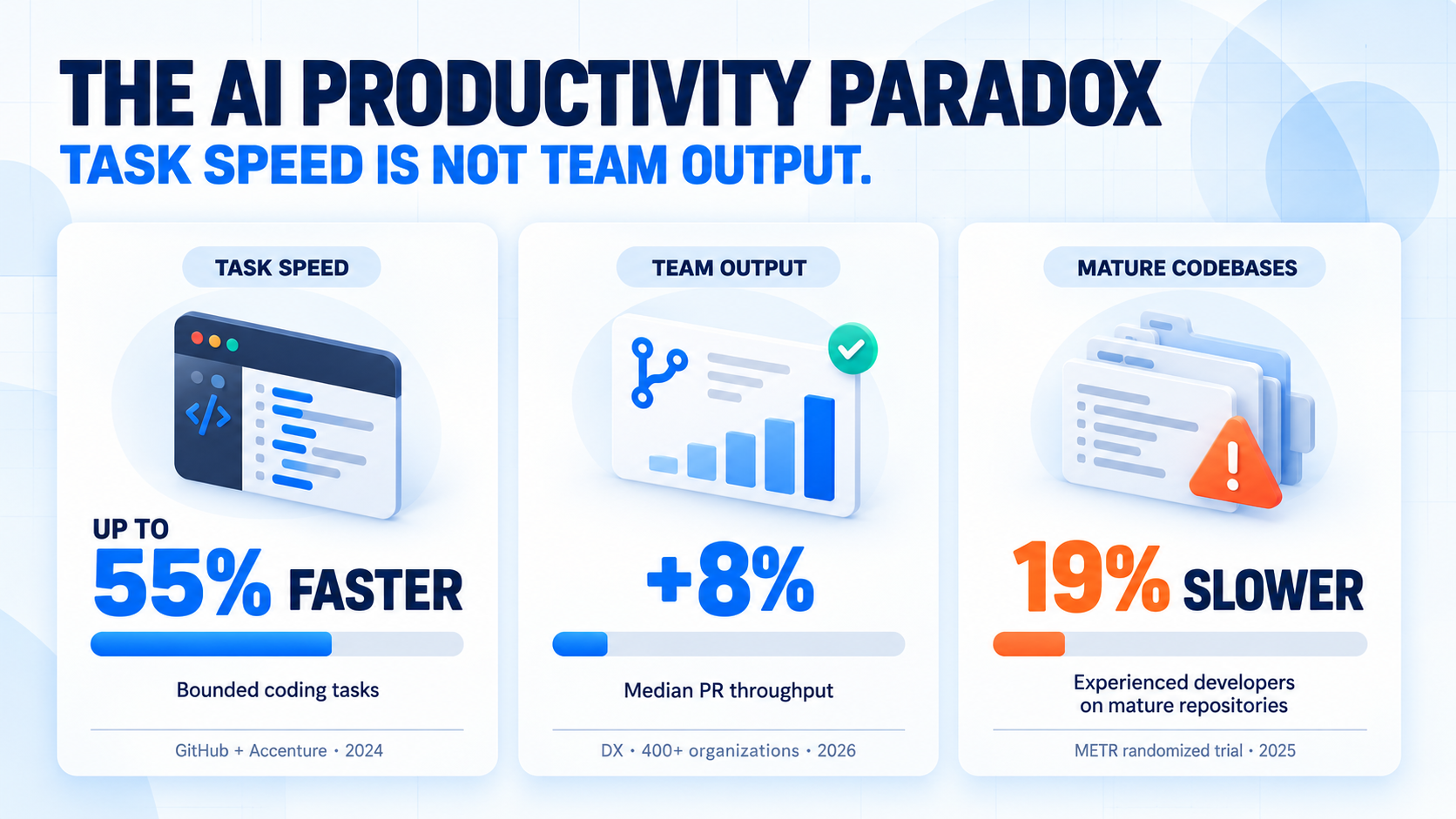
GitHub’s 2024 enterprise study with Accenture reported that Copilot users completed coding tasks up to 55 percent faster and that successful builds increased by 84 percent. The same study reported an 8.69 percent increase in pull requests and a 15 percent increase in pull-request merge rate. These are vendor-led study results and should be understood as evidence from a particular deployment, not as a forecast for every team.GitHub and Accenture study
DX’s longitudinal analysis of more than 400 organizations found that AI tool usage increased by 65 percent while median pull-request throughput rose by about 8 percent. That represents a measurable gain, but it is below the headline claims often used in tool marketing.DX longitudinal analysis
McKinsey’s 2023 lab research found that documentation could be completed 45 to 50 % faster, code generation 35 to 45 % faster, and refactoring 20 to 30 % faster. Those are task-level findings, not a claim that the whole engineering function becomes 45 percent faster.McKinsey study
Why do Experienced Developers Sometimes Slow Down with AI Tools?
AI assistance can slow experienced developers when the cost of checking, correcting, and contextualizing generated code exceeds the time saved by generating it. This is more likely when engineers work in mature repositories they know well, where correctness includes local conventions, hidden dependencies, architecture, and a high standard for testing and maintainability.
METR’s July 2025 randomized controlled trial studied 16 experienced open-source developers completing 246 tasks in mature repositories. Developers took 19 percent longer when AI tools were allowed. Before the study, they expected to be 24 percent faster; after the study, they still believed they had been 20 percent faster. The result is a 39 percentage-point gap between perceived and measured impact.METR study
This is a context-specific result, not evidence that AI always slows developers down. The study examined experienced maintainers working on familiar, complex codebases and early-2025 tools. It does show why a team should compare cohorts and task types instead of relying on usage dashboards or developer sentiment alone. A junior developer on a greenfield task, a senior developer in a mature service, and a QA engineer maintaining an unstable browser suite may experience very different returns.
Which AI Coding Assistant should Your Team Choose?
Choose an AI coding assistant according to the team’s repository, IDE, terminal habits, security requirements, and review workflow. Adoption data can show which tools are being used, but it cannot establish which one will improve outcomes in your environment.
Tool | Reported workplace adoption | Best fit | Strength to test |
|---|---|---|---|
GitHub Copilot | 29% globally; 40% in companies with 5,000+ employees | GitHub-centric enterprise teams | Low-friction integration and enterprise administration |
Cursor | 18% globally | IDE-native teams working across files and tests | Fast context switching and inline assistance |
Claude Code | 18% globally; 24% in the US and Canada | Terminal-first, multi-step engineering workflows | Agentic task execution; 91% CSAT and 54 NPS in the JetBrains survey |
These figures come from JetBrains’ January 2026 AI Pulse survey. The survey reported more than 10,000 professional developers in that wave, so the adoption percentages describe survey respondents, not global market share.JetBrains AI Pulse survey
Run a structured comparison using the same repositories and task types. Measure pull-request cycle time, escaped defects, security findings, test coverage, review load, and developer experience separately. Do not treat acceptance rate, number of prompts, or license activation as productivity.
How do AI Testing Tools Reduce QA Time?
AI testing tools can reduce blank-page work by generating candidate test cases, identifying edge cases, translating requirements into test scenarios, and helping analyze failures. They do not remove test design, environment setup, flaky-test management, or human judgment. The useful unit of value is reliable coverage that remains meaningful after the application changes.
A practical pattern is to generate a draft test suite from the pull-request diff and acceptance criteria, run it in CI, and require a developer or QA owner to review the assertions before merge. A generated test that asserts the wrong behavior can create false confidence, so test review is a quality gate rather than a formality.
The same principle appears in McKinsey’s developer research: AI tools performed best on routine, bounded work, while savings fell sharply on complex tasks and depended on developer expertise. Teams should therefore track coverage quality, escaped defects, flaky-test rate, maintenance hours, and release outcomes alongside test-generation speed. The goal is not to maximize generated tests. It is to increase trustworthy coverage without increasing review debt.
At Realisier Labs, test generation fits inside the broader Loop Engineering model. AI drafts or proposes; evaluation checks, CI/CD gates, and human approval determine what proceeds.
What does an AI Code Review Layer Add to a Development Pipeline?
An AI code review layer reads a diff before or alongside human review and can summarize changes, identify likely bugs, flag security concerns, suggest missing tests, and point to style or architecture issues. Its value is not that it replaces reviewers. Its value is that it adds a repeatable first pass while human reviewers focus on intent, business risk, and system-level decisions.
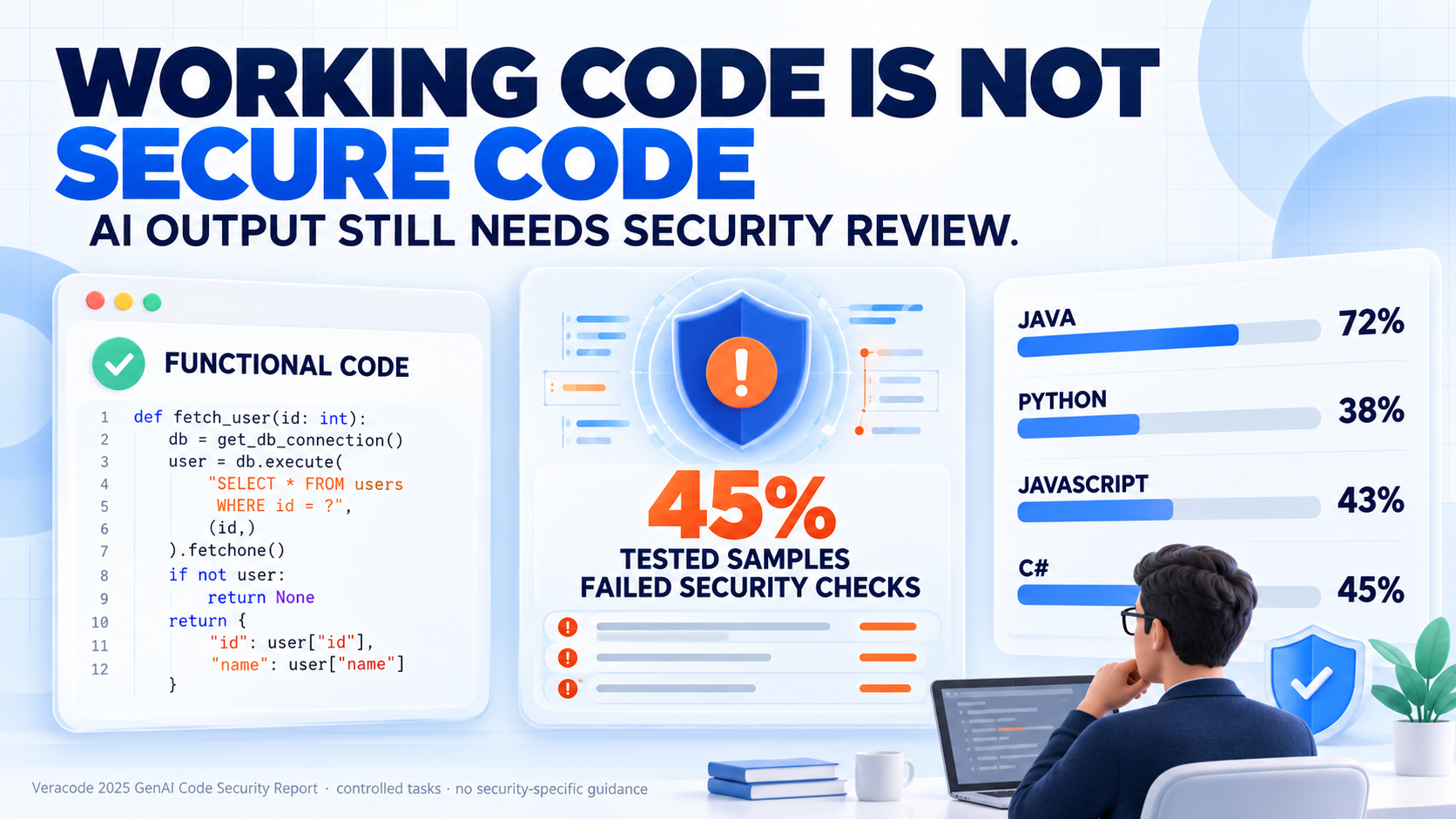
The security case is material. Veracode’s 2025 GenAI Code Security Report tested more than 100 large language models across 80 coding tasks and found that 45 percent of the tested code samples failed security tests by introducing a detectable OWASP Top 10 vulnerability when no security-specific guidance was provided. The rate varied by language: 72% for Java, 38% for Python, 43% for JavaScript, and 45% for C#. These results describe controlled test conditions, not every line of AI-assisted production code.Veracode report
The review layer should connect to the CI/CD pipeline, run security scanning, and produce traceable findings before merge. Every AI-assisted change should still pass the same functional, security, and human-review gates as a human-written change. Do not use unsupported claims about review accuracy, review speed, or per-pull-request cost unless a primary source and current pricing page support them.
How should Teams Govern AI Tool Use to Prevent Security Risks?
AI tool governance needs four controls: an approved tool list, a data-classification policy, review and security gates, and outcome measurement. The controls should describe what a tool may access, where prompts and code may be processed, what is retained, whether data is used for training, how administrators can audit usage, and who owns exceptions.
Do not infer HIPAA, SOC 2, ISO 27001, data residency, or non-training guarantees from a product name or subscription tier. Verify the current vendor terms, retention settings, training policy, identity integration, audit capabilities, and deployment model for the exact plan and region. The policy should distinguish public code, internal business logic, confidential information, credentials, regulated data, and production data.
Every AI-generated or AI-assisted change should pass the same review gates as human-written code, with automated security scanning where appropriate. Veracode’s test result is a reason to verify outputs, not a basis for claiming that all AI-generated code has a fixed vulnerability rate.
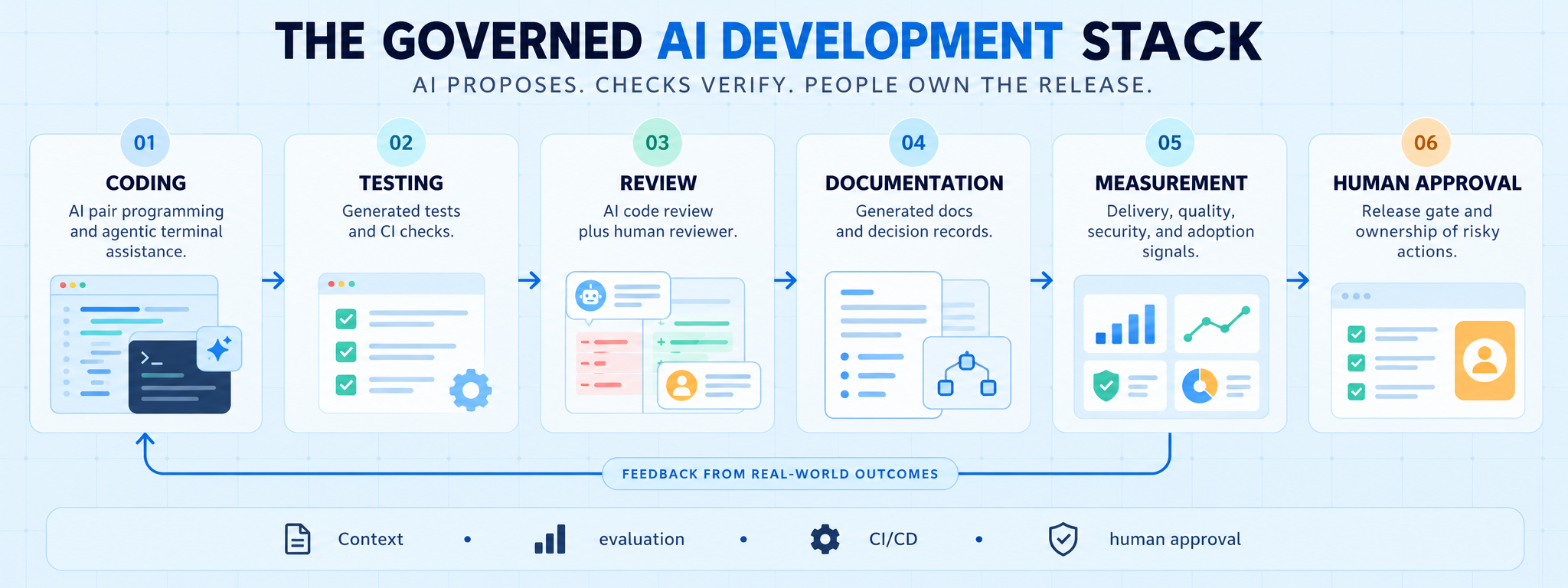
Realisier’s own delivery model adds four practical controls: evaluation sets decide releases, a person owns every risky action, holdouts measure outcomes where possible, and uncertainty routes to a human while every run is traced. These controls are used across systems that draft messages, recommend actions, generate content, or answer operational questions.
How do You Roll Out AI Tools Across an Engineering Team?
A practical rollout has three phases: establish a baseline, integrate the workflow, and formalize governance. The phases can overlap operationally, but the measurement baseline should exist before a team makes claims about productivity improvement.
Phase 1:
Baseline and bounded use. Deploy a small number of approved tools to representative developers and task types. Record the existing measures for cycle time, review load, escaped defects, test coverage, security findings, and developer experience. Do not mandate a single usage pattern before the team knows where the tool helps.
Phase 2:
Workflow integration. Connect coding assistance to repository context, tests, documentation, pull requests, and CI/CD. Add review and test-generation steps where they reduce friction without creating noise. Define when a human must approve, reject, edit, or escalate an AI output.
Phase 3:
Governance and measurement. Publish the approved tool list, data rules, exception process, review requirements, and metrics. Review results by developer segment, repository, task type, and tool. Retire workflows that increase review debt or security findings, even when usage is high.
The Realisier engagement model follows the same logic: Discovery defines the business problem and metric, Design defines prompts and approval points, Build creates the system and evaluation checks, Review gets client sign-off, and Launch establishes monitoring, handoff documentation, and runbooks. The sequence is designed to keep adoption connected to a real outcome.
The question is not whether an AI tool can write code. The question is whether your engineering system can verify what it writes, protect the data it sees, and keep a person accountable for what reaches production.
How do You Measure whether AI Tools are Actually Working?
Measure impact rather than activity. Tool usage, suggestion acceptance, and license activation show whether a tool is being used; they do not show whether the engineering system is delivering more value. A useful scorecard combines delivery speed, quality, security, developer experience, and business impact.
Track:
- Pull-Request Cycle Time: From first commit to merge, segmented by repository and change type.
- Change Failure and Escaped-Defect Rate: Defects or rollbacks after merge, not only the number of generated tests.
- Security Findings: Severity-weighted findings by repository, language, and workflow, with AI provenance used only where the tooling can measure it reliably.
- Test Quality: Meaningful coverage, flaky test rate, maintenance hours, and defects missed by the suite.
- Review Load: Review time, queue age, rework, and the number of AI comments that reviewers dismiss.
- Developer Experience: Satisfaction, cognitive load, and time spent correcting or explaining generated output.
Pulse is Realisier Labs’ internal AI adoption platform. It combines RAG-based Q&A over a curated knowledge base, multi-provider routing, and consent-based adoption analytics.
Realisier’s cleared internal figure is approximately 2× output per engineer, measured through Pulse and framed as capacity, not headcount reduction and not a universal causal benchmark. The point of Pulse is to connect tool adoption to output and quality signals while making the measurement visible to the people being measured.
What has Realisier Labs Built with AI-Assisted Engineering?
Realisier’s portfolio shows why AI tool adoption is an engineering and governance problem, not only a coding-assistant purchase. The clearest AI systems and related production systems are:
System | Domain and purpose | Correct status and evidence |
|---|---|---|
AI CRM for BOLD e-commerce. Selects the next best customer action and drafts outreach for marketer approval, including recovery, win-backs, and price-drop alerts. | Built to recover; pre-pilot. Cleared figures: $1.79M modeled cart-recovery opportunity, 30,800 lapsed customers identified for win-back, and approximately 10× lower sending cost validated through a holdout. These are modeled or identified outcomes, not booked revenue or conversions. | |
AI acquisition CRM for oil and gas. Reads lead behavior, selects a channel and pitch, drafts persona-matched outreach, requires human approval for every send, and auto-halts on reply or conversion. | Live in production. MineralView must not be named as Pursuit’s client. | |
Content engine for media. Watches trusted sources, catches trends, and turns one insight into 6+ platform-ready drafts with human approval before publishing. | In production. | |
Internal AI adoption platform. Provides RAG Q&A, multi-provider routing, and consent-based adoption analytics. | In production at Realisier Labs. The approximately 2× output-per-engineer figure is capacity framing only. | |
Multi-agent SEO operations for BOLD. Diagnoses weak pages, drafts the fix, and routes the change through an approval-gated task queue. | In production. | |
Provides profit and price answers inside Microsoft Teams. | In production. Client: BOLD Precious Metals. | |
Job Orchestrator | Consolidates legacy .NET jobs into an observable .NET 8 worker service with monitoring, worker backend, and SMS or email status alerts. | In production. This is a production engineering system, not presented as an AI product. |
Engineering audit work across both client portfolios, including database cleanup and Core Web Vitals remediation. | In production as a service and system. Approximately 500 findings were triaged, including critical security issues. |
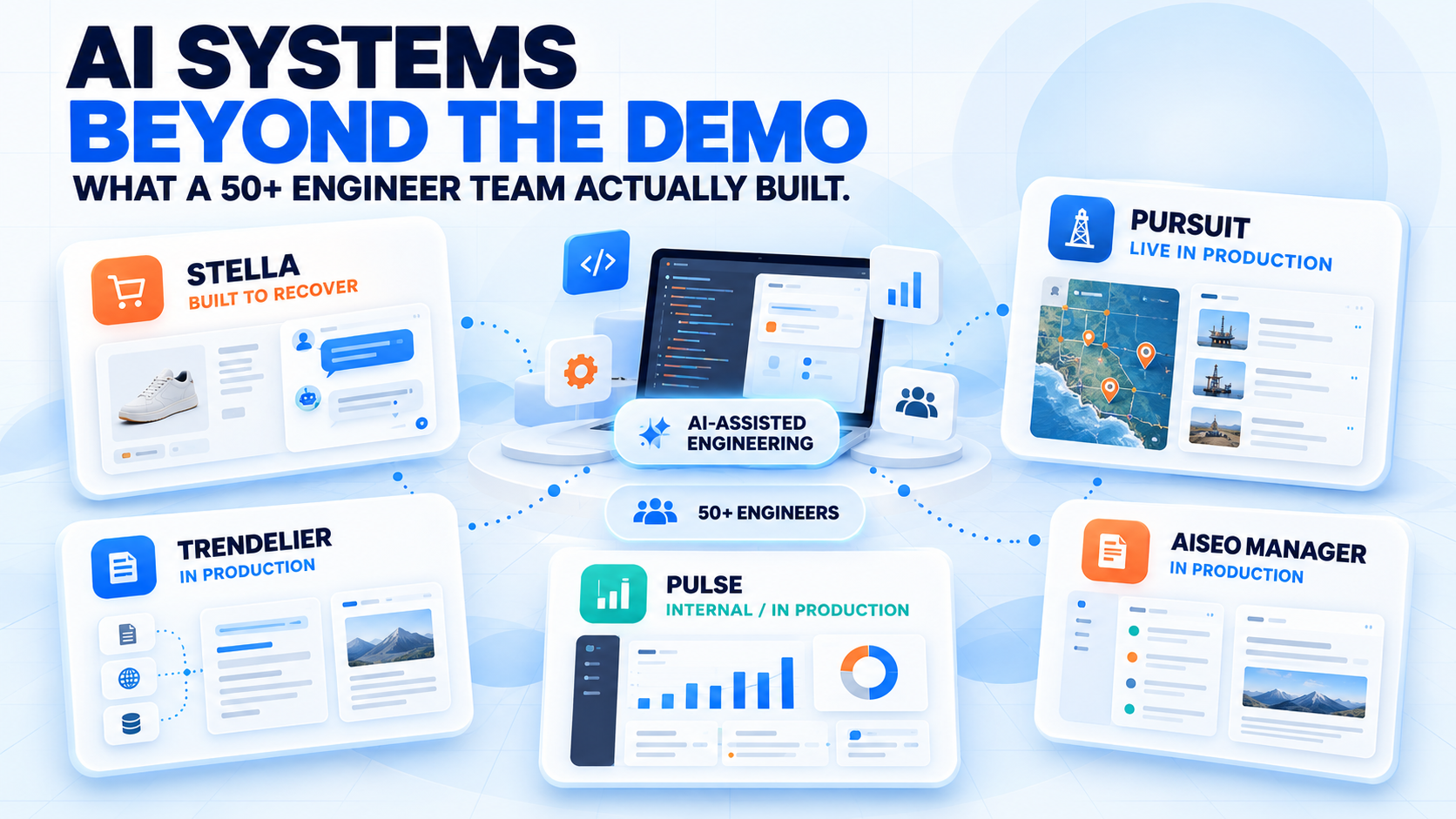
At the platform level, MineralView has been an anchor client since 2019 and BOLD Precious Metals since 2021. Both platforms were rebuilt end-to-end with AI-first engineering. That claim should remain separate from the individual product statuses above, and MineralView should never be described as Pursuit’s client.
What this Means in Practice
The strongest evidence does not support a universal “AI makes developers 2× faster” claim. It supports a more useful conclusion: AI can accelerate bounded work, but organization-level gains depend on context, review capacity, testing, security controls, and measurement.
The Stack Overflow survey shows high adoption alongside low trust. JetBrains shows that specialized coding tools are now widely used at work. GitHub’s enterprise study shows large gains in a particular deployment, while DX’s longitudinal data shows a much smaller median throughput gain across organizations. METR shows that experienced developers can be slower in mature repositories, and Veracode shows why secure verification must remain outside the model.Stack Overflow Developer Survey 2025
Realisier’s own portfolio points to the same operating model. Stella uses marketer approval before customer outreach. Pursuit requires approval before every send and halts on replies or conversions. Trendelier requires human approval before content ships. AISEO Manager uses an approval-gated task queue. Pulse makes adoption measurement visible. The system is not “AI writes and production accepts.” The system is AI proposes, evaluation checks, a person owns the risky action, and the workflow records what happened.
That is the path from tool adoption to dependable software delivery.
FAQ
1What are the Best AI Tools for Software Development in 2026?
The best tool depends on the team’s IDE, repository, terminal workflow, data controls, and CI/CD system. JetBrains reported workplace adoption of 29 percent for GitHub Copilot, 18 percent for Cursor, and 18 percent for Claude Code in its January 2026 AI Pulse survey. Treat these as survey adoption figures, not universal rankings.JetBrains survey
2Do AI Coding Tools actually Make Developers Faster?
Sometimes. GitHub and Accenture reported coding tasks up to 55 percent faster in their enterprise study, while DX found approximately 8 percent median pull-request throughput growth across more than 400 organizations. METR found experienced developers working in mature repositories were 19 percent slower with early-2025 AI tools. The result depends on task, codebase, developer, and workflow.
3How much AI-Generated Code Contains Security Vulnerabilities?
Veracode’s 2025 controlled study found that 45 percent of tested code samples failed security tests by introducing a detectable OWASP Top 10 vulnerability when no security-specific guidance was provided. The result should not be presented as a fixed rate for every production codebase. It does support automated scanning, human review, and release controls for AI-assisted changes.
4Which AI Coding Assistant has the Highest Developer Satisfaction?
Claude Code had the highest satisfaction metrics in the JetBrains AI Pulse survey, with 91 percent CSAT and a 54 NPS. GitHub Copilot had the highest reported workplace adoption in that survey. Satisfaction and adoption answer different questions, so teams should test both alongside delivery and quality metrics.
5How should a Team Roll out AI Tools Safely?
Start with a baseline, introduce bounded use cases, connect tools to repository and CI/CD context, and add approval and security gates before scaling adoption. Publish data-handling rules and an exception process. Review cycle time, defects, security findings, test quality, review load, and developer experience by task type rather than treating usage as success.
6How does Pulse Measure AI Adoption Across a Team?
Pulse is Realisier Labs’ internal platform for RAG-based Q&A, multi-provider routing, and consent-based adoption analytics. It connects tool adoption with delivery and quality signals such as pull-request cycle time, coverage trends, and defects. Realisier’s approximately 2× output-per-engineer figure is an internal capacity framing measured through Pulse, not a universal benchmark or a headcount claim.