

B2B SEO works differently because the person who searches first is rarely the only person who decides. A useful strategy maps each buying role to the questions it asks, the evidence it needs, and the page that should answer those questions. This guide explains how to build that map and connect it to pipeline.
6sense's 2024 Buyer Experience Report found that the average B2B buying group included 11 people. That does not mean every purchase involves exactly 11 people. It does mean that a strategy built for one generic buyer can overlook important research happening elsewhere in the account.
What makes B2B SEO different from B2C SEO?
B2B and B2C search optimization share the same technical foundations, but B2B content usually needs to address more stakeholders, account for more risks, and support a longer evaluation process. A consumer may compare convenience, price, and reviews. A B2B buyer may also need to evaluate security, integration, implementation effort, compliance, operational ownership, and business impact.
Search intent can be more valuable than search volume. A specific query such as enterprise RAG architecture may have low search volume but strong relevance for a technical evaluator. Search volume helps estimate an opportunity, but it does not replace buyer fit, commercial intent, or the evidence a company can provide.
How does the buying group change B2B SEO?
The 6sense report found that B2B buyers were nearly 70% through their purchasing process before engaging with sellers. This comes from a buyer survey and should not be treated as a universal rule. It does highlight an important point: much of the evaluation takes place before a sales conversation becomes visible in a CRM.
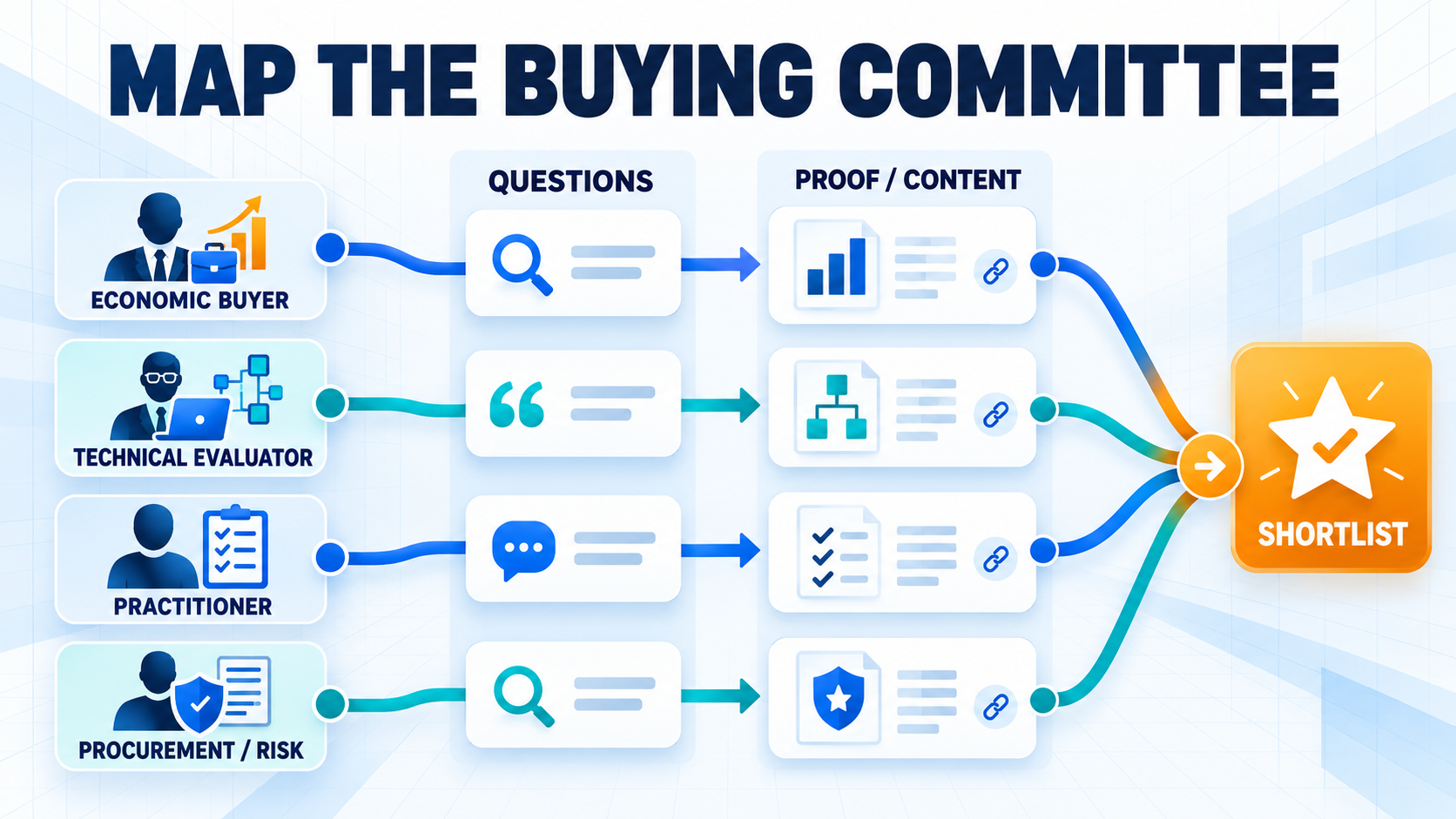
People within the same account may research the same category from different perspectives. A finance leader may look for a business case. An engineering leader may need architecture and integration details. A practitioner may look for implementation guidance. Procurement may require security documentation, references, and contract information.
A B2B SEO strategy has two objectives:
- Capture relevant searches before the account identifies itself.
- Provide enough evidence for the account to continue evaluating the company without leaving the site.
How do you build a buying-committee keyword map?
Start with the buying process the company actually encounters rather than a generic funnel template. Useful inputs include won, lost, and stalled opportunities; sales-call notes; customer interviews; Search Console queries; support questions; and questions raised during procurement.
- List the roles. Identify who approves, evaluates, uses, implements, secures, and purchases the solution.
- Collect real questions. Ask sales and delivery teams what each role needs to know before proceeding.
- Classify intent. Categorize each question as informational, commercial, comparison, validation, or navigational.
- Define the evidence. Specify whether the answer needs a case study, benchmark, architecture diagram, security details, process explanation, or customer reference.
- Choose the page. Match the question to an appropriate page type and a useful next action.
- Prioritize. Evaluate the opportunity by buyer value, business relevance, available evidence, search demand, ranking difficulty, and conversion path.
| Buyer role | Example search question | Stage | Evidence needed | Page type | Next action |
|---|---|---|---|---|---|
| Economic buyer | AI consulting ROI | Consideration | Business case, assumptions, measurable outcomes | ROI or business-case page | Read a relevant case study |
| Technical evaluator | Enterprise AI integration | Consideration | Architecture, APIs, limitations, ownership model | Technical deep-dive | Review implementation approach |
| Security or risk lead | AI consulting data security | Validation | Data flow, access controls, retention, compliance position | Security and governance page | Request diligence material |
| Practitioner or champion | How to implement an AI knowledge assistant | Awareness or consideration | Process, examples, failure modes, implementation steps | Guide or playbook | Explore service scope |
| Procurement or legal | AI consulting security documentation | Validation | Policies, contracts, references, commercial process | Trust and procurement page | Contact the appropriate owner |
| Executive sponsor | AI consulting case studies | Validation | Named work, outcomes, client context, limitations | Case-study hub | Start a scoped conversation |
What does a worked B2B SEO map look like?
Consider an AI consulting firm serving mid-market and enterprise teams. Its primary service page may target commercial search intent, but it should not be the only page supporting the buying process. The economic buyer needs a business case and a way to measure success. The technical evaluator needs architecture, integration, models, data, and operations. The security lead needs data handling and controls. The practitioner needs implementation guidance. Procurement needs confidence that the vendor can support diligence and handoff.
That calls for a connected content system: a service page for scope and fit; a business-case page for value and measurement; technical and security pages for validation; a practical guide for implementation questions; case studies for evidence; and a trust page for procurement. Each page should help a reader answer the next question rather than restart the research process.
Realisier Labs' AISEO Manager demonstrates the operating principle behind this structure: diagnosis, recommendations, approval, and implementation should work together. The lesson is not that every team needs the same tools. It is that content operations need a connected path from an identified gap to a reviewed change.
How should a B2B services firm organize pillar and cluster content?
A pillar-and-cluster structure is useful when it reflects the questions buyers actually ask. It is not a shortcut to rankings, and Google does not publish a topical-authority score simply because a site has a pillar page. For a B2B services firm, the pillar should communicate a clear point of view while its supporting pages show how the firm approaches problems, what it has done, and where its approach fits.
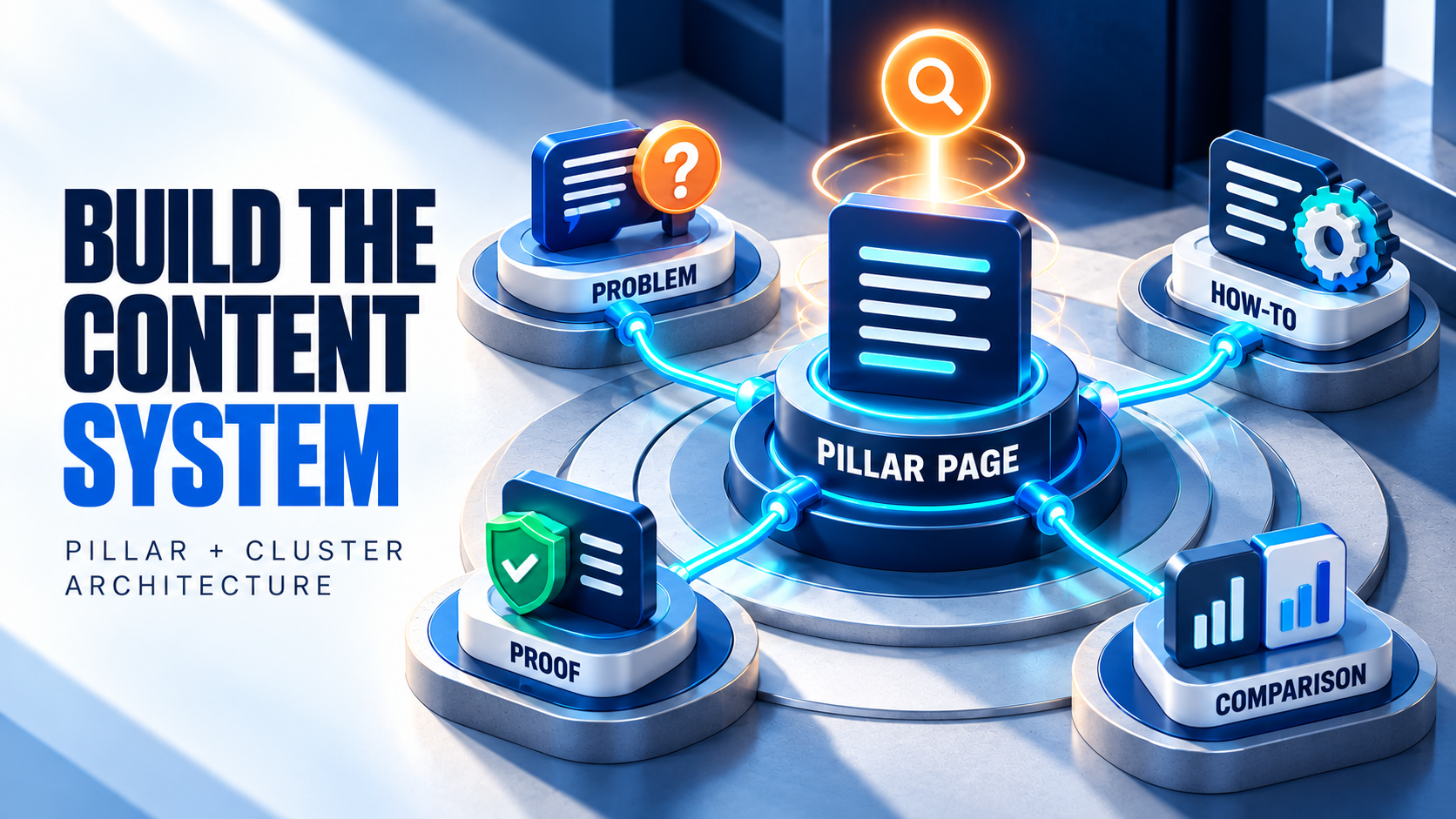
- Pillar: the broad service category or problem domain.
- Clusters: focused articles that answer role-based, use-case, technical, or implementation questions.
- Proof pages: case studies, comparison pages, security pages, process pages, and service pages that help buyers validate a decision.
Which bottom-of-funnel pages are B2B sites often missing?
Many B2B sites publish awareness-stage content but provide limited material for evaluation and validation. Useful bottom-of-funnel pages include factual comparison pages, use-case and industry pages with real constraints and proof, indexable case studies, security and governance pages, and process pages that explain implementation ownership, integrations, handoff, support, evaluation, and failure paths.
These pages should not become a collection of low-value SEO templates. Each should exist because it provides information an actual buyer needs. A well-structured public case study, for example, creates more organic-discovery opportunities than a PDF hidden behind a form.
What technical SEO foundations matter for B2B sites?
Technical SEO rarely creates a lasting advantage on its own, but technical problems can prevent useful content from being discovered, understood, or converted. The baseline includes complete mobile rendering, crawlability and indexation, descriptive information architecture, conversion tracking, and structured data where appropriate.
Google recommends an LCP of 2.5 seconds or less, an INP of 200 milliseconds or less, and a CLS of 0.1 or less when measured with real-user data. Treat these as user-experience targets rather than pass-or-fail rules based on one page load.
How do links, mentions, and digital PR build B2B authority?
Authority building works best when it puts useful evidence in front of the publications, communities, and people buyers already trust. The goal is not to collect a large number of links. It is to earn relevant attention and credible references.
Contribute useful analysis to trade publications, offer expert commentary, publish documented original research, and participate in relevant professional communities. A survey, anonymized first-party dataset, benchmark, or documented experiment gives other writers something specific to reference. Use client data only with permission, and document the sample, method, date, and limitations.
How does AI search change B2B SEO?
AI search changes how buyers discover and summarize information, but it does not remove the need for accessible, credible web content. Ahrefs reported that the presence of an AI Overview correlated with a 58% lower average click-through rate for the top-ranking page in its December 2025 analysis. This vendor study shows a correlation, not a universal forecast of traffic changes.
Forrester reported that 89% of B2B buyers used generative AI in at least one area of the purchase process in its 2024 Buyers' Journey Survey. No single optimization method guarantees inclusion in AI responses. The practical response is to publish clear answers, use consistent entity information, include evidence and limitations, earn independent references, and keep important pages accessible to search crawlers.
What on-page optimization helps long-cycle B2B searches?
Long-cycle buyers may return to a page several times, share it with colleagues, or use it to answer a specific question. Lead with the clearest answer and supporting evidence. Use descriptive headings, link to the next decision, and match the CTA to the reader's intent. A reader at awareness may need a practical guide; a reader validating a vendor may need a case study, technical detail, or a due-diligence discussion.
How should you measure B2B SEO pipeline?
Rankings and traffic indicate visibility. On their own, they do not show whether organic search is helping the business generate qualified opportunities or revenue. Keep first-touch, lead-source, assisted, account-influenced, self-reported, and closed-revenue views separate because they answer different questions.

| Layer | Metric | What it tells you | Main source |
|---|---|---|---|
| Visibility | Non-branded impressions and clicks | Whether potential buyers are finding you | Google Search Console |
| Visibility | Target-query rankings and SERP features | Whether priority content appears for relevant searches | Rank tracker |
| Engagement | Engaged sessions, return visits, and key-page paths | Whether visitors continue researching | Analytics platform |
| Demand | Form submissions, calls, downloads, and self-reported discovery | Whether organic visitors take a meaningful action | Analytics and CRM |
| Account influence | Target accounts with organic visits or conversions | Whether priority accounts are researching the company | CRM and account analytics |
| Pipeline | Opportunities with an organic first touch, lead source, or assisted touch | Whether organic search appears in the buying process | CRM |
| Revenue | Closed revenue with documented organic involvement | Whether organic search was present in the path to closed business | CRM and finance data |
How should you prioritize B2B SEO content?
Do not begin with the largest keyword list. Begin with the most valuable gaps in the buying process. Prioritize pages that perform well in terms of business value, buyer relevance, available evidence, and a realistic opportunity to rank. A lower-volume security page with strong validation intent may be more valuable than a high-volume definition article.
- Is the audience a genuine buyer or influencer for the offer?
- Does the query represent a meaningful problem, evaluation, or validation need?
- Can the company provide evidence that generic competitors cannot?
- Does the page have a clear internal-link path and next action?
- Can the company realistically compete for the query with its current authority?
- Can the page be maintained as the service, market, or evidence changes?
Frequently asked questions
1How do I build a B2B buying-committee keyword map?
List the roles involved in a typical purchase, collect the questions each role asks, classify intent, identify the required evidence, and assign each question to a page type and next action. Validate the map against sales calls, lost deals, customer interviews, and Search Console data.
2Which B2B SEO pages should I publish first?
Start with pages that address high-value questions from actual buyers and that the company can support with evidence. Depending on the offer, these may include a service page, case study, technical explanation, security page, implementation guide, comparison page, and business-case page.
3How is B2B SEO different from B2C SEO?
B2B SEO supports a group of buyers with different roles, risks, and evidence requirements. The strategy needs more than awareness-stage content. It should help technical, financial, operational, security, and procurement stakeholders evaluate the same purchase from their respective perspectives.
4How long does B2B SEO take to show results?
There is no reliable universal timeline. Results depend on existing authority, query competition, content quality, technical health, internal links, distribution, and the length of the buying process. Use early indicators such as indexation, relevant impressions, qualified engagement, target-account activity, and pipeline touchpoints rather than guaranteeing results within a specific number of months.
5How should a B2B company measure SEO pipeline?
Connect Search Console and analytics data with CRM outcomes. Track visibility and qualified visits as leading indicators, then measure conversions, target-account engagement, assisted opportunities, influenced pipeline, and closed-won revenue as the journey progresses.
6How does AI search change B2B SEO?
AI search increases the value of clear answer sections, evidence-rich explanations, well-structured pages, original insight, and trusted references. The core task remains the same: create material that helps a buyer understand and evaluate a decision.
7What is the biggest B2B SEO mistake?
Publishing generic content without mapping it to buyer questions, required proof, and a clear next step. Rankings alone do not create pipeline; the content must help people progress through a real buying decision.
Need a B2B SEO strategy tied to buyer decisions?
We can help map the questions your buying group asks to the evidence, pages, and measurement needed to support a real evaluation process.