
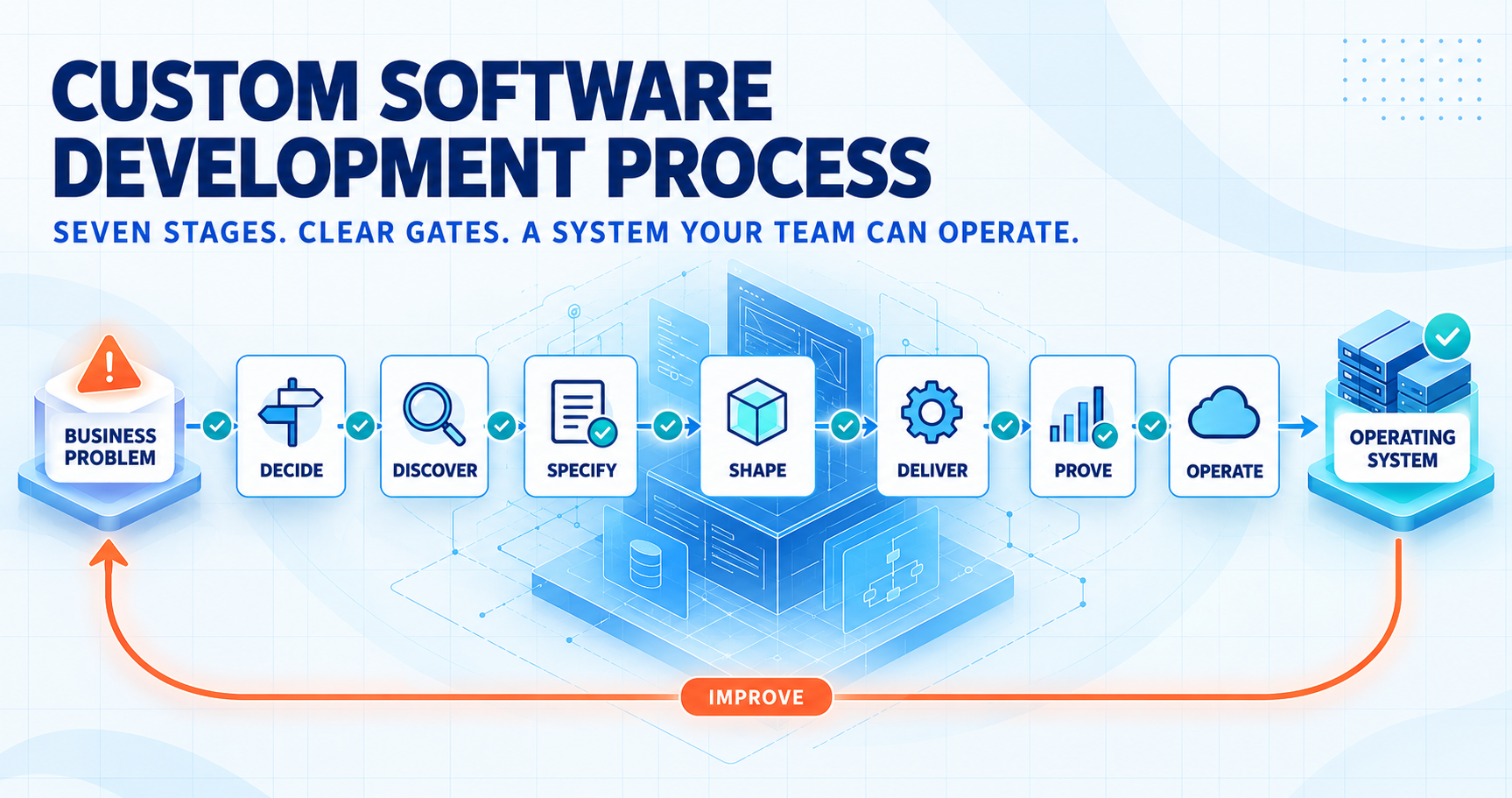
Custom software development is a controlled lifecycle that moves from a business problem to an owned operating system. It is not a single coding phase. A well-managed build passes through seven decision stages, each with a required artifact, an acceptance test, and a defined exit gate. A project that skips these stages operates on assumptions rather than evidence and may face avoidable issues at handoff.
The control model in this guide is a Realisier Labs synthesis, not a claim that one standard prescribes seven named stages. It uses lifecycle guidance from ISO/IEC/IEEE 12207:2017, secure-development practices from NIST SSDF, and assurance guidance from OWASP SAMM/ASVS. The purpose is practical: to turn a general process promise into evidence a buyer can review.
By the end of this guide, you will have a stage-by-stage control model: what must be decided, what artifact must exist, who accepts it, and what must be true before the project moves forward. Use it to evaluate a development partner, establish exit gates in a contract, and verify the handoff.
What Questions Does This Custom Software Development Process Guide Answer?
- What is the custom software development process?
- What does this process look like in a real project?
- How does a buyer decide whether custom software is the right investment?
- What must a discovery phase map before requirements can be written?
- How are requirements and acceptance criteria defined in custom software?
- What architecture and design decisions must be made before development begins?
- How are working increments reviewed and controlled during development?
- What separates a completed build from a system in production?
- How do you evaluate a custom software development partner?
- Frequently asked questions.
What Is the Custom Software Development Process?
Custom software development is a lifecycle of controlled stages that moves from a business problem to an operating system. ISO/IEC/IEEE 12207:2017 describes lifecycle processes as applicable concurrently, iteratively, recursively, and incrementally, meaning the stages do not have to run in a strict linear sequence, but all of them must be addressed. Choosing a delivery method (Agile, Waterfall, or hybrid) determines how the stages are sequenced and how feedback loops are structured. It does not determine whether discovery, specification, design, testing, and operation occur.
The table below records the business decision, minimum artifact, acceptance evidence, accountable owner, and exit gate for each stage. The security, accessibility, and operating controls are grounded in ISO/IEC/IEEE 12207:2017, NIST SSDF, OWASP SAMM/ASVS, CISA Secure by Design, and Google SRE. The seven-stage sequence itself is our operating synthesis.
| Stage | Business decision | Minimum artifact | Acceptance evidence | Accountable owner | Exit gate |
|---|---|---|---|---|---|
| Decide | Is custom software the right response? | Problem brief and option comparison | Named outcome, users, constraints, and rejected alternatives | Business sponsor | Problem is specific enough to investigate |
| Discover | What workflow must change? | Current/future workflow map and risk register | Users, exceptions, data sources, and integration boundaries reviewed | Product owner | Priority workflow and outcome agreed |
| Specify | What does “done” mean? | Requirements, non-functional requirements, acceptance criteria | Testable behavior and change-control rule in place | Product owner + engineering lead | Work can be estimated and tested without guessing |
| Shape | How should the system be designed? | UX prototype, architecture decision record, API/data contracts, threat model | Design review and security/accessibility constraints recorded | Technical owner | Build path and key risks accepted |
| Deliver | Are we building the right thing in usable increments? | Working increments, tests, decision log, demo record | Stakeholder review against acceptance criteria | Delivery lead | Release candidate meets quality gates |
| Prove | Is it safe and useful to release? | Test evidence, UAT record, release plan, rollback plan | Functional, security, performance, accessibility, and operational checks passed | Product owner + technical owner | Go-live decision recorded and accepted |
| Operate | Can the client run and improve it? | Runbooks, monitoring, ownership map, training records, improvement backlog | The named owner can operate, diagnose, recover, and request change | Client owner | Handoff demonstrated, not merely delivered |
What Does This Custom Software Development Process Look Like in a Real Project?
Consider a hypothetical B2B services company replacing email-based approval routing with an internal workflow portal. The process does not begin with a feature list. It begins by deciding whether the workflow is specific enough to justify a build, then makes each later decision visible through an artifact and an acceptance check.
| Stage | Worked example | Evidence before moving on |
|---|---|---|
| Decide | The sponsor defines the approval problem, affected users, desired business outcome, and alternatives considered. | A named sponsor accepts the problem brief. |
| Discover | The team maps request intake, approval rules, exceptions, data sources, and integration boundaries. | Users and exception paths are reviewed. |
| Specify | A requirement states what happens for a valid request, a rejected request, and an incomplete request. | Each behavior has an observable acceptance result. |
| Shape | The team records role permissions, the audit trail, data contracts, and deployment assumptions. | Architecture and risk decisions are accepted. |
| Deliver | Working slices are demonstrated against the agreed behaviors, with decisions and deferred scope logged. | The product owner accepts or rejects each increment. |
| Prove | Functional, security, accessibility, performance, and UAT evidence is assembled before release. | The release and rollback decisions are recorded. |
| Operate | The client receives runbooks, monitoring, training, ownership, and an improvement backlog. | The named owner demonstrates diagnosis and recovery. |
The example is deliberately ordinary: the value of the process is not the industry label or framework choice. It is the chain of decisions that helps prevent an apparently small workflow from becoming an unowned production system.
How Does a Buyer Decide Whether Custom Software Is the Right Investment?
The Decide stage answers one question: is this business problem specific enough that a custom build is justified, and is there a named outcome and owner? Custom software may be justified when the target workflow is specific to the business, no available product addresses the core need without significant compromise, and there is a business owner with the authority to accept and operate the system.
The Decide stage produces a problem brief and an option comparison. The option comparison names the alternatives considered (off-the-shelf products, configurable platforms, and process redesign) and states why each was rejected. Without this record, the project may have difficulty defending its scope when questions arise during delivery. The exit gate is that the problem is specific enough to investigate further without committing to a build.
A buyer who enters discovery without a named business owner, a documented outcome, and a record of rejected alternatives has increased the risk of scope change before a line of code is written. If the custom build will include AI capabilities, the question of whether those capabilities require a fully custom system or a configurable platform is a Decide-stage decision, not a Shape-stage revision. The option comparison should make that trade-off explicit rather than leaving it to a later architecture revision.
What Must a Discovery Phase Map Before Requirements Can Be Written?
Discovery must produce a current-state and future-state workflow map: all actors, data sources, system integrations, decisions, exceptions, and handoffs in the existing workflow—and what must change, what the system is not responsible for, and what measurable outcome defines success. Without both maps, requirements have no agreed baseline and scope has no agreed boundary.
Discovery is where assumptions become visible before they are built in. A team that learns late that a critical integration requires a licensed third-party API, or that a key workflow exception is handled by one person’s undocumented knowledge, is now facing a change request rather than a design decision. The risk register from discovery becomes a design input for the Shape stage.
The scope of discovery must cover non-functional constraints alongside functional ones: performance requirements, security obligations, accessibility targets under WCAG 2.2, and data residency rules. ISO/IEC/IEEE 12207:2017 covers the lifecycle from conception through supply, development, operation, maintenance, and disposal—not only the build phase. A discovery that covers feature requirements but skips integration, security, and operational constraints is leaving important risks for later stages, where they may be harder to change and test.
How Are Requirements and Acceptance Criteria Defined in Custom Software?
A requirement is only useful if it can be tested. The Specify stage must convert the discovery record into testable statements: for each functional requirement, a description of what the system must do, under what conditions, and with what observable result. Non-functional requirements (performance thresholds, security controls, accessibility conformance, availability, and data handling rules) must be specified and testable to the same standard.
The OWASP Application Security Verification Standard (ASVS) provides testable security requirements organized by level of assurance for web applications. WCAG 2.2, the W3C web accessibility standard, provides testable, technology-neutral success criteria and adds nine new criteria compared with WCAG 2.1. Using these standards as the baseline for security and accessibility requirements gives acceptance criteria a verifiable source rather than relying only on a project-internal judgment.
The Specify stage also establishes the change-control rule: a written agreement on how new or changed requirements are identified, assessed, estimated, and approved before entering the build. A well-defined change-control rule does not prevent change—it makes change visible, assessed, and accepted by the business owner. The exit gate is that the work can be estimated and tested without guessing about intent.
What Architecture and Design Decisions Must Be Made Before Development Begins?
Before the first line of production code is written, the team must record architecture decisions, API and data contracts, security constraints, accessibility targets, deployment assumptions, and ownership boundaries. Decisions made implicitly during development are harder and potentially more expensive to reverse than decisions made explicitly before the first commit.
An architecture decision record documents what was decided, why, what alternatives were considered, and what the implications are. It is not a lengthy document—it is a reversible record that explains why the system is the way it is. Teams that skip this step may discover that their architecture has locked in a constraint (a data schema, a third-party dependency, or a deployment topology) that no one intended to make permanent.
API and data contracts, specified in a format such as the OpenAPI Specification, define the boundary between the custom software and the systems it integrates with. A contract makes the integration testable before the dependent system is ready and makes breaking changes visible before they propagate. The NIST SSDF treats security as a product and lifecycle responsibility integrated from this stage, not added as a final gate.
The CISA Secure by Design guidance identifies three supplier principles relevant at the Shape stage: own customer security outcomes, embrace transparency and accountability, and build organizational leadership that supports those outcomes. These translate into design decisions about which controls are built in and who is accountable when they fail.
How Are Working Increments Reviewed and Controlled During Development?
Working software should be reviewed by business stakeholders in regular increments against the agreed acceptance criteria. Each increment should produce a decision log showing what was changed, what was tested, what was accepted by the business stakeholder, and what was deferred. Scope changes must pass through the change-control process before they enter the build — regardless of the delivery method in use.
The DORA Accelerate State of DevOps 2024 says more than 75% of respondents used AI in at least one daily professional responsibility, and more than one-third reported moderate-to-extreme productivity gains. Its analysis associated a 25% increase in AI adoption with 7.5% better documentation quality and 3.4% better code quality, while estimating 1.5% lower delivery throughput and 7.2% lower delivery stability. These are survey associations, not proof of causation. They reinforce the practical point: AI-assisted development still needs explicit review, testing, security, and ownership controls.
The delivery method (Agile sprints, Waterfall phases, or a hybrid) determines the review cadence and the feedback loop structure. The table below shows what changes across methods and what remains constant.
| Lifecycle concern | Agile | Waterfall | Hybrid |
|---|---|---|---|
| Discovery | Compressed into early sprint(s); revisited throughout | Full phase before specification begins | Bounded discovery before iterative delivery |
| Requirements | Maintained as a prioritized backlog; refined continuously | Specified fully before design begins; changes via formal request | Initial specification with backlog-managed changes |
| Architecture | Evolutionary; significant decisions recorded per increment | Defined upfront before development begins | Core architecture upfront; extensions evolutionary |
| Stakeholder review | Every sprint (1–4 weeks typically) | At phase-end gates | Sprint reviews plus stage-gate reviews |
| Scope change | Controlled through backlog prioritization and sprint planning | Formal change request per phase | Change-control process applies to both sprint and phase levels |
| What is constant | All seven lifecycle stages must be addressed. Exit gates exist in all methods. Acceptance decisions require business-owner sign-off. | ||
A release should move forward only when the evidence supports it.
What Separates a Completed Build From a System in Production?
A completed build is not the same as a production system. The transition from Deliver to Prove requires evidence: functional test results, security test results, performance and accessibility test results, a UAT record signed by the product owner, a release plan, and a rollback plan. Operational readiness (deployed observability, runbooks, trained personnel, and a defined operating owner) is equally required. A buyer who accepts a deployment without operational readiness accepts responsibility for an unverified system.
User acceptance testing (UAT) is the buyer’s formal confirmation that the software meets the agreed acceptance criteria and is suitable for production use. It is conducted by the business users or product owner, not by the development team. A signed UAT record is the evidence of acceptance, not the developer’s judgment that the work is complete, and not a passing automated test suite.
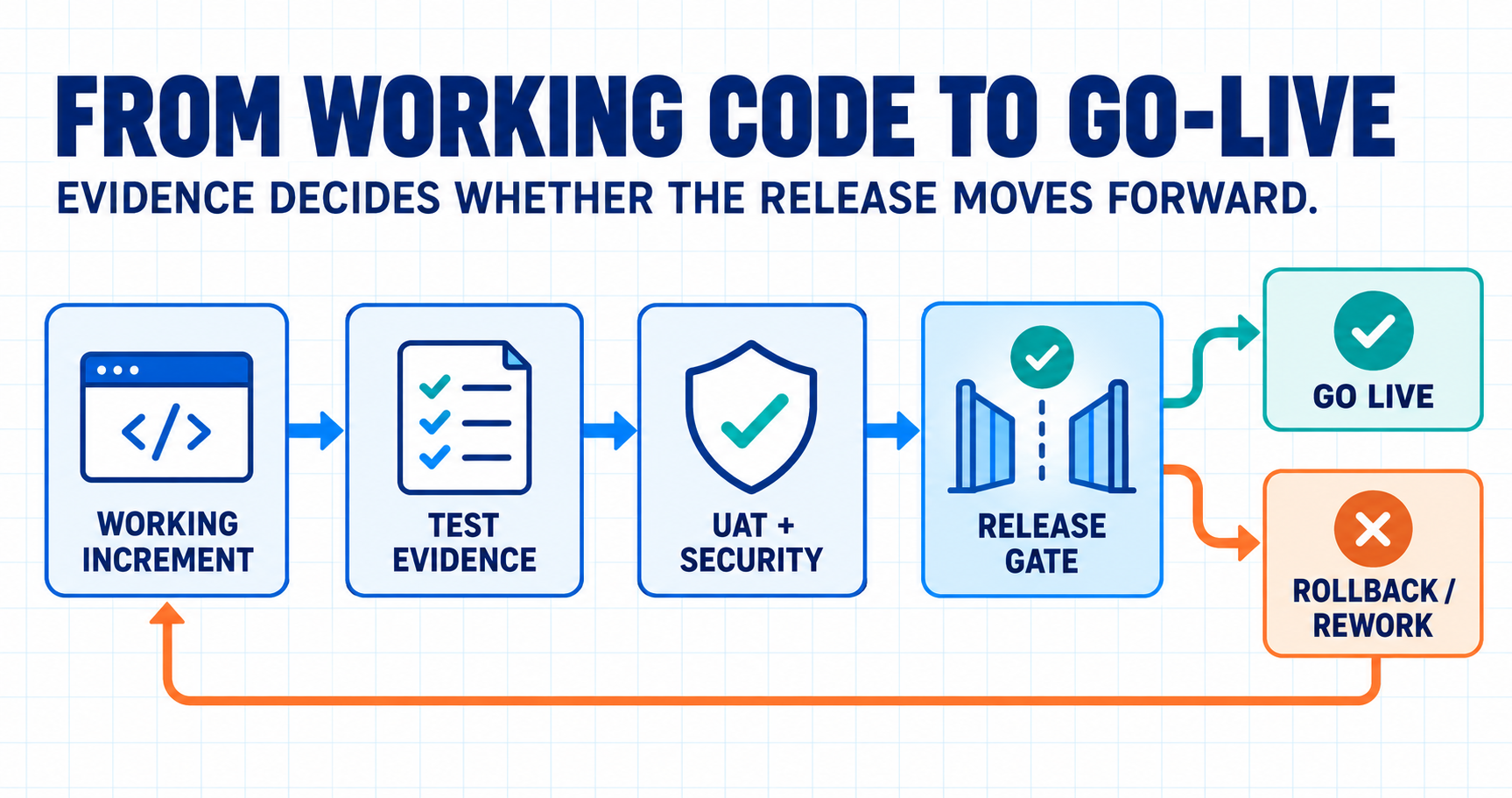
The NIST SSDF integrates secure practices throughout the lifecycle, not as a final phase gate. NIST SP 800-161 Rev. 1 covers cybersecurity supply-chain risk management across the processes used to develop, integrate, and deploy technology, meaning a security posture review should not wait until the deployment date. OWASP SAMM provides a technology-agnostic model for measuring and improving security assurance across lifecycle stages.
Google SRE defines service-level objectives around user-relevant service behavior. A system should enter production with named service-level indicators and objectives; an operational owner who cannot determine whether the system is healthy at a given time has not received a demonstrated handoff.
The business case for software investment (including the metrics that define success) should be defined before delivery and measured through the operating phase. For a framework on measuring technology investment outcomes, see measuring AI and software ROI.
How Do You Evaluate a Custom Software Development Partner?
Evaluate a development partner based on evidence of process, not only on promises. Ask for discovery artifacts, requirements examples, architecture decision records, test evidence, and handoff materials from a comparable completed engagement. These examples are a practical indication of how the partner works, not a guarantee of future performance. Ask how the same artifacts will be adapted to your workflow, risk profile, and operating team.
The CISA Secure by Design guidance gives buyers a useful lens for assessing suppliers: who owns customer security outcomes, how transparent and accountable the supplier is, and whether leadership supports those outcomes. Translate those principles into questions with verifiable answers rather than self-reported scores.
Questions to ask a development partner before signing a contract:
- What does a completed discovery phase produce, and who reviews and accepts it on behalf of the client?
- How is a scope change identified, estimated, and approved before it enters the build?
- What security and accessibility testing is included, and at which lifecycle stage does it begin?
- What does the handoff package contain, and how is the handoff demonstrated rather than declared?
- Who is responsible for production issues in the first 90 days after launch, and how is that period governed?
A partner who can explain these answers before the contract is signed gives you more to evaluate than a partner who leaves every control detail to the statement of work. Compare the answers with the partner’s completed work, engineering audit approach, and engagement model before you choose.
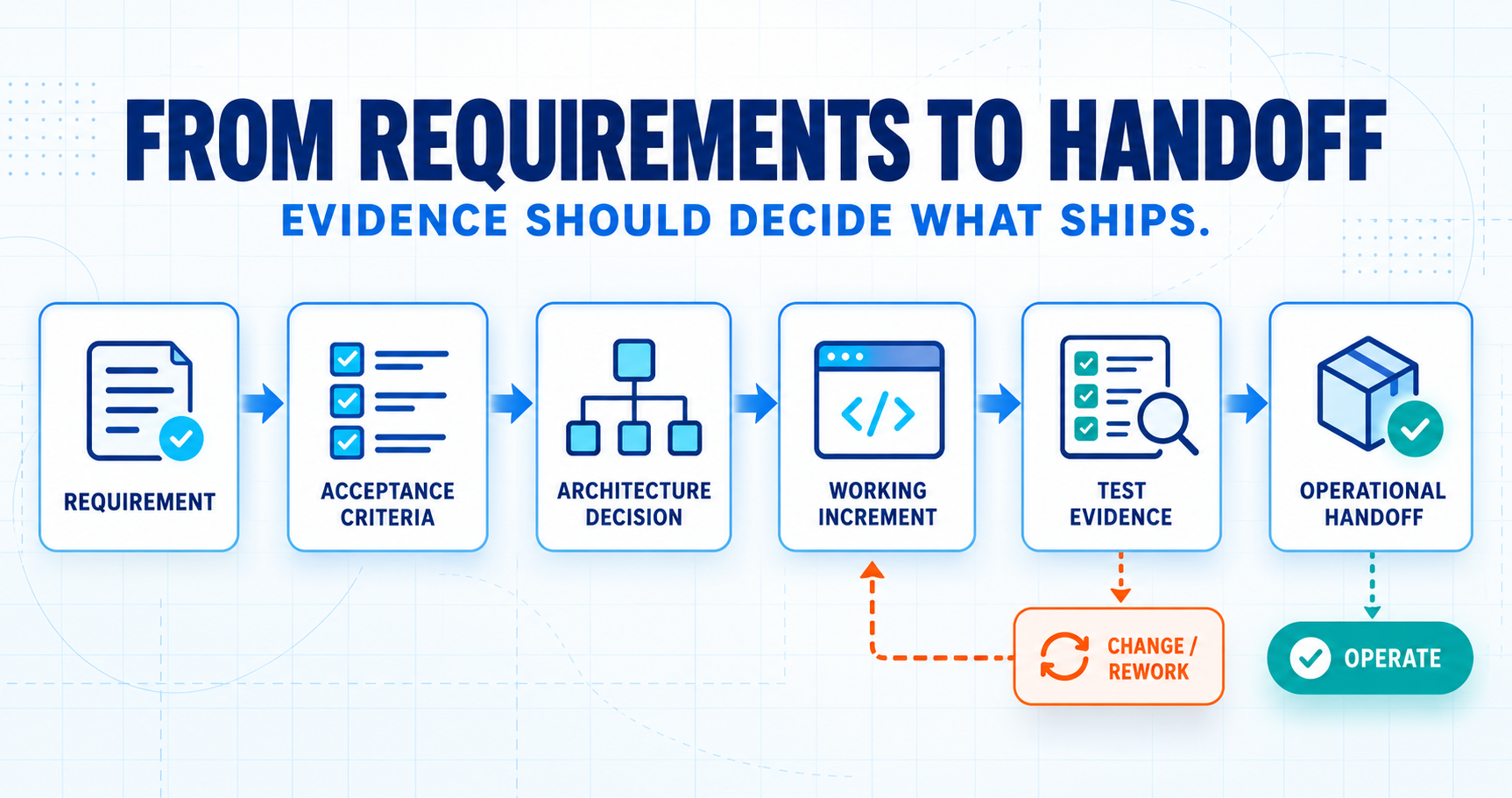
From requirements to handoff, evidence should decide what ships.
What Are the Most Common Custom Software Development Process Questions?
Is Custom Software Better Than Off-the-Shelf Software?
Custom software is justified when the target workflow is specific to the business, no available product addresses the core need without significant compromise, and there is a named business owner who can accept and operate the system. Off-the-shelf software may be appropriate when the workflow can adapt to the product without sacrificing competitive differentiation. The option comparison produced in the Decide stage should document this analysis explicitly.
What Is the Difference Between Agile and Waterfall in Custom Software Development?
Agile and Waterfall are delivery methods, not lifecycle substitutes. Both must address discovery, requirements, design, development, testing, and operation. Agile sequences these as short iterative increments with frequent stakeholder review. Waterfall sequences them as phases with formal handoffs. The lifecycle stages exist in both; the feedback loops, review cadence, and scope-change process differ. Neither method removes the requirement for exit gates and acceptance evidence.
How Much Client Involvement Does a Custom Software Build Require?
A custom software build works best with a product owner who has the authority to prioritize requirements, review working increments, sign off on acceptance criteria, and approve scope changes. This is an important project role, not a ceremonial function. Without a named decision-maker, change requests can remain unresolved, acceptance criteria can go untested, and delivery decisions can default to the development team.
What Is User Acceptance Testing in Custom Software Development?
User acceptance testing is the buyer’s formal review of whether the software meets the agreed acceptance criteria and is suitable for production use. Business users or the product owner should lead that decision, with the development team supporting the test. In this control model, a signed UAT record is the recommended evidence of acceptance — not a developer’s assessment, not a passing automated test suite, and not a stakeholder’s verbal approval.
Who Owns the Custom Software After Delivery?
The buyer’s rights depend on the contract and the components used. Before signing, clarify the rights to use, maintain, modify, and transfer the deliverables, along with third-party and open-source licenses, dependency obligations, credentials, and build artifacts. A complete handoff includes source code, build and deployment scripts, documentation, runbooks, and a named internal owner who can operate, update, and recover the system. Have counsel review the commercial terms when the licensing or regulatory risk warrants it.
What Should Happen in the First 90 Days After a Custom Software Launch?
If a 90-day review window fits the operating context, use it to confirm that observability and alerting are working, that runbooks are accurate, that real users can complete key workflows, and that the improvement backlog is prioritized by the business owner. The exact window can vary; the principle is that handoff is demonstrated through operation, not declared at the moment of deployment.
How Can You Build Custom Software With a Process You Can Audit?
Discovery artifacts, acceptance criteria, architecture decisions, test evidence, and runbooks—these are the deliverables that convert a delivery into a system a buyer can own and operate. If you are assessing a new build or a delivery partner, Realisier Labs can review the workflow, controls, and handoff you need.