
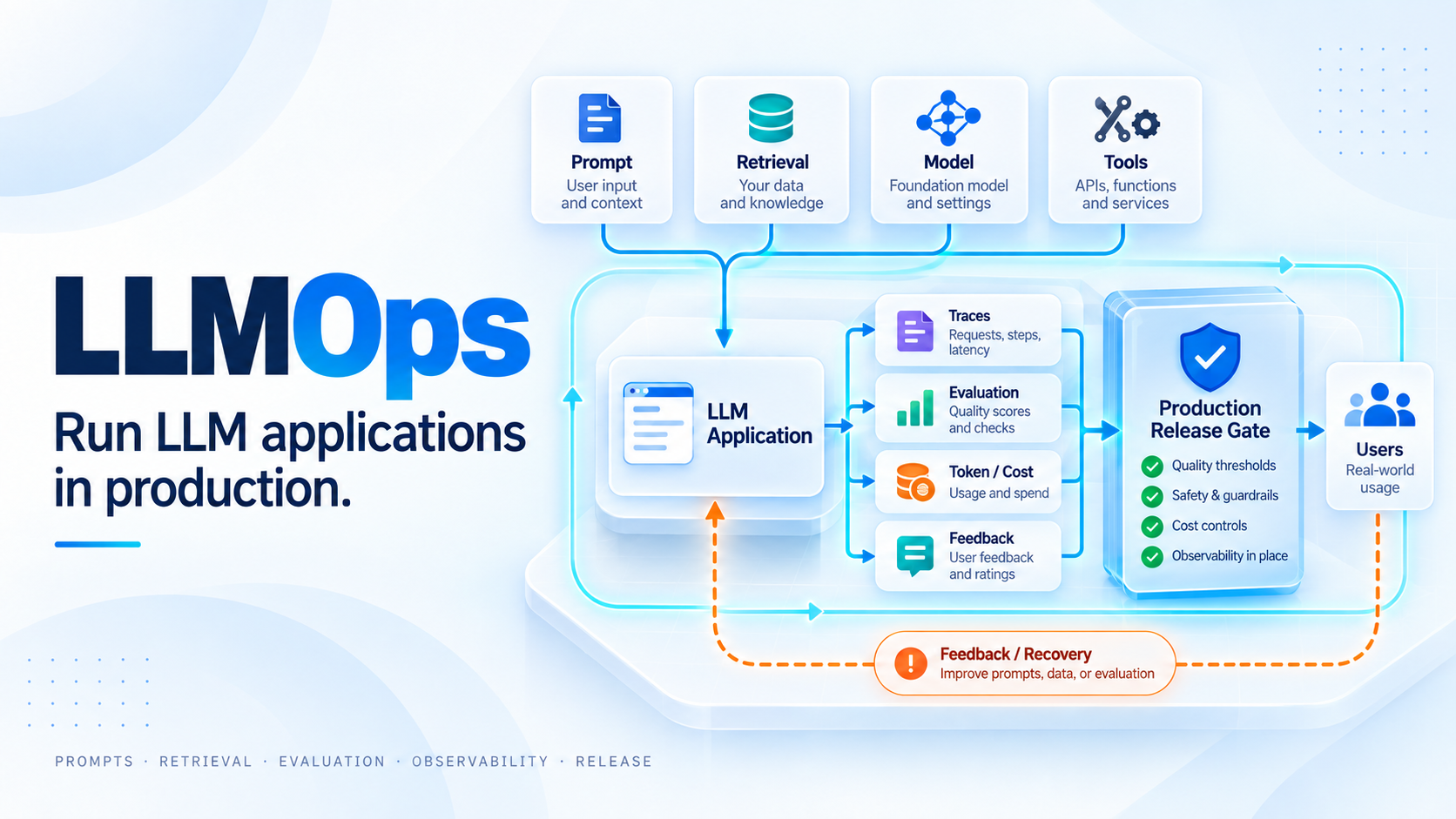
LLMOps stands for Large Language Model Operations. It is the discipline of developing, evaluating, deploying, monitoring, and improving applications powered by large language models. It adds controls for prompts, model changes, retrieved context, tool calls, evaluation, token usage, latency, security, and probabilistic output to the software systems around the model.
The model is only one dependency. A production LLM application also includes prompts, model parameters, retrieval sources, tools, routing rules, guardrails, application code, and human review. If those parts are not versioned and observable together, a team may know that an answer became worse without knowing what changed or how to reverse it.
By the end of this guide, you will have a practical LLMOps model covering the release gate, evaluation dataset, production telemetry, cost controls, and feedback loop needed to move beyond a successful demo.
Questions this Article Answers
- What is LLMOps?
- How is LLMOps different from MLOps?
- Why do LLM applications need a separate operating discipline?
- What should be versioned in an LLM application?
- How should teams evaluate prompt and model changes?
- What should LLM monitoring capture?
- How do you measure LLM cost and latency?
- How do you operate RAG systems in production?
- How do you manage model-provider changes?
- What belongs in an LLMOps release gate?
- How do you build a continuous LLMOps improvement loop?
What Is LLMOps?
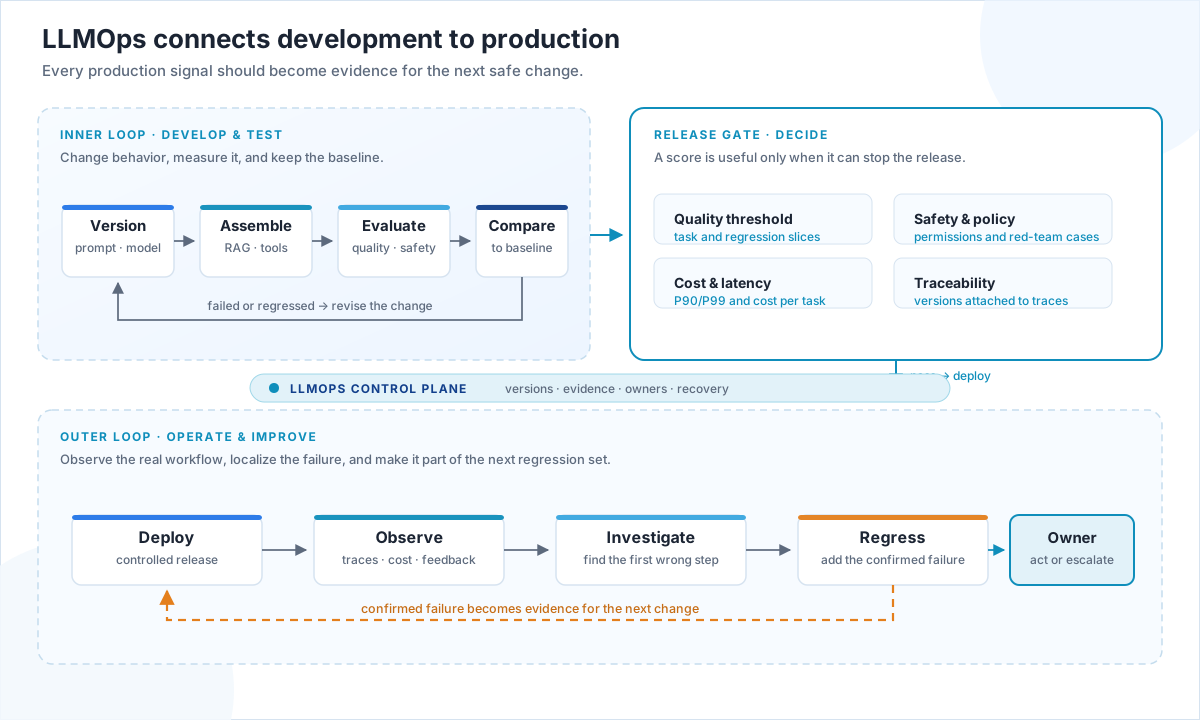
LLMOps is the operating discipline for LLM-powered applications. It covers the inner loop of developing and testing prompts, retrieval, models, and workflows, plus the outer loop of deploying, monitoring, governing, and improving those systems in production. Microsoft describes this as separate inner and outer loops because experimentation and operations need different controls while remaining connected.
The important word is application. LLMOps is not only about training or hosting a foundation model. It applies to assistants, RAG (Retrieval-Augmented Generation) systems, copilots, workflow automation, and agents where the model is one component in a larger system.
LLMOps Area |
Question the Team must Answer |
|---|---|
Versioning |
Which prompt, model, retrieval configuration, and code produced this result? |
Evaluation |
Did the change improve the intended task without breaking important cases? |
Observability |
Which model call, tool, retrieval step, or retry caused the problem? |
Cost control |
What did this workflow cost by task, model, user, and retry? |
Governance |
Who approved the change, what data was exposed, and what happens when the system fails? |
Improvement |
How does a confirmed production failure become a better test case? |
LLMOps is therefore not a single product category. It is the set of practices that makes the whole application traceable and changeable.
How Is LLMOps Different from MLOps?
MLOps manages the lifecycle of machine learning models, data, training, deployment, and monitoring. LLMOps uses those foundations but adds application-level controls for prompts, retrieved context, tool calls, long outputs, model-provider dependencies, and quality judgments that may not have one deterministic correct answer.
The distinction is not that LLMOps replaces MLOps. A production LLM system may need both. MLOps may manage a fine-tuned model or embedding model, while LLMOps manages the prompts, retrieval pipeline, evaluations, routing, traces, and user-facing workflow around it.
The practical rule is straightforward: if the model is embedded in a workflow, operating the model alone is not enough. The workflow must be evaluated and observed as a system.
Concern |
Traditional MLOps Emphasis |
LLMOps Emphasis |
|---|---|---|
Main artifact |
Model, weights, features, training data |
Model plus prompts, tools, retrieval, policies, and workflow configuration |
Evaluation |
Accuracy, precision, recall, loss, calibration |
Task success, groundedness, instruction following, trajectory, safety, cost, and latency |
Failure signal |
Prediction error or service failure |
A plausible but incorrect answer, incorrect tool call, inadequate retrieval, policy violation, or silent quality drift |
Change control |
Model and data versions |
Model, prompt, context, tools, routing, evaluator, and deployment versions |
Monitoring |
Model and infrastructure metrics |
Infrastructure metrics plus traces, tokens, retrieved sources, tool calls, feedback, and quality signals |
Why Do LLM Applications Need a Separate Operating Discipline?
LLM applications can fail without returning an ordinary software error. A request may receive a fluent response even though the model selected the incorrect tool, used outdated retrieved context, skipped a required action, exceeded a cost limit, or violated a policy. The application can return HTTP 200 while the business outcome is incorrect.
The system is also sensitive to changes that can be easy to overlook. A prompt edit, model update, retrieval-index change, context-window change, tool-schema modification, or retry policy can alter quality and cost. That is why the release unit must be larger than the model call.
AgentBench illustrates the evaluation problem. Its benchmark used eight interactive environments and evaluated 27 API-based and open-source models, identifying long-term reasoning, decision-making, and instruction following as important obstacles to usable agents. The benchmark should not be treated as a production guarantee, but its structure shows why static question-answer tests are incomplete. AgentBench research paper
The Operating Discipline Exists to Answer Five Questions after Every Important Change:
- What changed?
- What did the change improve?
- What did it make worse?
- Can we detect the regression in production?
- Can we roll back or route around it safely?
What Should Be Versioned in an LLM Application?
Version the complete behavior configuration, not only the model identifier. A production trace should point to the exact prompt, model, parameters, retrieval configuration, tool definitions, guardrail policy, evaluator version, and application build that generated it.
Prompt versioning is important because prompt text is executable behavior. Two prompts that differ by one instruction may produce different tool choices, response formats, refusal behavior, or token usage. A prompt stored only in a chat window or edited directly in production does not support reliable debugging.
At minimum, version these artifacts together:
Artifact |
Why it Matters |
|---|---|
System and task prompts |
Instructions and output behavior change over time |
Model and provider |
Model behavior, availability, limits, and defaults can change |
Inference parameters |
Temperature, output limits, structured-output settings, and retry rules affect behavior |
Retrieval configuration |
Chunking, embedding model, filters, ranking, and corpus version affect context |
Tool schemas and permissions |
Tools define what the system can do and what arguments it may send |
Evaluation dataset and rubric |
A quality score is meaningful only when its test set and criteria are known |
Application build and dependencies |
Orchestration, parsing, fallbacks, and state management can change outcomes |
The version record should be attached to the trace, not stored in a separate release note that an engineer must reconstruct later.
How Should Teams Evaluate Prompt and Model Changes?
Evaluate a change against a representative dataset before release, then compare it with a known baseline. The evaluation should measure the business task and the failure modes that matter, not only whether the answer sounds fluent. Use deterministic checks where the expected state is known, model-based judges for bounded semantic criteria, and human review for high-stakes or ambiguous cases.
Amazon Bedrock documents three evaluation modes: automatic evaluation, human evaluation, and judge-model evaluation. Its RAG evaluation flow also separates the prompt or query, expected retrieved evidence, and generated answer. That separation is useful because a RAG failure may begin in retrieval even when the final answer is well written. Amazon Bedrock evaluation documentation
The Evaluation Dataset should Contain:
- Normal representative requests
- Known failure cases
- Ambiguous or incomplete requests
- Long-context cases
- Permission and policy cases
- Tool failure and timeout cases
- Adversarial or prompt-injection cases where relevant
- Recent production examples, redacted and approved for evaluation
Do not Reduce Every Result to a Single Average Score. Report the Dimensions Separately:
Dimension |
Example Question |
|---|---|
Task outcome |
Did the required business state change? |
Groundedness |
Is the answer supported by the retrieved evidence? |
Instruction following |
Did the system follow the required format and policy? |
Tool correctness |
Did it choose the right tool and arguments? |
Reliability |
Does it succeed consistently across repeated runs? |
Cost and latency |
Is the result acceptable at the expected operating conditions? |
An evaluation is a release control only when it can fail the release. If a score is collected but no threshold, owner, or rollback action exists, it is reporting, not operational discipline.
What Should LLM Monitoring Capture?
LLM monitoring should connect system health with AI behavior. Infrastructure metrics alone can show that the API responded quickly, but they cannot show whether the response used the wrong document, called the incorrect tool, or claimed success without changing the required state.
OpenTelemetry's GenAI guidance describes telemetry for model identity, input and output token counts, prompts, completions, tool calls, tool results, traces, metrics, and events. It also warns that full prompt and tool content may contain sensitive data, so content capture should be deliberate and protected. OpenTelemetry GenAI observability guidance
Capture Enough Information to Reconstruct the Execution Path:
- Request and workflow identifier
- Model provider and model identifier
- Prompt and configuration version
- Input and output token counts
- Retrieval queries, document identifiers, and ranking metadata
- Tool names, arguments, results, and errors
- Retry and fallback events
- Latency for each span and the complete task
- Evaluation or quality signals where available
- Final state or business outcome
Redact or exclude sensitive content according to the application's data policy. A trace that contains everything but cannot be accessed safely is not a production solution. A trace that contains only latency is safer but may still be insufficient for diagnosing AI behavior.
How Do You Measure LLM Cost and Latency?
Measure cost and latency per completed task, not only per model request. A single user action may trigger several model calls, retrieval requests, tool calls, retries, and fallback models. The business question is what the workflow costs and how long it takes from request to accepted outcome.
The Minimum Operational View should Include:
Metric |
Why it Matters |
|---|---|
Input tokens per task |
Long context and repeated history can increase cost without improving the result. |
Output tokens per task |
Verbosity and unnecessary reasoning affect cost and latency. |
Model calls per task |
Extra calls often indicate retries, routing, or an inefficient path. |
Cost per task |
Connects runtime use to a business workflow |
End-to-end latency |
Measures what the user experiences |
P90 and P99 latency |
Shows the slow tail hidden by averages |
Error and throttling rate |
Separates quality problems from dependency or capacity problems |
Success within budget |
Tests whether the task is both correct and economically viable |
Amazon CloudWatch's GenAI observability documentation lists token usage, average and percentile latency, errors, throttling, and cost attribution as useful operational signals. The exact dashboard will differ by system, but the principle is stable: quality, cost, and latency belong in the same release conversation. Amazon CloudWatch GenAI observability
Anthropic's report on its multi-agent research system gives a useful first-party warning. Its internal analysis found that token usage explained 80% of performance variance in one BrowseComp analysis, while its multi-agent systems used about 15 times as many tokens as chat interactions. Those figures describe Anthropic's system and evaluation, not every agent, but they show why an architecture decision should not be evaluated on quality alone. Anthropic engineering report
How Do You Operate RAG Systems in Production?
Operate retrieval as a versioned and evaluated subsystem, not as invisible plumbing. A RAG answer can fail because the right document was not retrieved, the retrieved passage was incomplete, the context was misinterpreted, or the answer went beyond the evidence. Each failure needs a different fix.
Track the Retrieval Configuration Alongside the Application:
- Corpus and Document Versions
- Ingestion and Chunking Rules
- Embedding Model and Index Version
- Query Rewriting and Filters
- Ranking or Reranking Configuration
- Retrieved Document Identifiers and Scores
- Citation or Evidence Requirements
- Access-Control Filters Applied during Retrieval
The RAGAs research introduced a reference-free evaluation framework for RAG pipelines and separated dimensions such as context relevance, faithfulness, and answer quality. That separation supports a practical diagnostic rule: do not change the prompt when the underlying failure is that the retriever returned the incorrect context. RAGAs research paper
For every important RAG workflow, store a small approved evaluation set with expected evidence. Measure retrieval quality and generated-answer quality separately, then test access controls and stale-document behavior. A production The RAG system is not reliable simply because it cites a document. It is reliable when it retrieves permitted, relevant, current evidence and uses it faithfully.
How Do You Manage Model-Provider Changes?
Treat a provider or model change as a production change, even when the application code is untouched. Record the provider, model identifier, inference parameters, context settings, structured-output contract, and date of the change. Run the candidate against the same evaluation set as the baseline and review the cases where the results disagree.
A model-selection decision should compare more than quality. Include:
Decision factor |
Measurement |
|---|---|
Task quality |
Outcome, groundedness, instruction following, and safety scores |
Reliability |
Repeated-run consistency and failure distribution |
Latency |
End-to-end and tail latency under representative load |
Cost |
Cost per completed task, including retries and fallbacks |
Integration fit |
Schema adherence, tool calling, context limits, and provider features |
Operational risk |
Availability, rate limits, data handling, and rollback options |
The resulting architecture may use a router rather than a single model. A simpler model may handle routine classification, while a more capable model handles ambiguous or high-value tasks. That routing policy must itself be versioned and evaluated because it changes the distribution of work across models.
What Belongs in an LLMOps Release Gate?
An LLMops release gate is a written decision rule that determines whether a change can move from evaluation to production. It should combine quality, safety, operational, and business checks. The gate must name the evidence required, the owner who approves it, and the action taken if the change fails.
Gate |
Minimum Evidence |
|---|---|
Behavior |
The candidate meets the task-success threshold on the representative evaluation set |
Regression |
No critical slice regresses beyond the approved tolerance |
Grounding |
Retrieved evidence and answer faithfulness meet the workflow requirement. |
Safety |
Permission, policy, prompt injection, and sensitive-data checks pass |
Operations |
Cost, P90/P99 latency, error, and throttling limits are acceptable |
Traceability |
Prompt, model, retrieval, tool, and evaluator versions are recorded |
Recovery |
Rollback, fallback, or human-escalation path has been tested |
Ownership |
A named team owns alerts, incidents, and the next review |
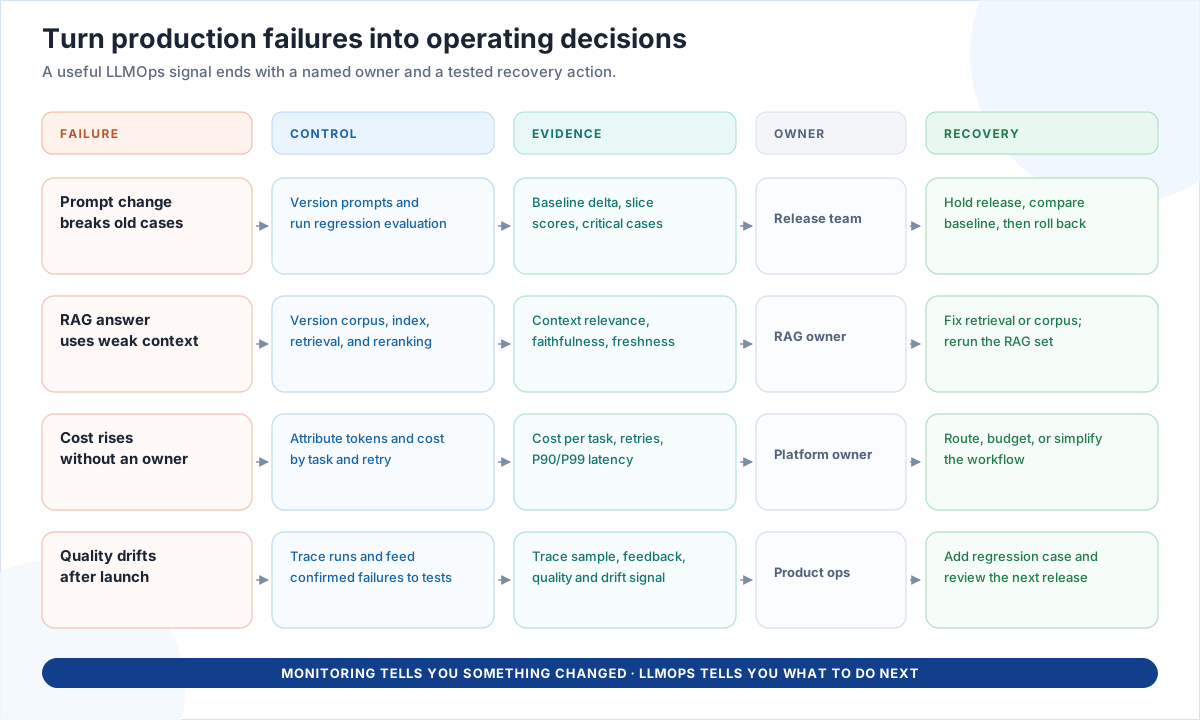
NIST's Generative AI Profile organizes its focus around governance, content provenance, pre-deployment testing, and incident disclosure. LLMOps should translate those ideas into artifacts and decisions rather than leaving them as policy language. NIST Generative AI Profile
The gate is not an attempt to eliminate uncertainty. It is a way to make uncertainty visible before a change reaches users.
How Do You Build a Continuous LLMOps Improvement Loop?
The continuous loop begins with a representative evaluation set, connects every production run to trace and outcome data, samples failures, investigates the earliest incorrect step, and converts confirmed failures into regression cases. The next release is then tested against both the original set and the new cases.
The loop should look like this:
- Define the success state and unacceptable behaviors.
- Build the initial evaluation set from real task patterns and known edge cases.
- Version the prompt, model, retrieval, tools, policies, and code.
- Run candidate and baseline evaluations.
- Release only when the quality, safety, cost, and latency gates pass.
- Trace production runs with appropriate redaction.
- Sample user feedback, failures, and unusual cost or latency patterns.
- Localize the failure to the model, prompt, retrieval, tool, policy, or application layer.
- Add the confirmed failure to the regression set.
- Re-run the gate before the next change.
This is the difference between monitoring and operations. Monitoring tells you that behavior changed. LLMOps gives the team a repeatable path from that signal to a tested correction.
What Does an LLMOps Architecture Look Like in Practice?
An LLMOps architecture should put a control plane around the model calls and workflow components. The control plane owns versioning, evaluation, routing, access, telemetry, and release decisions. The application plane handles the user request, retrieval, tools, state, and final response.
At Realisier, Pulse is a first-party example of the type of production system this model is intended to describe. Its public page presents a platform that grounds answers in company knowledge, routes across Claude, GPT, and Gemini, measures AI usage by person and tool, records the cost of each answer, and gives employees visibility into their own data. In LLMOps terms, those are retrieval, provider routing, telemetry, cost attribution, and consent-aware visibility controls. This is an architecture example, not a claim that Pulse is a universal reference implementation.
The architecture does not require one platform to own every function. It requires the functions to be connected well enough that a production result can be traced to the configuration that produced it and a failure can be converted into a better test.
What Does This Mean in Practice?
LLMops is not the step after an LLM application is built. It is the operating model that makes the application controlled to change and structured for improvement. A team should version the behavior configuration, evaluate the task, trace the production path, measure cost and latency, protect sensitive telemetry, and turn confirmed failures into permanent tests.
The practical question is not whether a model can produce a good answer in a demo. It is whether the team can show what happened when the answer was wrong, how much the workflow cost, which change caused the regression, and what can prevent the same failure from recurring.
Frequently Asked Questions
What is the Difference between LLMOps and MLOps?
MLOps manages machine-learning models, data, training, deployment, and monitoring. LLMOps includes those concerns that are relevant but also manages prompt, retrieval, tool calls, probabilistic output, evaluation rubrics, token usage, and model-provider changes in the surrounding application. A production LLM application may need both disciplines.
Do Small LLM Applications Need LLMOps?
They need the controls in proportion to their risk and operating volume. A small internal assistant may start with prompt versioning, a representative evaluation set, basic traces, cost monitoring, and a rollback path. A customer-facing workflow or system that changes records needs stronger access controls, state verification, human escalation, and incident procedures.
Is LLMOps a Tool or a Platform?
LLMOps is a discipline, not one tool. Platforms can provide pieces such as prompt registries, tracing, evaluation, gateways, dashboards, and feedback collection. The important test is whether the team can connect those pieces into a release and incident process with clear owners, thresholds, and recovery actions.
What should be Included in an LLM Evaluation Dataset?
Include representative requests, known failures, ambiguous inputs, long-context cases, policy cases, tool failures, and recent redacted production examples. Add expected outcomes or evidence wherever possible. Do not rely only on clean synthetic prompts because they may not represent the distribution and failure conditions the application sees after launch.
How do You Monitor an LLM Application?
Monitor infrastructure health and AI behavior together. Capture model and prompt versions, token usage, latency, errors, retries, retrieved evidence, tool calls, user feedback, evaluation signals, and final task state. Redact or restrict prompt and tool content when it contains sensitive information. Metadata-only telemetry can reduce exposure but may be insufficient for diagnosis.
When should a Team Use a Human Reviewer?
Use human review for high-stakes, irreversible, ambiguous, or novel cases, and to calibrate automated or LLM-based judges. Deterministic checks work well for verifiable state changes and policy boundaries. LLM judges can help assess bounded semantic criteria, but their scoring should be compared with human judgments before becoming a release control.
Build LLM Applications That Hold Up in Production
Versioning, evaluation, observability, cost control, and release gates are the disciplines that separate a production-ready LLM system from a successful demo. That is where an engagement with Realisier Labs begins.