

Key Takeaways
- Multi-agent orchestration is worth paying for when the task has substantial parallel work, information beyond one context window, or several complex tool domains.
- Coordination seams are the main reliability risk. Instrument delegation, handoffs, state mutation, verification, and termination.
- Compare repeated end-to-end success against a single-agent baseline, and collapse the system when the additional capability no longer justifies the coordination cost.
Multi-agent orchestration coordinates several AI agents around a common goal, with defined rules for delegation, state transfer, verification, and failure recovery.
The trade-off can be measurable: Anthropic reported a 90.2 percent improvement over a single-agent Claude Opus 4 baseline on its internal research evaluation, while its multi-agent system used approximately 15 times the tokens of a chat interaction (Anthropic, 13 June 2025).
This article provides a framework for determining whether a task justifies that cost, selecting an orchestration pattern based on the type of failure it may introduce, and identifying when it may be appropriate to simplify the system back to one agent.
Questions this Article Answers
- What is Multi-Agent Orchestration?
- What does Multi-Agent Orchestration Actually Cost?
- When is Multi-Agent Worth Paying for?
- What are the Orchestration Patterns, and How do you Choose?
- How do Agents Hand Work to Each Other without Losing Context?
- Why do Coordination Failures Go Undetected?
- Who Owns State in a Multi-Agent System?
- What Happens when One Agent in the Chain Fails?
- How do You Stop Agents Duplicating Work or Spawning Endlessly?
- How do you Debug a System that Behaves Differently on Identical Input?
- How do you Evaluate a Multi-Agent System?
- When should you Collapse a Multi-Agent System Back into One Agent?
What is Multi-Agent Orchestration?
Multi-agent orchestration is the control structure that coordinates several AI agents toward one outcome. It defines which agent makes decisions, which agent executes tasks, what state is transferred, who can modify the system, and how the run ends. The important factor is not simply the number of agents, but the number and quality of coordination points between them.
AutoGen, introduced by Wu and colleagues in 2023, described applications in which multiple customizable agents communicate with one another while combining language models, human input, and tools. Communication alone is not sufficient for production. A production system also requires clear ownership, defined limits, verification, and a record of what occurred.
A team can run six agents concurrently and still lack orchestration if the agents do not share a defined protocol for state, authority, or completion. Conversely, a small manager-and-specialist system can be considered orchestrated when every transfer is explicit and observable. This distinction matters because coordination introduces an additional reliability burden.
If the underlying single-agent-versus-multi-agent decision has not been settled, start with Agentic AI Architecture: What Breaks in Production. This article addresses the next challenge: operating a multi-agent system without losing control.
What does Multi-Agent Orchestration Actually Cost?
Multi-agent orchestration generally requires more model work, more latency, and a larger operational surface area than a comparable chat interaction.
- Anthropic measured agent use at approximately 4 times the tokens of chat interactions and its multi-agent research system at approximately 15 times. These figures describe one published research system, not a universal billing multiplier, but they demonstrate the potential scale of the trade-off.
- Anthropic also reported that token usage alone explained 80% of performance variance on BrowseComp, a benchmark for browsing agents. In that setting, higher token usage was not simply a side effect of the architecture; it was a major contributor to the result.
- The same source reported a 90.2% improvement over a single-agent baseline on its internal research evaluation, which makes the result useful as an example of a trade-off rather than as a general performance expectation.
The cost has two less visible components. Parallel work can improve throughput, but synchronous dependencies can make the entire run wait for slower branches. Each additional agent also creates another prompt, tool interface, version, trace, and evaluation target. A system that improves quality while making failures difficult to attribute may be more expensive to operate than its token usage alone suggests.
When is Multi-Agent Worth Paying for?
Multi-agent orchestration is most appropriate when a task involves substantial parallel work, information that exceeds one context window, or several complex tool domains that should be separated. It may be less suitable when every step depends on a shared, evolving context or when one agent can complete the work with comparable quality and lower operational complexity.
Anthropic identifies these three positive conditions in its account of the research system. It also notes that many coding tasks contain fewer truly parallelizable subtasks than research tasks. The 90.2% research result came from a breadth-first research problem and should not be treated as representative of enterprise workflows in general.
The practical test is concrete. Write down the subtasks and identify which ones can run without the output of another subtask. If almost every branch depends on the previous branch's result, the workflow is primarily sequential and may not provide a strong case for independent agents. If the work can be divided into genuinely independent investigations and later synthesized, the split has a clearer capability rationale.
The final consideration is value. Multi-agent systems can require higher model usage and introduce a larger failure surface. If the business outcome cannot justify a slower, more expensive, or more difficult-to-debug run, a simpler architecture may be more appropriate.
What are the Orchestration Patterns, and How do you Choose?
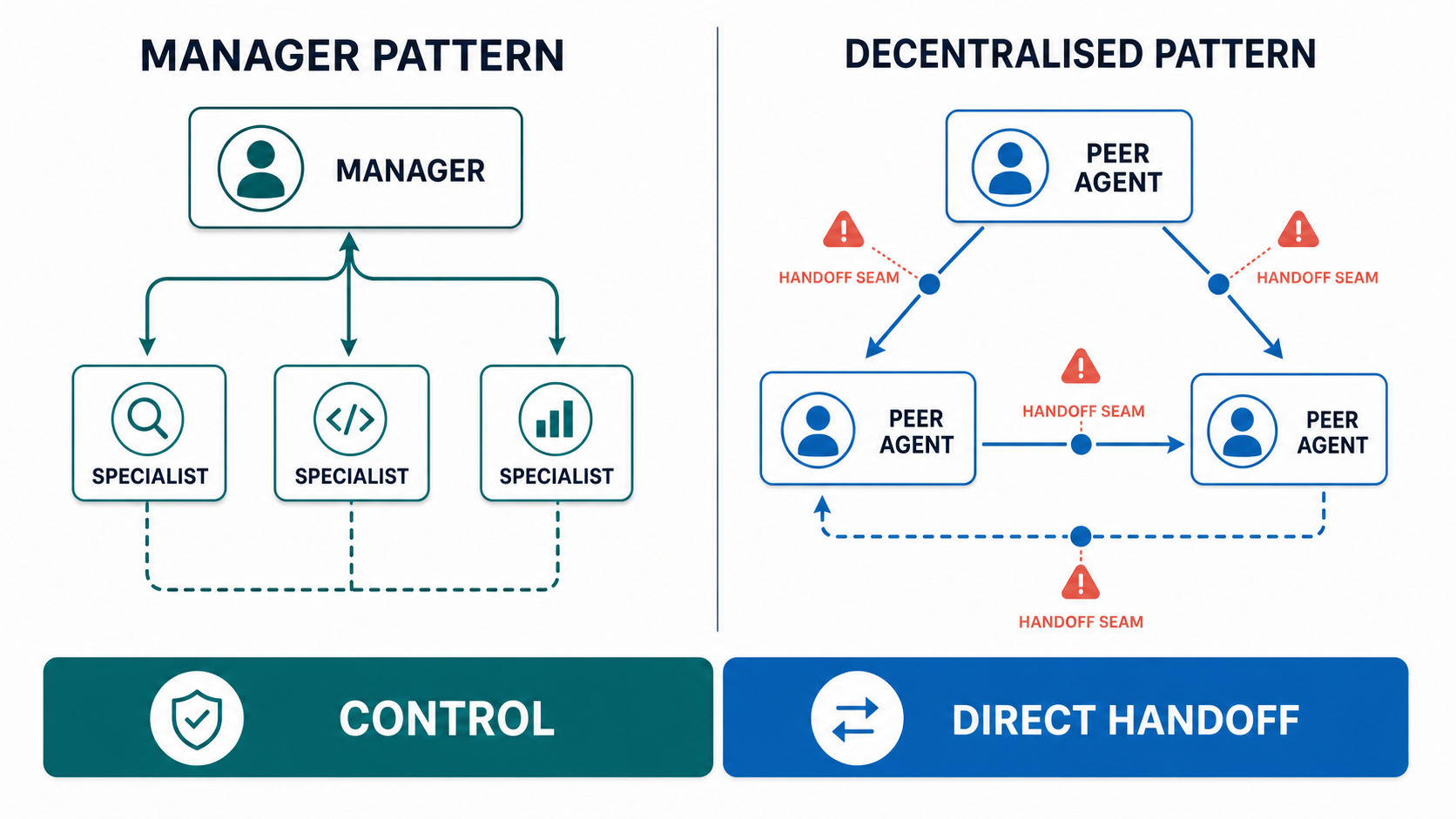
Choose an orchestration pattern based on the failure you need to expose and the authority you need to preserve. OpenAI's guide describes two broad patterns: a manager that calls specialist agents as tools, and a decentralized design in which agents hand execution to one another. A sequential workflow is a third useful structure when subtasks are fixed and ordered.
Manager patterns preserve a central point of control. Decentralized patterns move control through handoffs. The coordination points differ, but both require explicit instrumentation.
| Pattern | Useful property | Risk to design for | Instrument first |
|---|---|---|---|
| Manager | One agent retains control and synthesizes results | Central bottleneck or incorrect delegation | Delegation decision, tool arguments, returned evidence |
| Decentralized handoff | Specialists can take control directly | Context or accountability is lost during transfer | Full state payload, receiving agent, authority change |
| Sequential workflow | Fixed steps are easy to inspect | Errors can compound from one step to the next | Output contract and verification at every boundary |
The manager pattern is appropriate when one agent should remain the user-facing authority. The decentralized pattern can suit work where no central synthesizer is required and a specialist should take over. Neither pattern is automatically more reliable. The choice determines where an incorrect decision can be identified and who is responsible for recovery.
Anthropic's guidance is consistent with this approach: add complexity only when it produces a demonstrable improvement in the outcome. A pattern diagram alone is not evidence that a particular pattern is appropriate.
How do Agents Hand Work to Each Other without Losing Context?
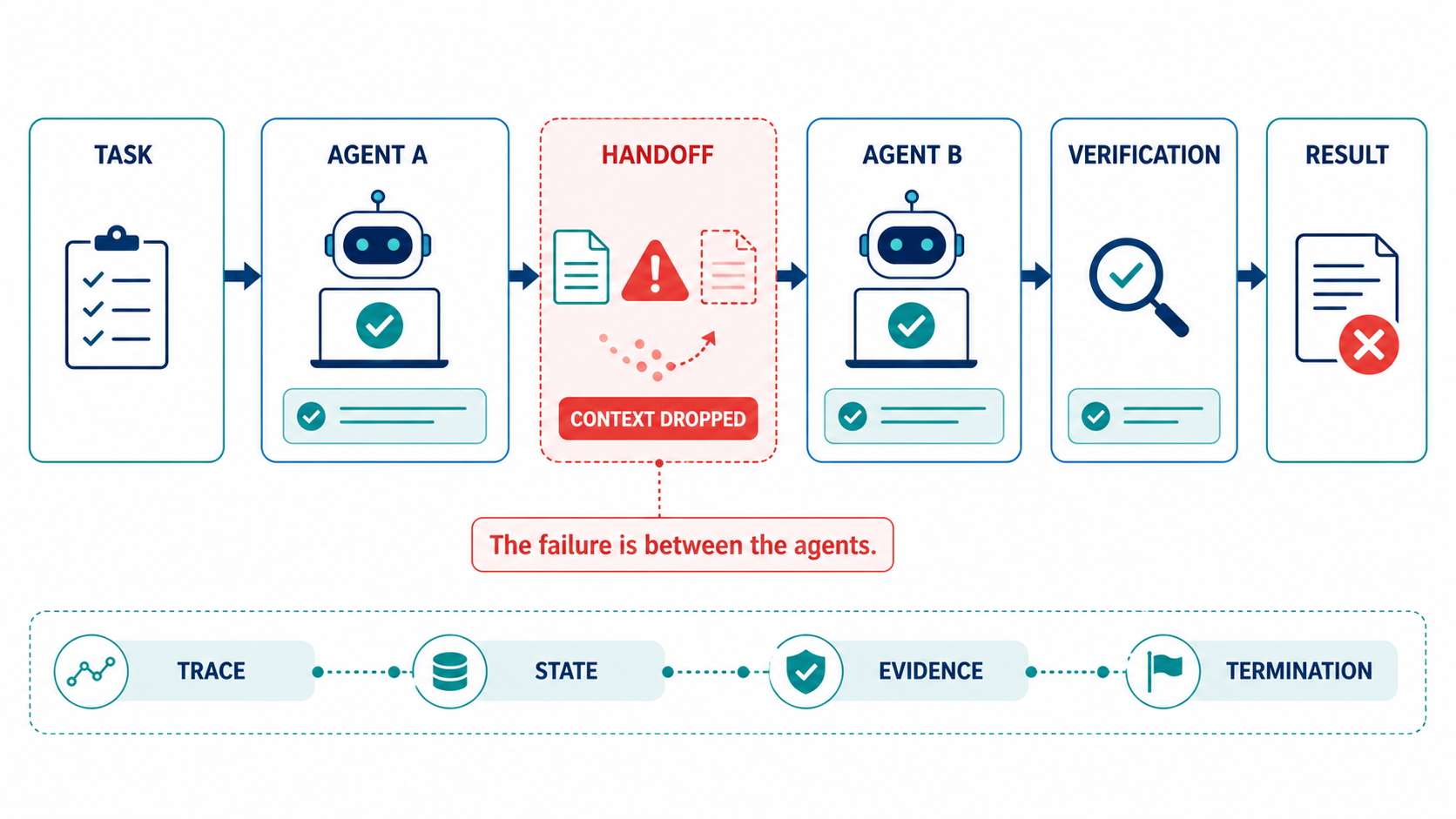
Agents can preserve context across a handoff by transferring an explicit state payload rather than assuming the next agent can reconstruct the conversation. The payload should state the goal, constraints, completed work, rejected approaches, relevant evidence, pending decisions, and the artifact or record being changed. Required fields should be validated before the receiving agent begins work.
OpenAI describes a handoff as a one-way transfer that moves the latest conversation state to the new agent. This is an important operational consideration. Information that the sending agent does not include is unavailable to the receiving agent, which may still act confidently because a missing field is not necessarily treated as an explicit error.
The payload should also distinguish facts from proposals. "Customer approved refund" is a fact only when the system has a durable approval record. "Customer appears eligible" is an agent judgment that still requires verification. Mixing the two can turn a model interpretation into an authority claim.
Treat the handoff as an API boundary: version the schema, reject missing required fields, include a correlation ID, and record the payload hash in the trace. This makes a coordination defect easier to inspect without replaying a non-deterministic run.
Why do Coordination Failures Go Undetected?
Coordination failures can go undetected because each individual agent may behave reasonably while the combined system fails to complete the intended task correctly. The defect may exist in a missing instruction, an ambiguous handoff, an incorrect assumption about state, or a premature termination condition. Monitoring only the final answer or individual model calls can therefore miss the point where the failure originated.
The MAST study by Cemri and colleagues identified 14 failure modes across seven multi-agent frameworks. Its analysis covered 1,642 annotated execution traces, and the authors reported a Cohen's kappa of 0.88 for the agreement process used to develop the taxonomy. The modes are grouped into specification and system-design failures, inter-agent misalignment, and task-verification and termination failures.
That middle category is particularly relevant to orchestration. An agent may follow its local instructions and still misunderstand another agent, ignore information, repeat a step, or fail to provide a required result. Anthropic reported similar practical issues in its own research system, including excessive spawning, repeated searches, and duplicated work.
A coordination failure can occur between two locally correct agents when a handoff loses important context.
Instrument the coordination points: delegation, handoff, state mutation, verification, and termination. The goal is not simply to collect more logs. It is to create a trace that can show where authority changed and what evidence allowed the run to continue.
Who Owns State in a Multi-Agent System?
Durable application state should have one authoritative owner outside any agent's context window. Agents can read that state and propose changes, while a controlled component validates and commits those changes. This separates an agent's interpretation of the current state from the system's recorded state.
Nowaczyk's architecture paper treats memory and telemetry as explicit components of an agentic system, alongside planning and execution. Context is temporary and model-generated. It should not be treated as a database, an audit log, or a transaction boundary.
The single-writer rule is a practical design choice, not a requirement that every application use one database process. It means one authority determines which state transition is committed. Other agents can prepare a draft update, request a tool action, or submit a decision for review, but they should not silently maintain competing versions of the same business record.
The state-ownership testDurable application state should have one authoritative owner outside any agent’s context window.
For state-changing work, record the old value, proposed new value, actor, reason, timestamp, correlation ID, and verification result. If a run fails halfway through, this record can support recovery. Without it, the team may have to compare several conversational states after the system has already changed the underlying record.
What Happens when One Agent in the Chain Fails?
If a chain has no per-step verification and recovery policy, one failed agent can produce a later answer that appears complete but is based on invalid state. Reliability can decrease across dependent steps: the run requires each critical transition to succeed, rather than simply having a majority of agents produce plausible text.
The tau-bench paper introduced pass^k to measure whether an agent succeeds across all k repeated attempts. Its abstract reports that GPT-4o succeeded on fewer than 50% of tasks overall and achieved pass^8 below 25% in the retail domain. The metric illustrates how repeated evaluation can expose inconsistency that a single-run success rate may not show.
Three controls can reduce the potential impact of failures.
- Verify each important output before passing it downstream.
- Make retryable state changes idempotent, so repeating the same request does not create a duplicate order or mutation.
- For non-retryable actions, define a compensating action and make the point of human approval explicit before sensitive or irreversible changes.
- Do not resolve a failed branch by asking another agent to infer what happened.
- Route the run to a defined failure state with the trace, unfinished work, and available recovery options attached. Human-in-the-Loop AI: Where the Approval Gate Belongs covers the placement of approval gates in more detail.
How do You Stop Agents Duplicating Work or Spawning Endlessly?
Enforce limits in the runtime rather than relying only on instructions inside an agent prompt. A controlled run should have a maximum number of agents, maximum recursion depth, maximum tool calls, token or time budget, and an explicit termination rule. It should also maintain a shared record of attempted work so parallel agents can avoid repeating the same investigation.
Anthropic reported that early versions of its research system spawned 50 subagents for simple queries, searched repeatedly for nonexistent sources, and generated excessive updates between agents. The account also describes duplicated research caused by unclear task boundaries. These are architecture and control issues rather than evidence that a model simply requires a better prompt.
Every subtask should have an objective, boundary, output format, source policy, and stop condition. The orchestrator should determine whether the result closes a gap or creates a new one. If a subagent returns no new evidence, the run should record that result and stop additional branching.
Source selection requires the same discipline. Anthropic's testers found that agents consistently preferred SEO-optimized content farms over authoritative sources. Retrieval volume cannot compensate for weak source quality, so source authority should be included in the task contract and evaluation.
How do you Debug a System that Behaves Differently on Identical Input?
Debug the recorded trace rather than assuming that a rerun should reproduce the same path. Agent runs can vary because model sampling, tool results, search ranking, timing, and branch decisions can change. A rerun is therefore a new experiment rather than a faithful replay unless the system has captured and can reproduce every relevant input.
Anthropic explicitly describes its agents as non-deterministic between runs, even with identical prompts. A useful trace records the model and configuration, prompt version, tool schema, tool arguments and results, retrieved documents, handoff payloads, state reads and writes, branch decisions, verification outcomes, and termination reason.
The trace must preserve causal structure. "Final answer was wrong" is an outcome. "Research agent passed an unverified claim to the synthesizer after the citation check timed out" is a more useful debugging lead. Correlation IDs should connect the user request, every child run, every tool call, and every state mutation.
AI Agent Observability: A Practical Best-Practices Guide covers general tracing and monitoring. Multi-agent systems add one requirement: make ownership and state transfer first-class fields rather than details buried in free-form logs.
How do you Evaluate a Multi-Agent System?
Evaluate the complete task repeatedly, compare it against a single-agent baseline, and record quality, consistency, token use, latency, and intervention rate together. A multi-agent system is not necessarily better because one run performs better. It provides stronger evidence of value when the additional capability remains reliable across repeated runs and justifies the additional resources and operational complexity.
Anthropic reported that its multi-agent research system exceeded its single-agent baseline by 90.2% on an internal research evaluation, while token usage alone explained 80% of performance variance on BrowseComp. The two figures should be considered together. Without cost and effort normalization, the comparison cannot determine whether the improvement came from the architecture, increased model usage, or both.
Use pass^k or a similar repeated-run measure for tasks where consistency matters. The tau-bench authors designed pass^k specifically to evaluate reliability across multiple trials, and their retail result of below 25% pass^8 illustrates why a high single-run score can be misleading.
An evaluation set should include normal tasks, ambiguous inputs, missing data, tool failures, duplicate requests, partial completion, and high-risk actions. Score intermediate contracts as well as the final result, but keep end-to-end success as the release gate. Component tests can show that an individual agent works in isolation; only full-run tests expose coordination failures.
When should you Collapse a Multi-Agent System Back into One Agent?
Collapse the system when its subtasks depend heavily on shared context, when a single agent with the same tools delivers comparable quality per token, or when the team cannot attribute failures from the trace. Simplifying the architecture is a valid production decision. The split should remain only while it provides measurable capability that outweighs its coordination cost.
Anthropic recommends starting with the simplest solution and adding complexity only when it improves outcomes. OpenAI similarly notes that a single agent can handle many tasks by adding tools incrementally, which can keep evaluation and maintenance simpler. These recommendations are not arguments against multi-agent systems. They establish the need to demonstrate that the additional complexity provides value.
Run a Collapse Test:
- Give one agent the same tools, task contract, evidence rules, and evaluation set.
- Compare end-to-end success, pass^k, token use, latency, intervention rate, and failure attribution.
- If the multi-agent design is not materially better on the metric that matters to the business, consider removing the coordination seams.
- Re-run the test after a significant model, tool, or context-window change.
The capability boundary that justified the split can change over time. A system may become simpler without losing its desired outcome as the underlying model improves.
What this Means in Practice
Multi-agent orchestration is a trade-off. The published evidence indicates that it can be valuable for broad, parallel, tool-intensive work, while adding cost and complexity when the task is primarily a dependent sequence.
The operating rule is three parts: establish that the task structure requires parallel capacity, instrument every point where authority or state crosses an agent boundary, and measure repeated end-to-end success against a simpler baseline. If the system cannot meet those criteria, using fewer agents may provide the more appropriate architecture.
FAQ
1What is Multi-Agent Orchestration in Simple Terms?
Multi-agent orchestration is the structure that coordinates several AI agents around one outcome. It defines who delegates, who executes, what state is transferred, which actions require verification, and how the run stops. Multiple agents running at the same time without these rules are concurrent processes, not necessarily a reliable orchestration design.
2Is Multi-Agent Orchestration always better than a Single Agent?
No. Anthropic's research found its strongest results on work involving substantial parallelization, information beyond one context window, and numerous complex tools. The same source notes that shared context and many dependencies can be poor fits, while the MAST research identified substantial failure rates across evaluated multi-agent systems. The architecture should therefore be selected based on demonstrated need rather than complexity alone.
3How much more does a Multi-Agent System Cost to Run?
There is no universal multiplier, but Anthropic reported approximately 4 times the tokens for agents and 15 times for its multi-agent research system compared with a chat interaction. These are published observations from a specific system, not a price quote. Latency, evaluation, tracing, retries, and human intervention can add operational costs beyond token usage.
4What is the Difference between the Manager and Decentralized Patterns?
In a manager pattern, one central agent calls specialist agents as tools and retains control and synthesis. In a decentralized pattern, agents hand execution to one another as peers. The manager pattern provides a clear authority point but can create a bottleneck. The decentralized pattern can reduce that bottleneck but makes state transfer and accountability more difficult to inspect.
5Why are Multi-Agent Failures so Hard to Find?
The error often occurs between agents. Each agent can follow its local instructions while the combined system loses context, repeats work, accepts an unsupported claim, or terminates early. The MAST study identified inter-agent misalignment as one of three broad failure categories, which is why endpoint-only monitoring may be insufficient.
6How do you Test a Multi-Agent System?
Run complete tasks repeatedly against a single-agent baseline. Measure end-to-end success, pass^k consistency, token use, latency, interventions, and failure attribution. Include tool errors, ambiguous inputs, duplicate requests, missing data, and partial failures. A unit test for each agent is useful, but it cannot fully expose the defects created by the handoffs between agents.
Need to know whether your multi-agent design is earning its coordination cost? Realisier Labs helps teams identify the failure boundaries, controls, and evaluation evidence that matter in production.