

Key Takeaways
- An AI governance framework is the operating model that determines which AI use cases are permitted, who is responsible for them, what controls apply, what evidence is retained, and how risks are managed after deployment.
- The NIST AI Risk Management Framework organizes AI risk activities into four functions: Govern, Map, Measure, and Manage.
- Generative AI and agents require governance at the action boundary, not only at the model boundary.
An AI governance framework is the operating model that determines which AI use cases are permitted, who is responsible for them, what controls apply, what evidence is retained, and how risks are managed after deployment.
The need is operational, not theoretical: Stanford’s 2026 AI Index reports organizational AI adoption at 88% and documented AI incidents rising to 362, from 233 in 2024.
This guide explains how to turn governance into a repeatable process using NIST, ISO/IEC 42001, and risk-based regulatory thinking, without treating a framework as the same as legal compliance.
Questions this Article Answers
- What is an AI governance framework?
- Why does AI governance matter now?
- What should an AI governance framework include?
- How does the NIST AI RMF work?
- What is the difference between NIST AI RMF and ISO/IEC 42001?
- How should a company classify AI use-case risk?
- Who owns AI governance?
- What documentation should an AI system have?
- How do you monitor AI risks after deployment?
- How does governance apply to generative AI and agents?
- Does an AI governance framework make a company compliant?
- How do you start an AI governance program without blocking delivery?
What is an AI Governance Framework?
An AI governance framework is a set of decision rights, policies, processes, controls, and evidence that governs AI throughout its lifecycle. It answers five production questions: what systems exist, what they can do, who is accountable, what happens when they fail, and what evidence shows that the organization managed the related risk.
The important distinction is between a principle and an operating control. “Use AI responsibly” is a principle. A named owner, an approved use-case record, a measured performance threshold, a release gate, an incident process, and a review date are controls that can be reviewed and verified.
NIST describes governance as a cross-cutting function that informs other risk-management activities and continues throughout the AI lifecycle. ISO/IEC 42001 approaches the same challenge through an AI management system: a set of related organizational elements that establish policies and objectives and continually improve how AI is managed.
Governance is therefore not simply a committee that meets after engineering is complete. It is the mechanism that connects business purpose, technical behavior, human oversight, and operational response before and after launch.
Why does AI Governance Matter Now?
AI governance matters because adoption is moving faster than many organizations’ ability to define, measure, and respond to risk. As systems move from generating suggestions to making recommendations, calling tools, and changing business state, an incorrect output can become an incorrect action. Governance provides a structured way to determine what level of autonomy is appropriate.
Stanford’s 2026 AI Index reports 88 percent organizational adoption and 362 documented AI incidents, up from 233 in 2024. These figures do not establish that governance would prevent a specific incident, but they illustrate why postponing controls can create operational risk.
McKinsey’s 2026 AI Trust Maturity Survey gathered responses from approximately 500 organizations. Only about 30 percent reached maturity level 3 or higher in strategy, governance, and agentic AI governance and controls. Security and risk were among the leading reported barriers to scaling agentic AI, while active mitigation remained behind risk awareness across many risk categories.
The implication for a delivery team is direct: governance must be close enough to engineering to influence the system and close enough to operations to understand what happens in production. A policy that cannot influence a release, stop an action, or trigger a review is documentation, not effective governance.
What should an AI Governance Framework Include?
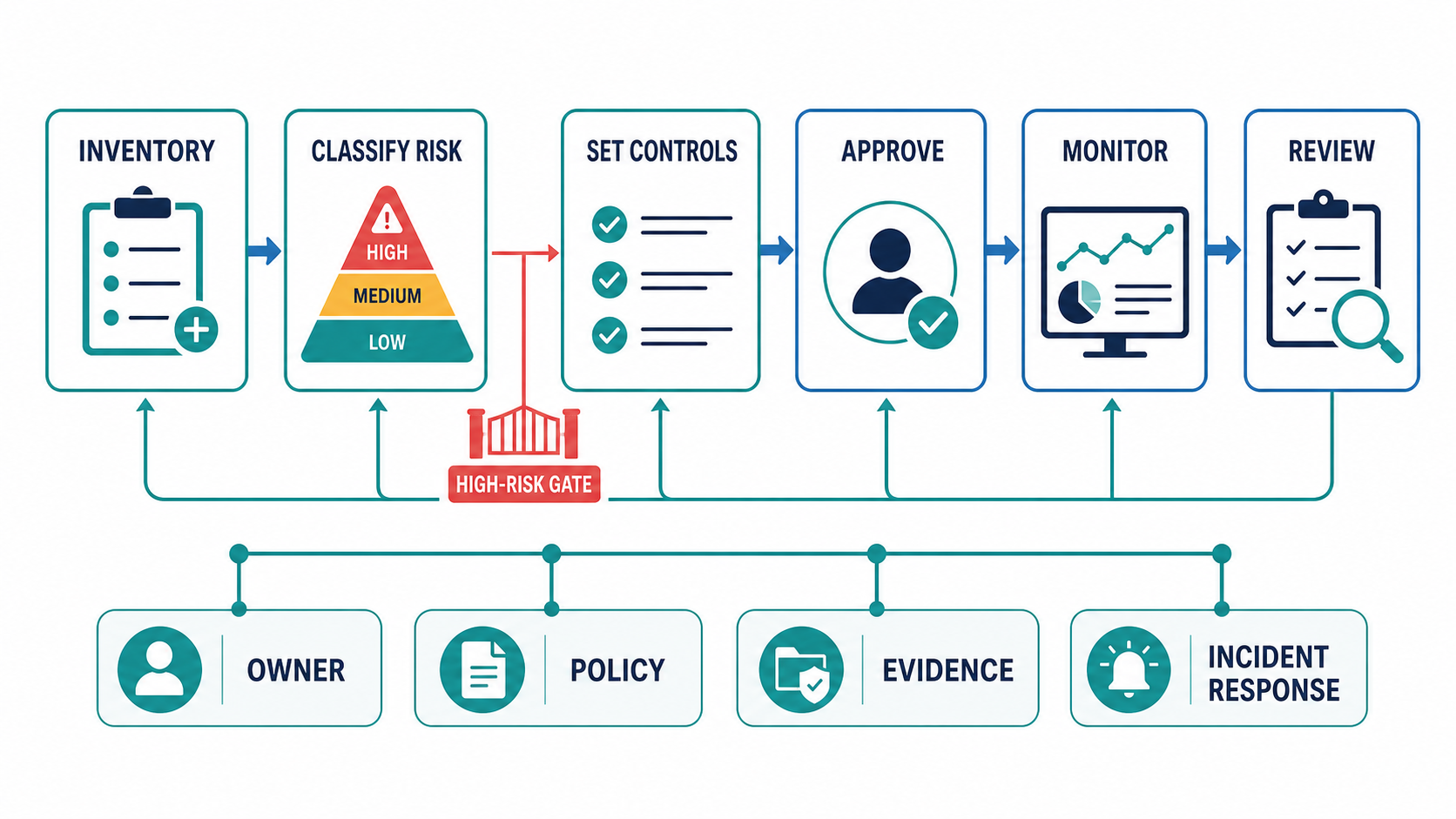
An effective AI governance framework includes an inventory, risk classification, decision rights, control requirements, evidence records, monitoring, and incident response. These elements form a continuous loop rather than a one-time approval process: meaningful changes to the model, data, tool access, users, or operating context can require the assessment to be revisited.
| Capability | Decision it enables | Evidence to retain |
|---|---|---|
| Inventory | What AI systems and use cases exist? | System register, owner, purpose, model and vendor records |
| Context and risk | What could go wrong, for whom, and how severely? | Intended use, affected groups, threat and impact assessment |
| Controls | What must the system do or not do? | Policy rules, access controls, guardrails, approval conditions |
| Measurement | Does the system meet its quality and risk thresholds? | Evaluation set, test results, drift and incident metrics |
| Accountability | Who can approve, operate, stop, and change it? | Named roles, decision log, escalation path |
| Response | What happens when the system fails or context changes? | Incident record, rollback or shutdown path, corrective action |
The framework should also cover third parties. NIST’s Generative AI Profile identifies risks related to third-party data and components, including the challenge of determining how behavior can be attributed to a particular source. Vendor documentation and model cards can provide useful information, but they do not transfer accountability for how an organization deploys and operates the system.
How does the NIST AI RMF Work?
The NIST AI Risk Management Framework organizes AI risk activities into four functions: Govern, Map, Measure, and Manage. Govern establishes the organizational structure and risk culture; Map defines the system’s context and impacts; Measure evaluates risks and performance; and Manage prioritizes responses and improvements. These functions are iterative rather than a rigid sequence.
NIST explicitly states that the AI RMF actions are not a checklist or necessarily an ordered set of steps. Governance is cross-cutting, and risk management should continue throughout the AI system lifecycle. This is important because a system that is acceptable in a test environment may require reassessment after a new user group, data source, model, or tool is introduced.
The four functions translate into a delivery loop:
- Govern: Name the decision owner, risk tolerance, escalation path, and review authority.
- Map: Define purpose, users, affected people, data, dependencies, foreseeable misuse, and non-AI alternatives.
- Measure: Test quality, reliability, security, privacy, bias-related harms, and robustness against representative cases.
- Manage: Accept, mitigate, transfer, avoid, or stop the risk, then monitor residual risk and corrective actions.
NIST’s GAI Profile adds generative-AI considerations such as content provenance, pre-deployment testing, and incident disclosure. The value is not in adopting every suggested action. The value is in using the framework to make risk decisions clear, consistent, and repeatable.
What is the Difference between NIST AI RMF and ISO/IEC 42001?
NIST AI RMF is a voluntary risk-management framework that helps teams structure risk activities and outcomes. ISO/IEC 42001 is an international management-system standard that specifies requirements for establishing, implementing, maintaining, and continually improving an AI management system. One provides a flexible risk framework; the other provides a formal management-system standard.
NIST’s AI RMF Core is organized around Govern, Map, Measure, and Manage, and its Playbook provides suggested actions. ISO describes ISO/IEC 42001 as applicable to organizations that develop, provide, or use AI systems, using a Plan-Do-Check-Act approach. ISO also distinguishes implementing the standard from certification by an independent body.
| Question | NIST AI RMF | ISO/IEC 42001 |
|---|---|---|
| Primary use | Structure AI risk decisions and activities | Establish an organization-wide AI management system |
| Flexibility | Select and adapt outcomes to context | Requirements and guidance for a management system |
| Best starting point | Use-case mapping, measurement, and risk treatment | Policies, objectives, processes, audits, and continual improvement |
| Compliance meaning | Voluntary framework; adoption is not legal compliance | Certification can provide assurance, but the standard itself is not a legal safe harbor |
They can be used together. NIST can help engineering and risk teams assess and manage an AI system. ISO/IEC 42001 can help an organization establish those practices across functions. Neither replaces a jurisdiction-specific legal analysis.
How should a Company Classify AI Use-Case Risk?
Classify an AI use case by its context and potential impact, not by the model name. The same language model can be low risk when summarizing internal meeting notes and higher risk when recommending employment, credit, medical, or customer-affecting decisions. Risk classification should consider autonomy, affected people, data sensitivity, tool access, reversibility, and the potential consequence of an incorrect result.
NIST’s GAI Profile recommends considering information integrity, dependencies on other systems, fundamental-rights or public-safety harms, malicious use, security vulnerabilities, impacts on groups, and the reliability and variability of system performance. A useful internal tiering model is therefore a decision aid, not a universal legal classification.
| Tier | Typical control posture | Release question |
|---|---|---|
| Low | Standard access, logging, quality checks, owner | Is the intended use clear and reversible? |
| Medium | Stronger evaluation, data review, monitoring, escalation | Can a human detect and correct a bad result before impact? |
| High | Formal impact assessment, restricted access, approval gate, incident plan, continuous review | Is the benefit worth the residual risk, and is there a stop path? |
The EU AI Act uses its own risk-based legal categories. A company’s internal tiers should align with applicable law where relevant, but should not be presented as a substitute for legal analysis. Risk is a property of the use and operating context, not a permanent label attached to a vendor or model.
Who Owns AI Governance?
Executive leadership owns the organization’s risk tolerance, while named business and technical owners are responsible for each AI system’s decisions and operation. Governance becomes difficult to manage when accountability is assigned only to “the AI team” and no individual can approve a use case, stop a system, explain a metric, or respond to an incident.
NIST’s GOVERN 2 outcomes state that roles and communication lines should be documented and clear, personnel and partners should receive relevant training, and executive leadership should take responsibility for decisions about AI system risks. This creates a clear chain of authority rather than assigning responsibility only to a committee.
McKinsey’s 2026 survey found that organizations with explicit responsible-AI accountability achieved an average maturity score of 2.6, compared with 1.8 for organizations without explicit accountability. This is an association, not proof that assigning an owner alone causes higher maturity. It is nevertheless a useful design signal: ownership is an important part of organizational infrastructure.
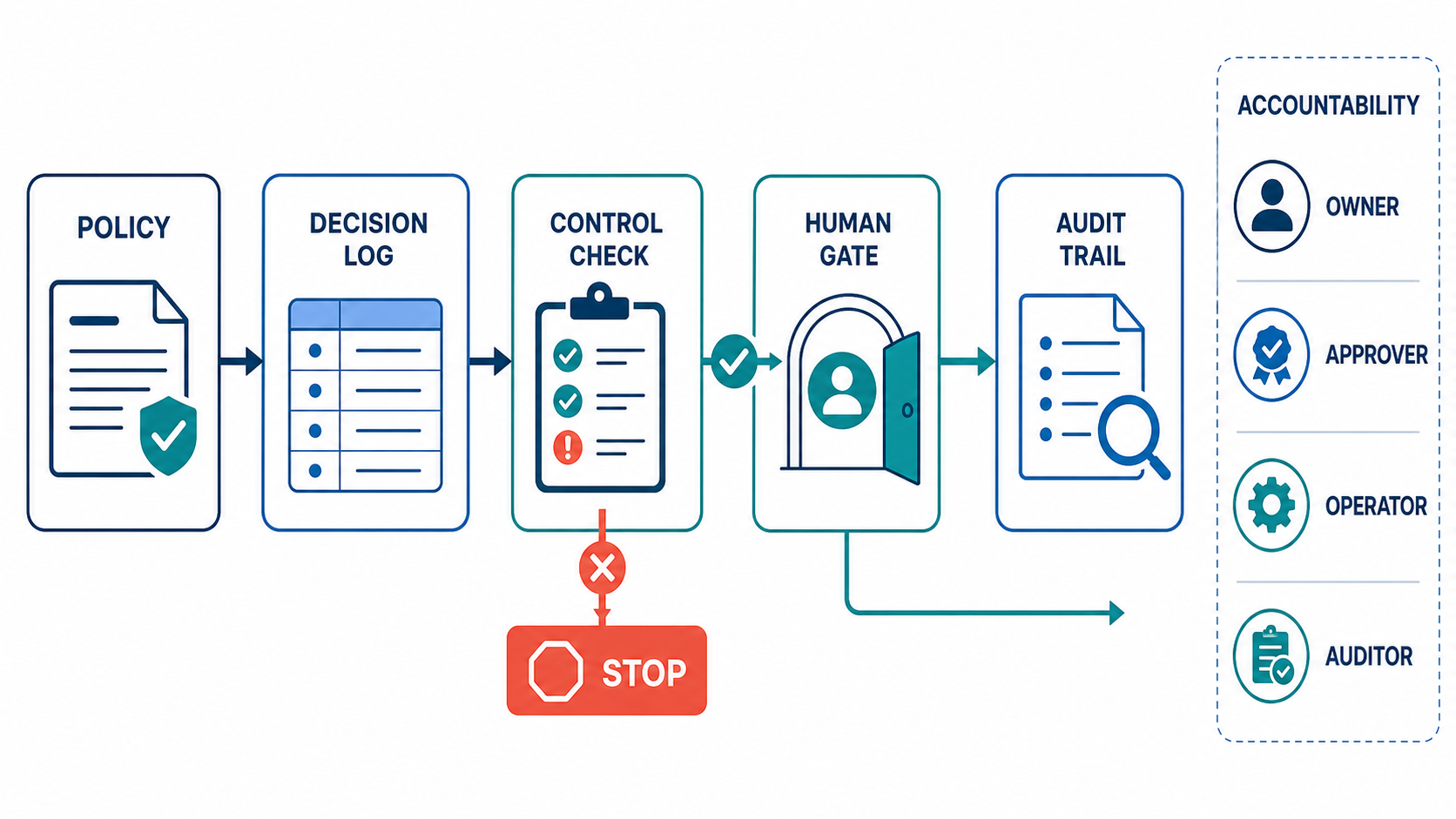
At the system level, separate at least four roles: business owner for purpose and outcome, technical owner for system behavior and change, operator for day-to-day monitoring, and approver for gated actions. One person can hold more than one role in a small team, but the decisions and responsibilities should remain clear and free of conflicts.
The Accountability TestIdentify the person who can stop a deployment. If multiple names are provided, or the answer is a forum rather than a person, score this dimension zero and address it before moving further through the assessment.
If this system produced an incorrect customer-facing output at 2 a.m. on a Sunday, whose phone would be called?
What Documentation should an AI System Have?
An AI system should have enough documentation for a new operator to understand its purpose, boundaries, dependencies, evidence, decisions, and failure response without relying on the memory of the original builder. Documentation is not simply a static report. It is the durable record that connects governance decisions to the running system.
At minimum, retain:
- System Record: Owner, purpose, users, model or vendor, version, data sources, tools, and environments.
- Context Record: Intended use, prohibited use, affected groups, assumptions, foreseeable misuse, and non-AI alternative.
- Risk Record: Identified risks, likelihood and impact reasoning, residual risk, treatment, and acceptance authority.
- Evaluation Record: Test set, thresholds, results, known limitations, red-team findings, and approval decision.
- Change Record: Model, prompt, retrieval, tool, data, policy, and workflow changes with impact assessment.
- Operations Record: Alerts, incidents, overrides, escalations, rollback, shutdown, and corrective actions.
NIST’s framework connects governance, mapping, measuring, and managing through documentation and communication. The EU Commission describes logging, documentation, human oversight, robustness, cybersecurity, and accuracy among the controls associated with high-risk AI systems, with applicability depending on the relevant provision and use case.
How do You Monitor AI Risks After Deployment?
Post-deployment monitoring should consider both system performance and the context surrounding the system. A model can maintain an acceptable benchmark score while the user population changes, the data distribution shifts, a vendor changes its behavior, a tool permission expands, or operators begin using the system outside its intended purpose.
NIST states that risk management should be continuous and timely throughout the lifecycle, and the MANAGE function includes prioritizing responses, documenting residual risk, and sustaining the value of deployed systems. Monitoring is therefore more than an uptime dashboard. It provides evidence that the approved operating boundary continues to hold.
Track at least five categories:
- Quality: Task success, groundedness, factual error, refusal behavior, and human correction.
- Safety and Security: Policy violations, prompt injection, data exposure, abuse, and unauthorized tool use.
- Fairness and Impact: Outcome differences, complaints, accessibility, and affected-group feedback where relevant.
- Operations: Latency, cost, tool errors, fallback rate, override rate, and incident response time.
- Context: Model or vendor changes, new data, new users, new jurisdictions, and changes in business purpose.
Define thresholds before deployment. An alert without an owner, severity, action, and stop path can create noise without producing a useful response. A mature system can pause a high-risk action, preserve the evidence, route the case to a named human, and record whether the control worked.
How does Governance Apply to Generative AI and Agents?
Generative AI and agents require governance at the action boundary, not only at the model boundary. The organization must govern what the system can generate, retrieve, remember, send, change, and delegate. As the number of tools and level of autonomy increase, it becomes more important to define permissions, approval gates, state ownership, and traceability.
NIST’s Generative AI Profile identifies risks such as confabulation, information integrity, data privacy, intellectual property, cybersecurity, and value-chain or component integration. It recommends pre-deployment and ongoing evaluation of risk-relevant capabilities and safety measures, along with policies for provenance and incident handling.
For agents, add explicit controls for:
- Tool Scope: Each agent receives only the tools and permissions required for its task.
- State: Durable business state has an authoritative owner outside the conversation.
- Handoffs: Transfers include the goal, constraints, evidence, authority, and pending decisions.
- Verification: Important outputs are checked before a downstream action.
- Human Control: Sensitive, irreversible, or high-impact actions require a defined approval path.
- Termination: Runs have budgets, depth limits, failure states, and shutdown behavior.
This is where governance meets architecture. Multi-Agent Orchestration: What It Costs and When to Pay covers coordination seams, while Human-in-the-Loop AI: Where the Approval Gate Belongs covers the human decision boundary.
Does an AI Governance Framework Make a Company Compliant?
No. An AI governance framework can organize evidence and controls, but it does not automatically make a company compliant with every law, contract, sector rule, or customer requirement. Compliance depends on the organization’s role, location, use case, data, system architecture, and the specific legal obligations that apply.
NIST AI RMF is voluntary. ISO/IEC 42001 is a management-system standard, and certification is a separate assurance activity. Both can improve consistency, accountability, traceability, and audit readiness, but neither provides a universal legal safe harbor.
The EU AI Act illustrates why these boundaries matter. The European Commission describes a risk-based approach with separate obligations for prohibited practices, general-purpose AI models, transparency-risk systems, and high-risk systems. Its official timeline states that transparency obligations under Article 50 apply from 2 August 2026, while certain high-risk obligations apply on later dates depending on the category. Those dates and duties are jurisdiction-specific and may change through amendments or guidance.
The practical approach is to maintain two linked records: a governance record that explains how the system is controlled, and a legal applicability record maintained with qualified counsel. Do not claim “NIST compliant” or “ISO compliant” when the evidence only shows that a team adopted selected practices from a framework.
How do You Start an AI Governance Program without Blocking Delivery?
Start with the systems that can create meaningful impact, rather than beginning with a company-wide policy rewrite. Build a small inventory, select one risk model, name owners, define a minimum evidence pack, and connect the controls to the delivery workflow. Governance becomes useful when it influences a real go/no-go decision and helps an operator respond to a real failure.
Use this sequence:
- Inventory: List deployed, piloted, purchased, and employee-used AI systems, including embedded vendor features.
- Triage: Classify use cases by affected people, autonomy, reversibility, data, tool access, and impact.
- Assign: Name a business owner, technical owner, operator, and approval authority for each material system.
- Define: Write the intended use, prohibited use, success metric, risk thresholds, controls, and stop path.
- Test: Create representative evaluations for quality, safety, privacy, security, and failure handling.
- Gate: Require evidence and approval appropriate to the risk tier before production use.
- Operate: Monitor outcomes, incidents, overrides, drift, vendor changes, and context changes.
- Improve: Review residual risk and update the system record after material changes or incidents.
NIST states that its Playbook is neither a checklist nor an ordered set of steps. This is a useful reminder for implementation: adopt the outcomes that fit the organization’s risk, then make them executable within the product and operating workflow. A concise evidence pack attached to a real release can be more useful than an extensive policy that no one consults.
What this Means in Practice
An AI governance framework is successful when it can answer, quickly and with evidence: what is this system allowed to do, who owns the decision, what did we test, what changed, and what happens if it fails?
The strongest starting point is not a universal score. It is an inventory with named accountability and a risk-linked control for every material use case. Make governance part of design, release, and operations, and it can support responsible scaling rather than becoming a review process that occurs only after the fact.
FAQ
0What is an AI Governance Framework in Simple Terms?
An AI governance framework is the operating model for making and reviewing AI decisions. It records which systems exist, what they are allowed to do, who owns them, what controls apply, what evidence is retained, and how the organization responds when performance, context, or risk changes.
1What are the Four Parts of the NIST AI RMF?
The NIST AI Risk Management Framework uses Govern, Map, Measure, and Manage. Govern establishes accountability and risk culture. Map defines context and impacts. Measure evaluates performance and risk. Manage prioritizes treatment, response, residual risk, and improvement. NIST describes the functions as iterative rather than a rigid checklist.
2What is the Difference between AI Governance and AI Compliance?
AI governance is the organization’s system for making, documenting, controlling, and monitoring AI decisions. Compliance is meeting applicable legal, regulatory, contractual, and policy obligations. A governance framework can create evidence that supports compliance work, but adopting NIST or ISO/IEC 42001 does not automatically satisfy every obligation.
3Who should Own AI Governance?
Leadership owns the organization’s risk tolerance and accountability structure. Each material AI system should also have a named business owner, technical owner, operator, and approval authority. Small teams can combine roles, but they should not hide ownership behind a committee or an unnamed “AI team.”
4How often should an AI Governance Framework be Reviewed?
Review it continuously through monitoring and whenever the system’s model, data, users, tools, purpose, vendor, jurisdiction, or risk changes. NIST treats AI risk management as a lifecycle activity. A fixed annual review can be one checkpoint, but it should not be the only trigger for reassessment.
5Does Every AI Use Case Need the Same Controls?
No. Controls should be proportionate to context and potential impact. A low-impact internal summarizer may need basic access, quality checks, and logging. A system that affects people or can take irreversible actions needs stronger evaluation, restricted permissions, human oversight, incident response, and documented approval.
Not Sure Where Your Gaps Are?
Scoring the rubric is fast when documentation exists. Finding out why it does not exist is usually where the real work starts. That conversation is what an engagement with Realisier Labs begins with.