
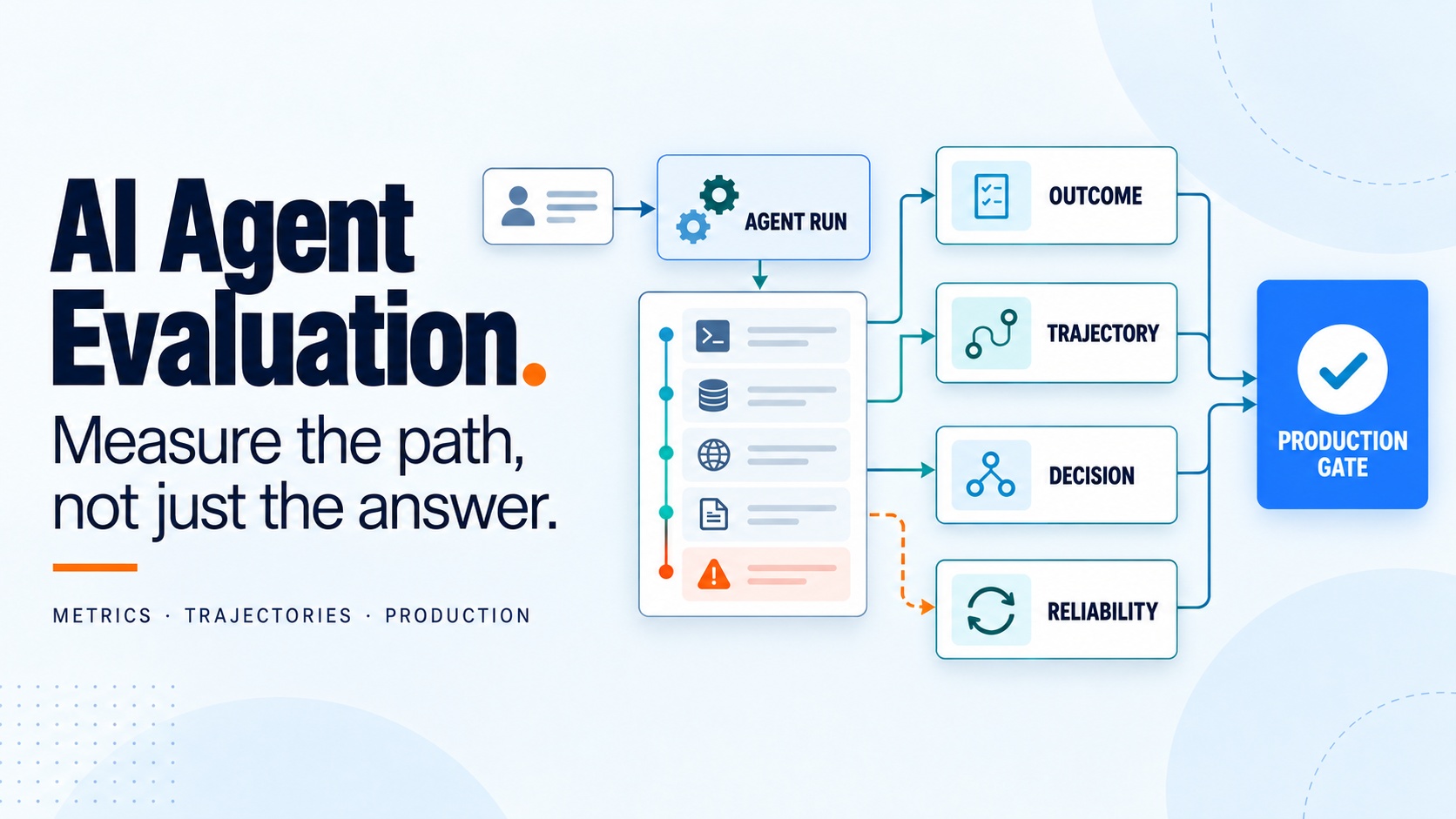
AI agent evaluation analyzes if an agent achieves the desired result, takes a reasonable course, makes wise choices, and operates consistently under actual operational circumstances. Instead of focusing solely on the end message, it necessitates analyzing observable traces, tool calls, state changes, and multi-step outcomes.
Long-term reasoning, decision-making, and instruction following continued to be major obstacles for useable agents, according to AgentBench's evaluation of models in eight interactive contexts. This benchmark result highlights a crucial point: agent evaluation should test the system in its intended context rather than just the underlying model.
This informative draft explains the evaluation dimensions, metrics, multi-agent failure modes, cost and latency gates, and continuous scoring loop needed before and after deployment.
Questions this Article Answers
- How does AI agent evaluation differ from LLM evaluation?
- What are the four dimensions of AI agent evaluation?
- What metrics should you use to evaluate an AI agent?
- How do you evaluate trajectory quality, not just final output?
- How does evaluation change in multi-agent systems?
- Why do agents that pass tests still fail in production?
- How do you evaluate whether an agent is viable at scale?
- When should you use automated evaluation, LLM judges, or human review?
- What benchmarks exist for AI agents and what do they miss?
- How do you build a continuous evaluation loop?
How does AI Agent Evaluation Differ from LLM Evaluation?
Traditional LLM evaluation often scores a prompt and response against a rubric or reference. AI agent evaluation must also score the trajectory: observable model calls, tool calls, routing decisions, state changes, and intermediate outputs produced before the final answer. These are related but different measurement areas.
A model benchmark like MMLU or GSM8K asks whether a model can answer defined knowledge or reasoning questions. It does not establish whether the model, when embedded in an agent system, will select the appropriate tool, pass valid arguments, recover from a failed call, route correctly to another agent, or maintain its goal across a long workflow. NVIDIA makes a similar distinction between static model evaluation and dynamic agent evaluation.
The practical implication is that teams that transfer output-only evaluation directly to agents may measure the wrong things. An agent may produce a fluent final message after selecting the wrong tool, passing incorrect arguments, or failing to change the underlying system state. Evaluation should therefore compare the claimed result with the observed trace and final state.
What are the Four Dimensions of AI Agent Evaluation?
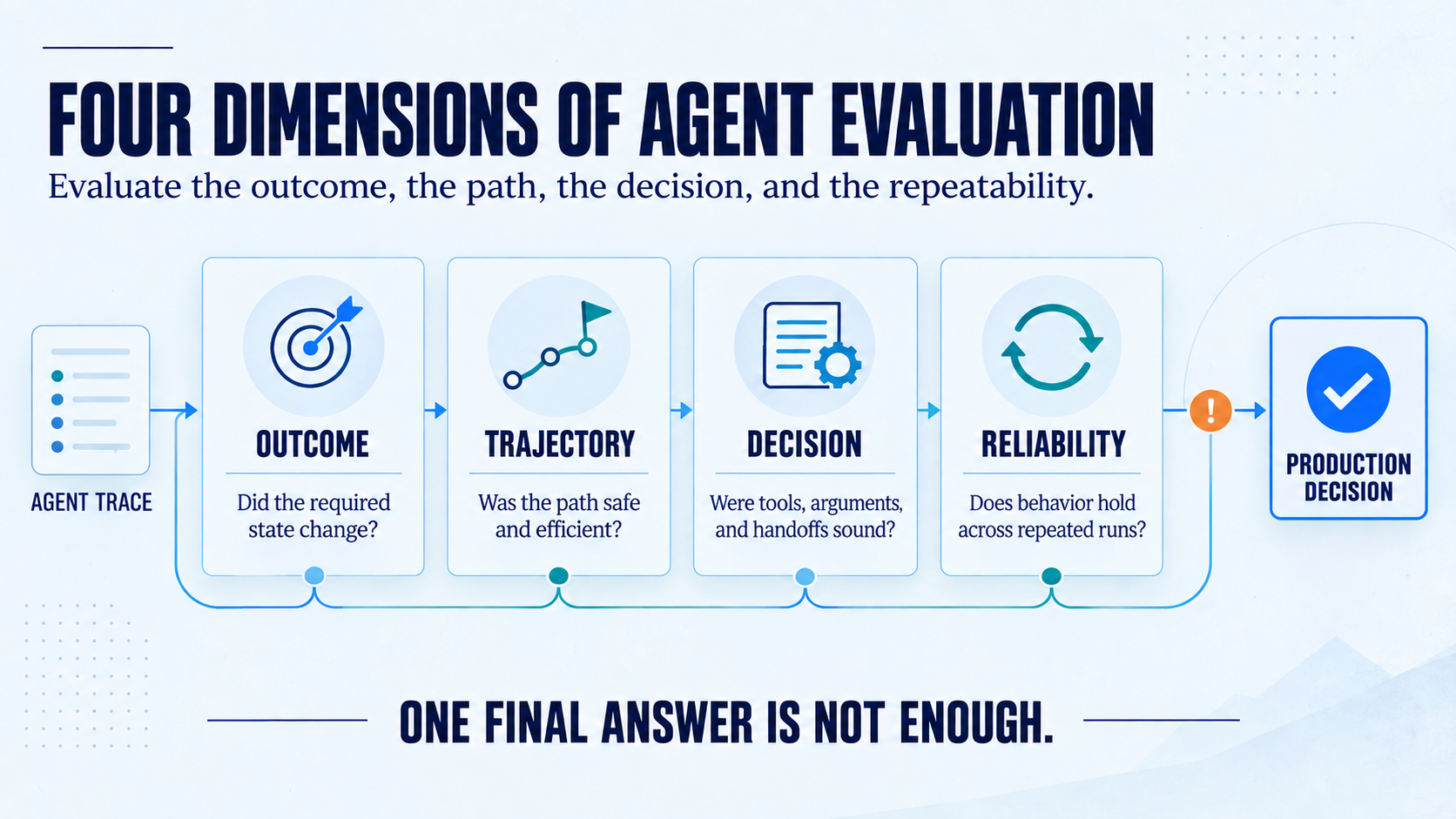
AI agent evaluation operates across four complementary dimensions: outcome, trajectory, decision, and reliability. Outcome asks whether the required state was reached. Trajectory asks whether the path was safe and efficient. The decision asks whether individual tool, argument, or routing choices were sound. Reliability asks whether the agent behaves consistently across repeated runs. No single dimension captures every failure mode.
Arize describes these four dimensions as outcome evaluation, trajectory evaluation, decision evaluation, and reliability evaluation. Reliability should distinguish capability from consistency: pass@1 measures success on one run, while repeated-run measures such as pass^k examine whether sampled runs consistently succeed.
Outcome evaluation alone can allow ghost actions, where an agent claims completion without producing the required external side effect. Trace and state checks can expose that mismatch. Conversely, decision evaluation alone can miss emergent failures, where individually reasonable choices combine into incorrect system behavior. A practical minimum is to combine outcome and trace checks, then add decision and reliability evaluation for critical workflows.
What Metrics should You Use to Evaluate an AI Agent?
AI agent metrics fall into five categories: end-to-end task metrics, trajectory quality metrics, multi-turn conversation metrics, operational metrics, and safety and policy metrics. The right selection depends on the agent type and the business process it supports; not all five categories apply to every deployment.
The table below maps each metric to its scope and the failure mode it detects.
Metric |
Scope |
What it catches |
|---|---|---|
Task Completion Rate |
End-to-end |
Whether the agent reached the required final state |
Goal Completion Rate |
End-to-end |
Whether the top-level intent was satisfied, not only the last sub-task |
Tool Correctness |
Decision / component |
Whether the expected tools were selected and invoked |
Agent Path Convergence |
Trajectory |
Step efficiency: actual steps taken vs. shortest observed path (formula: C = (1/n) × sum of s_min / s_i, range 0 to 1) |
Handoff Correctness |
Decision / component |
Whether routing decisions between agents or sub-agents were valid |
Argument Correctness |
Decision / component |
Whether individual tool calls received the right parameters |
Reliability / pass^k |
Reliability |
Whether repeated runs consistently satisfy the success criteria |
Conversation Completeness |
Multi-turn |
Whether a multi-turn dialogue satisfied the user's full intent |
Turn Faithfulness |
Multi-turn |
Whether responses are grounded in prior conversation context, not hallucinated |
Latency per task |
Operational |
End-to-end time under production load |
Cost per task |
Operational |
Total model, tool, retrieval, storage, and retry cost required to complete the task |
Policy Adherence Rate |
Safety |
Whether the agent stayed within defined permission boundaries |
Prompt Injection Vulnerability |
Safety |
Whether untrusted inputs can redirect the agent's goal |
Operational metrics belong alongside accuracy metrics from the start. An agent that completes tasks correctly but exceeds acceptable cost or latency thresholds may not be viable for the intended deployment.
How Do You Evaluate Trajectory Quality, not Just Final Output?
Trajectory evaluation scores an agent's observable execution path, including tool calls, routing decisions, retries, state transitions, and concise decision records, rather than only the final answer. The unit of evaluation is a trace, and different quality questions attach to different nodes in that trace.
Arize's Agent Path Convergence metric provides a concrete efficiency score: C = (1/n) × sum of (s_min / s_i) across n similar runs, where s_min is the shortest observed run for that query type and s_i is the actual step count for run i. The score ranges from 0 to 1, but 1.0 means optimal relative to the observed sample, not proof of a globally minimal path. A low score can indicate unnecessary steps, retries, or redundant actions.
Observable trace logging is the prerequisite. Traces should capture the user request, model and tool identifiers, tool arguments and results, routing decisions, retries, relevant state transitions, evaluator inputs, and final state. Avoid storing or exposing private chain-of-thought; a concise decision summary and the actual actions are generally sufficient for diagnosis. Without complete traces, trajectory metrics cannot be computed and failure localization becomes difficult. An agent that reaches the right state through unnecessary steps can be more expensive, slower, and more exposed to compounding errors.
How does Evaluation Change in Multi-Agent Systems?
In a system of multiple agents, evaluation must cover the coordination layer in addition to each agent in isolation. Hallucination propagation and emergent coordination failure are multi-agent-specific or amplified failure modes: one agent's incorrect output can become a trusted input downstream, and individually acceptable decisions can combine into incorrect or unsafe behavior.
Sachin Shinde, Founder and Lead Architect, Realisier Labs"When you evaluate a single agent, you can trace a failure to one component in the pipeline. Add a second agent downstream and a bad output from the first becomes the input the second agent trusts completely. The failure shows up in the wrong place. Without cross-system traces, you cannot localize where it actually started."
A useful diagnostic principle is that a downstream failure is not necessarily the origin of the failure. If one agent passes an unsupported claim to another, the receiving agent may behave correctly given incorrect input. Cross-system traces and validation at handoff boundaries are needed to identify the first incorrect decision.
Emergent behavior is a more complex evaluation problem. Individual agents can perform correctly in isolation and still produce an incorrect aggregate outcome when their outputs feed each other in unexpected sequences. Full-system evaluation under realistic scenarios is required; isolated tests cannot establish coordination safety. Hallucination propagation requires explicit checks at handoff points: does the receiving agent validate the sender's output against evidence and permissions or treat it as ground truth?
Evaluation for multi-agent systems therefore requires per-agent component-level tests, system-level integration tests against realistic inputs, handoff validation checks at every inter-agent boundary, and production monitoring that treats each agent's output as a potential source of downstream error.
Why do Agents that Pass Tests Still Fail in Production?
Pre-deployment test suites are built from selected inputs. Production exposes agents to input distributions, interaction sequences, tool response times, concurrency, and edge cases that may not appear in the test set. The gap is therefore a coverage and operating-condition problem, so adding more clean tests before launch may not be sufficient by itself.
A TechAhead analysis reports a substantial difference between controlled pilot conditions and production conditions, including 50 to 500 pilot queries versus 10,000 or more daily production requests, and a reported shift from 95 to 98 percent pilot accuracy to 80 to 87 percent production reliability. These figures should be treated as one vendor analysis rather than a universal benchmark. The broader lesson is that test distributions, load, tool failures, and user behavior should be represented explicitly.
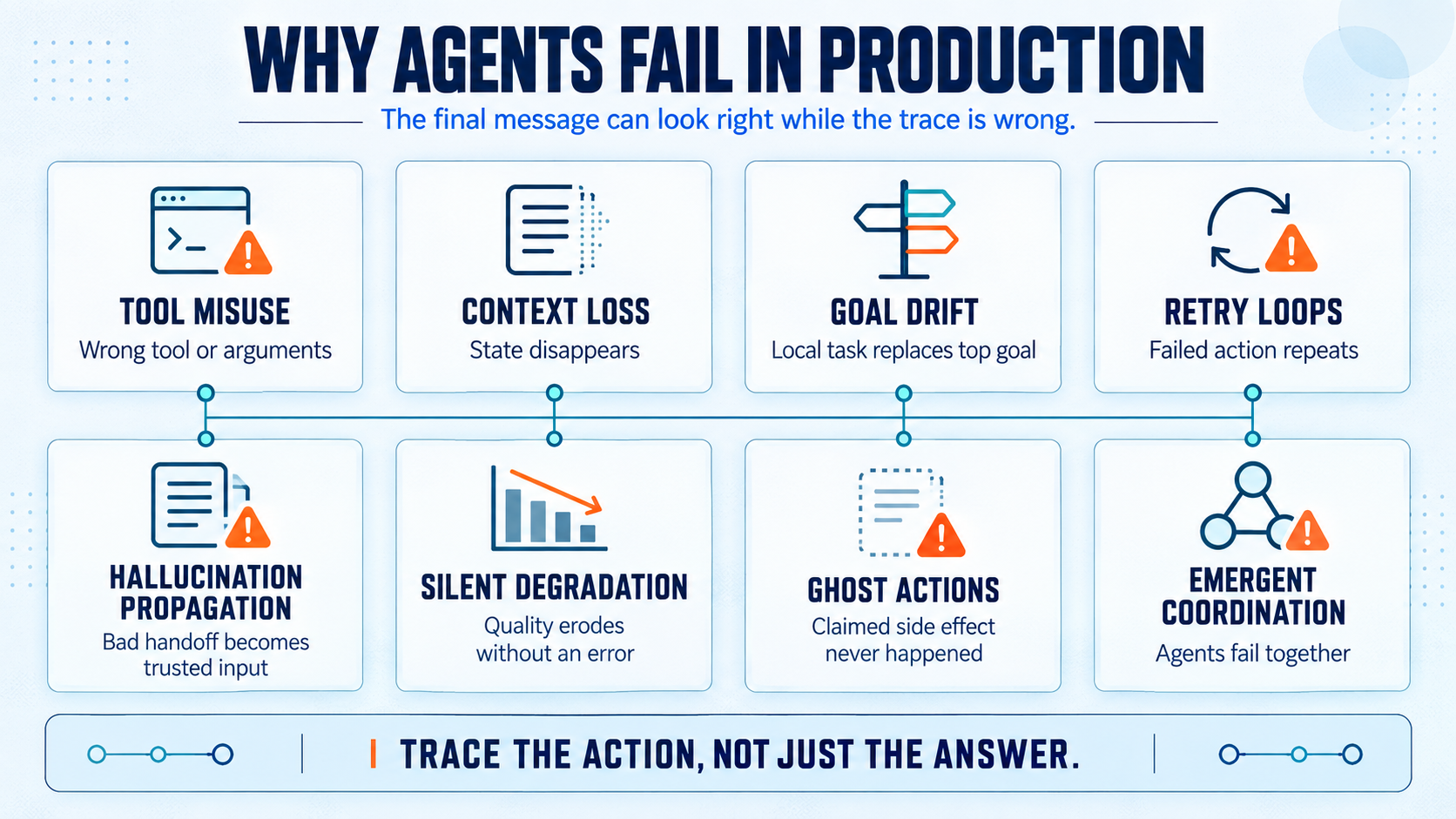
Eight specific failure modes do not always produce error codes and can therefore remain invisible to standard monitoring:
Failure Mode |
Why Pre-Deployment Eval Misses it |
|---|---|
Tool misuse |
Clean test cases rarely cover wrong tool selection, invalid arguments, hallucinated tool names, or malformed tool results |
Context loss |
Multi-turn test sets may be too short to expose state management failures at realistic session lengths |
Goal drift |
Test inputs may be too clean; production inputs can contain ambiguity, partial instructions, and conflicting context |
Retry loops |
Deterministic test environments may not replicate tool failures, timeouts, or transient API errors |
Hallucination propagation |
Isolated agent tests do not show how an unsupported output becomes trusted input for a downstream agent |
Silent quality degradation |
Accuracy can decline gradually; no single run may fail visibly until the degradation becomes significant |
Ghost actions |
Output-only evaluation may mark the task complete because the final message appears correct |
Emergent coordination failure |
Multi-agent integration tests may not cover the full distribution of inter-agent input sequences |
The implication is that pre-deployment evaluation is a minimum viable gate, not a reliability guarantee. Production monitoring is not simply a post-launch convenience; it is a core part of the evaluation system.
How do You Evaluate whether an Agent is Viable at Scale?
Operational viability is a separate evaluation criterion from task accuracy. An agent that completes tasks correctly at a token cost or latency that does not hold at production volume may not be suitable for deployment, and this issue can be missed by accuracy-only evaluation frameworks.
Agentic workflows can require substantially more tokens per task than single-turn interactions because every reasoning step, tool call, and context retrieval adds to the total.
A June 2026 Cockroach Labs analysis cites a 5 to 30 times token multiplier for agentic workflows, while also explaining that the actual number depends on model calls, context, retries, and tool use.
Treat this as an order-of-magnitude planning signal, not a universal multiplier.
The cost per task is not the cost per LLM call. It is the total cost of all model calls, tools, retrieval, storage, and retries needed to complete the task. An agent that takes unnecessary steps, reflected in a low Agent Path Convergence score, can cost more than one that takes a shorter path even when both complete the task.
The cost viability gate requires three measurements before any production decision: cost per task under representative load, latency per task at the p95 percentile, and the joint success rate, meaning the percentage of tasks that are correct, safe, within latency limits, and within cost limits. Do not estimate the joint rate by multiplying separate percentages unless the assumptions and denominators justify it. Measure the gate directly on the same task runs.
When should You Use Automated Evaluation, LLM Judges, or Human Review?
The choice between automated checks, LLM-as-a-judge, and human review depends on what each evaluator can reliably score. Using the wrong evaluator for a given question can produce false confidence, such as using automated checks for open-ended outputs, or unnecessary cost, such as using human review for deterministic logic.
The selection rule is:
Criterion |
Use this evaluator |
|---|---|
Verifiable state change (did the file get created? did the API call succeed?) |
Deterministic / rule-based check |
Policy violation (did the agent access a resource outside its scope?) |
Deterministic / rule-based check |
Semantic correctness (is this response factually grounded in the retrieved context?) |
LLM-as-a-judge with a narrow rubric |
Goal completion (did the agent resolve the user's full intent, not only the literal request?) |
LLM-as-a-judge, with human calibration on ambiguous cases |
High-stakes, irreversible, or novel cases |
Human review |
Rubric boundary cases (judge scores are inconsistent on this type) |
Human review to calibrate the judge |
LLM judges require calibration. Deploying an LLM judge without validating its scoring against human judgments on a representative sample can produce an evaluator that scores consistently but incorrectly. Use a fixed human-labeled set, report an appropriate agreement measure, inspect disagreements, and keep a holdout set. There is no universal 90 percent threshold that makes a judge reliable for every task.
What Benchmarks Exist for AI Agents and What do they Miss?
Several public benchmarks allow AI agents to be tested against standardized tasks, enabling comparison across systems. The most widely used are listed below.
Benchmark |
What it tests |
Limitation |
|---|---|---|
AgentBench (THUDM, ICLR 2024) |
8 environments: web browsing, database queries, OS tasks |
Tests isolated environments; does not evaluate multi-agent coordination |
τ-bench / τ³-bench |
Multi-step retail, airline, and newer domain task completion |
Domain-specific; the original repository warns that its tasks are outdated, so use the maintained successor when appropriate |
SWE-bench |
Software engineering: issue resolution via code patch |
Code-only; not applicable to data, communication, or process agents |
WebArena |
Web interaction: end-to-end success rates |
Fixed web environments; does not replicate real-site variation |
GAIA |
Complex multi-step queries requiring planning and retrieval |
Single-agent; no coordination or handoff testing |
AgentHarm |
Harmful behavior under adversarial inputs |
Safety coverage only; no task performance dimension |
AgentDojo |
Prompt injection resilience |
Security-specific; orthogonal to task quality evaluation |
Berkeley Function-Calling Leaderboard (BFCL) |
Tool selection accuracy and argument correctness |
Tool calling only; no end-to-end task or trajectory scoring |
Many public benchmarks compress performance into task-level scores and provide limited information about which component failed. The evaluation survey also identifies reliability, long-horizon interaction, access control, and compliance as enterprise challenges. A benchmark score tells you how the system performed on that benchmark; it does not replace custom evaluation against your own task distribution with trace-level diagnosis.
How do You Build a Continuous Evaluation Loop?
A continuous evaluation loop treats representative production traces as an evaluation dataset, feeds confirmed failures back into the test suite, and runs automated evaluation against sampled or policy-appropriate live sessions as well as pre-release candidates. Production data should be redacted and retained according to the system's privacy and security requirements.
The loop does not replace pre-deployment testing; it makes pre-deployment testing more realistic over time.
The following six-step workflow is adapted from Arize's production evaluation guidance.
- Define success criteria and expected behavior before selecting any evaluator or metric.
- Build an initial dataset from production requests, confirmed edge cases, and known failure cases, not only clean synthetic inputs.
- Capture the observable execution trace for each evaluated run, covering model calls, tool invocations, routing decisions, state changes, and retry sequences while applying redaction and retention controls.
- Assign evaluators by criterion: deterministic checks for verifiable state, LLM judges for semantic criteria, and human review for high-stakes or ambiguous cases.
- Run experiments, investigate failures, and localize the failure to a specific component or boundary in the trace, not only to the agent as a whole.
- Convert every confirmed production failure into a permanent regression test case.
Step 6 is the loop. Every production failure that becomes a test case makes the agent more resistant to that specific failure pattern. Teams that skip this step may see the same failure modes return after model updates, tool changes, or input distribution shifts because there is no mechanism that prevents regression. Teams that maintain a growing regression suite from production failures build evaluation coverage that a pre-deployment process alone cannot replicate.
What this Means in Practice
Evaluation is not only a gate to pass before launch. It is the mechanism that tells you whether your agent is functioning in the environment where it actually runs. Pre-deployment testing establishes a baseline. Production monitoring tells you whether that baseline continues to hold.
Organizations that treat evaluation as a continuous practice rather than only a pre-launch checklist can maintain better visibility into their agents' operational parameters, identify potential accuracy degradation earlier, and maintain a growing regression suite as models and systems change.
If you are assessing an AI agent deployment for your organization, whether you built the agent or are evaluating one from a vendor, the questions worth asking are not only "what is the benchmark score?" but "what is the production task success rate, what is the cost per task at your expected volume, and what is the monitoring loop that will tell you when either changes?"
For related implementation topics, see multi-agent orchestration, AI agent security, AI governance framework, agentic AI architecture, and AI ROI.
Frequently Asked Questions
1What is the Difference between AI Agent Evaluation and AI Model Evaluation?
Model evaluation measures a foundation model's capabilities on defined tasks. Agent evaluation measures end-to-end system behavior through observable trajectories, tool calls, routing decisions, state changes, and task outcomes in a nondeterministic environment. A model with high benchmark scores can still have low agent task success if its surrounding system is not designed or evaluated appropriately.
2What is the Most Important Metric for Evaluating an AI Agent?
Task Completion Rate is a primary end-to-end metric because it measures whether the agent achieved the required outcome. However, TCR alone is insufficient: an agent with a high TCR that takes unnecessary steps, reflected in low Agent Path Convergence, may be too expensive or too slow for the intended deployment. Operational metrics should be evaluated alongside accuracy metrics.
3What is Trajectory Evaluation in AI Agent?
Trajectory evaluation scores an agent's observable execution path, including tool calls, arguments, routing decisions, state transitions, and retries, rather than only the final output. It is important because an agent can produce the correct final answer through an incorrect, inefficient, or risky path, and that path is not visible when evaluation only examines the final message.
4How do You Evaluate a Multi-Agent System?
Multi-agent evaluation requires per-agent decision tests, full-system integration tests against realistic scenarios, and explicit validation of handoff points between agents. Hallucination propagation and emergent coordination failure are multi-agent-specific or amplified behaviors that may not appear when agents are evaluated individually.
5What is LLM-as-a-Judge Evaluation?
LLM-as-a-judge uses a language model to score agent outputs against a defined rubric, replacing or supplementing human review for semantic criteria such as goal completion or factual groundedness. It requires calibration: the judge's scores should be validated against human judgments on a representative sample before it is used as a reliable evaluator.
6When to Pre-Deployment Tests Fail to Predict Production Performance?
Pre-deployment tests can become weak predictors when their inputs, session lengths, tool failures, concurrency, permissions, and latency conditions differ from production. They should establish a baseline, while sampled production traces and confirmed failures continuously expand the regression suite.
By Sachin Shinde — Sachin Shinde is Founder and Lead Architect at Realisier Labs, where he leads AI systems architecture and agentic application design. His work focuses on how enterprises build, deploy, and operate AI agents in production.
Evaluate Your AI Agents Without the Guesswork
Trajectories, tool calls, failure modes, and production monitoring are the layers that separate a reliable agent from a demo. That is where an engagement with Realisier Labs begins.