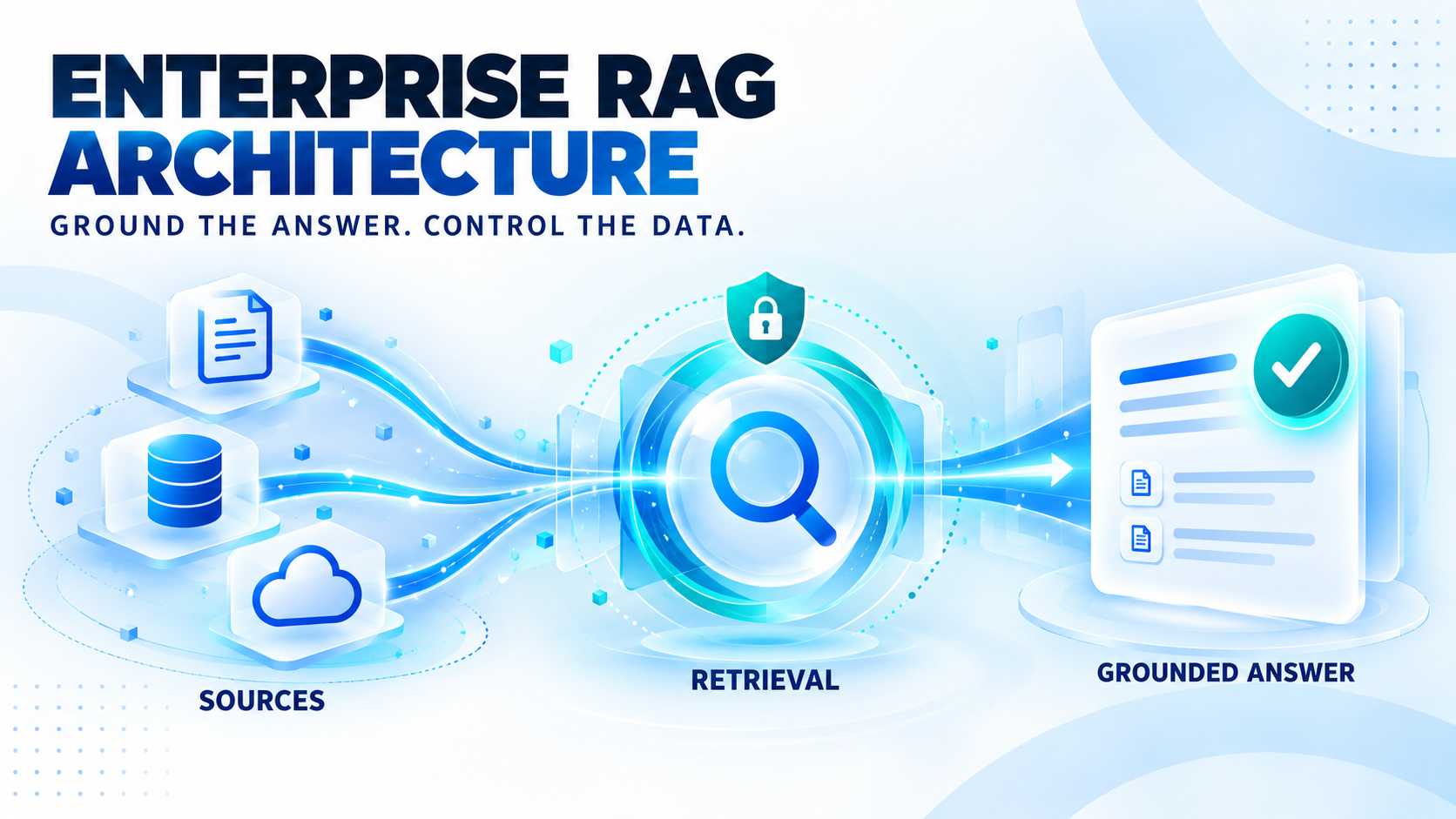
Enterprise RAG (Retrieval-Augmented Generation) architecture is a production system that consumes governed company knowledge, obtains pertinent and authorized context, produces a traceable response, and assesses the accuracy of the outcome. Permissions, document freshness, retrieval evaluation, output validation, observability, and rollback should all be included in the architecture in addition to embeddings and a vector database.
In its 2020 design, the original RAG study reported state-of-the-art performance on three open-domain question-answering tasks by combining the parametric memory of a language model with a non-parametric retriever over an external index. A more stringent criterion is added by enterprise systems: the response must be helpful without disclosing information that the requester is not permitted to access.
By the end of this guide, you will have a blueprint for choosing the ingestion, retrieval, security, evaluation, and release controls that fit your data and query patterns.
Questions this Article Answers
- What is enterprise RAG architecture?
- What components belong in an enterprise RAG system?
- How should enterprise RAG separate ingestion and serving?
- How should enterprise documents be parsed and chunked for RAG?
- Should enterprise RAG use vector, keyword, or hybrid search?
- How do you preserve permissions in enterprise RAG?
- How do you evaluate enterprise RAG retrieval and answers?
- When is GraphRAG better than baseline RAG?
- How do you handle freshness, deletion, and versioning?
- How do you defend RAG against poisoning and prompt injection?
- What belongs in an enterprise RAG release gate?
- Should an enterprise use managed or custom RAG architecture?
What Is Enterprise RAG Architecture?
Enterprise RAG architecture is the set of data, retrieval, model, security, and operating controls that allow an AI application to answer from company knowledge in production. The system retrieves external context at request time and applies the requester's access boundary, generates an answer from that context, and records enough evidence to investigate the result.
The useful distinction is between a RAG demo and an enterprise RAG system:
|
RAG Demo |
Enterprise RAG System |
|---|---|
|
A folder is embedded once |
Sources, ownership, permissions, versions, and deletions are managed |
|
One vector search produces context |
Retrieval uses filters, multiple signals, and often reranking |
|
The model returns an answer |
The application validates grounding, citations, policy, and task state |
|
Quality is judged by a few examples |
Retrieval and generation are evaluated on representative failure cases |
|
A prompt is edited in place |
Prompts, index versions, models, tools, and evaluators are versioned |
AWS describes the baseline RAG flow as document preparation, user query, similarity retrieval, and generation. Google Cloud separates the same architecture into ingestion and serving subsystems. The enterprise extension is the control layer around both paths: identity, governance, testing, telemetry, and recovery.
What Components Belong in an Enterprise RAG System?
An enterprise RAG system has five connected planes: source systems, ingestion, retrieval, generation, and governance. Source systems hold the authoritative content. Ingestion parses, classifies, chunks, embeds, and indexes it. Retrieval finds evidence. Generation turns permitted evidence into a response. Governance controls identity, quality, auditability, and recovery across the entire path.
|
Plane |
Main Responsibility |
Failure when Omitted |
|---|---|---|
|
Source |
Identify the systems of record and content owners |
The index becomes a second, stale source of truth |
|
Ingestion |
Parse, normalize, classify, version, and index content |
Tables, headings, permissions, or deletions disappear |
|
Retrieval |
Search, filter, rerank, and cite evidence |
The model receives irrelevant or unauthorized context |
|
Generation |
Follow instructions and answer from evidence |
The response is fluent but unsupported or incomplete |
|
Governance |
Evaluate, monitor, audit, and recover |
The team cannot prove quality or contain failure |
The planes do not need to be separate products. They do need separate responsibilities. A single platform can host them, but an application should still be able to identify which source produced a chunk, which identity was authorized to retrieve it, which model generated the answer, and what test supported the release.
How Should Enterprise RAG Separate Ingestion and Serving?
Separate ingestion from serving so document preparation can change without making the user-facing query path responsible for indexing work. Ingestion is an asynchronous data pipeline. Serving is a low-latency request path that authenticates the user, constructs retrieval filters, selects evidence, calls the model, validates the result, and returns citations.
Google Cloud's reference architecture explicitly separates data ingestion from serving. Its ingestion flow receives external data, prepares metadata, parses and chunks content, and builds a searchable index. Its serving flow accepts a query, preprocesses it, retrieves indexed data, and generates a grounded response.
The separation creates useful operational boundaries:
- A document update can be retried without blocking user queries.
- Index builds can be versioned and tested before promotion.
- Serving can reject stale or incomplete indexes instead of silently using them.
- Access filters can be computed from the authenticated request rather than stored in a prompt.
- Ingestion failures can be measured separately from retrieval failures.
The serving path should never assume that an index is current merely because a document upload succeeded. It should know the index version, source timestamp, and ingestion status relevant to the request.
How Should Enterprise Documents Be Parsed and Chunked for RAG?
- Parse documents according to their structure before splitting them into retrieval units.
- Preserve headings, paragraphs, tables, captions, source identifiers, dates, owners, and permissions as metadata.
- A chunk should be large enough to contain a useful idea and small enough to retrieve precisely. Fixed character windows are a fallback, not an architecture.
- Microsoft's document-layout guidance describes structure-aware chunking that preserves headings and uses paragraphs and sentences to maintain semantic coherence.
- It also shows how tables can be represented as Markdown before vectorization.
The general rule is portable: retrieval quality depends on the evidence unit, not only on the embedding model.
Each chunk should carry at least:
- Stable document and chunk identifiers, source URL or system-of-record reference
- Heading path and document title
- Owner, department, tenant, and classification
- Effective date and last-modified date
- Document version and ingestion run
- Deletion or supersession state
- Permission attributes used during retrieval
Do not treat a chunk as an anonymous string. It is a governed record that happens to contain text and an embedding. If the source document changes, the index needs a deterministic way to replace or retire the affected chunks.
Should Enterprise RAG Use Vector, Keyword, or Hybrid Search?
Use the retrieval method that matches the query, and default to hybrid search when enterprise content contains both natural-language concepts and exact identifiers. Dense retrieval is strong at meaning. Keyword retrieval is strong at names, product codes, policy numbers, dates, and proprietary terms. A reranker can then improve precision over a smaller candidate set.
Azure AI Search documents a hybrid query that runs full-text and vector search in parallel, then merges results with Reciprocal Rank Fusion. Its guidance identifies BM25 for text retrieval and HNSW, or exhaustive nearest-neighbor search for vectors. Google Cloud makes the same architectural point: semantic search can miss newly created codenames, SKUs, or out-of-domain terms that keyword search can find.
|
Query Shape |
Useful First Retrieval Path |
Why |
|---|---|---|
|
“What is our parental leave policy?” |
Dense or hybrid |
The user may not use the document's exact wording |
|
“What changed in policy HR-204?” |
Keyword or hybrid |
The identifier must match exactly |
|
“Which accounts mention Project Cedar?” |
Hybrid with metadata filters |
Names and access boundaries matter |
|
“What themes appear across these reports?” |
Graph, map-reduce, or corpus summarization |
The question is global, not one-fact retrieval |
|
“What is the approved exception for this customer?” |
Filtered hybrid plus reranking |
Precision and authorization matter together |
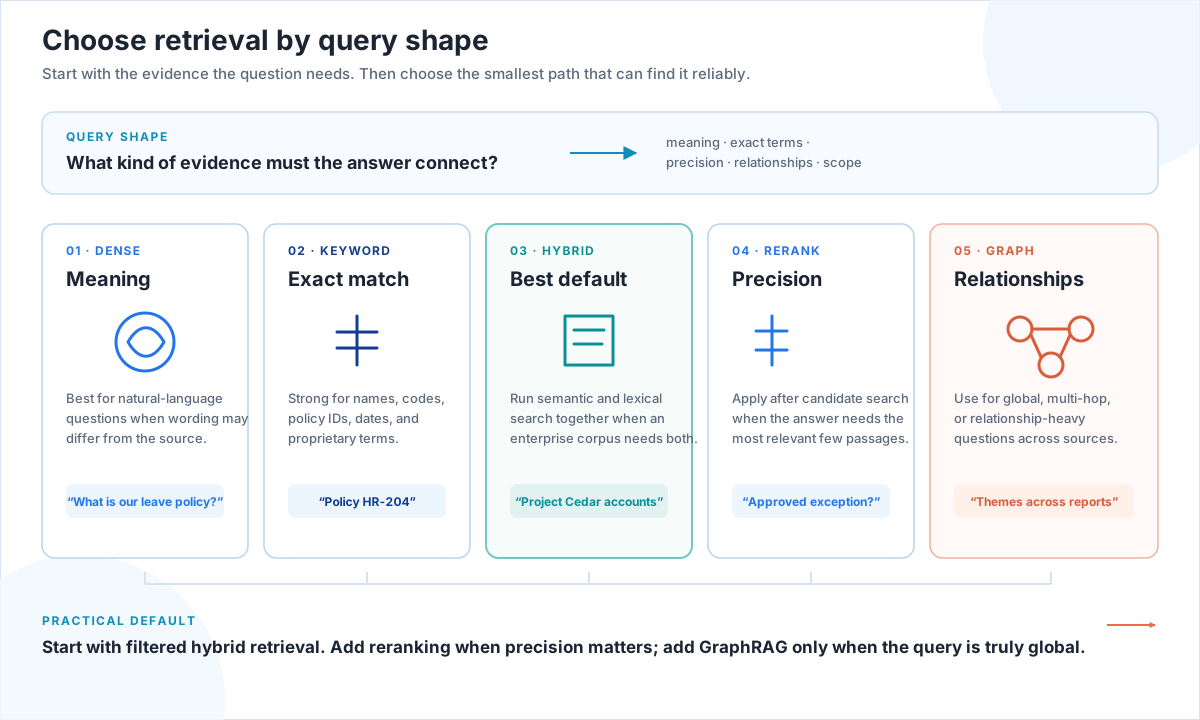
Do not choose a vector database first and design retrieval around its default settings. Start with representative queries, label the evidence that should be found, and test the retrieval paths against those queries.
How Do You Preserve Permissions in Enterprise RAG?
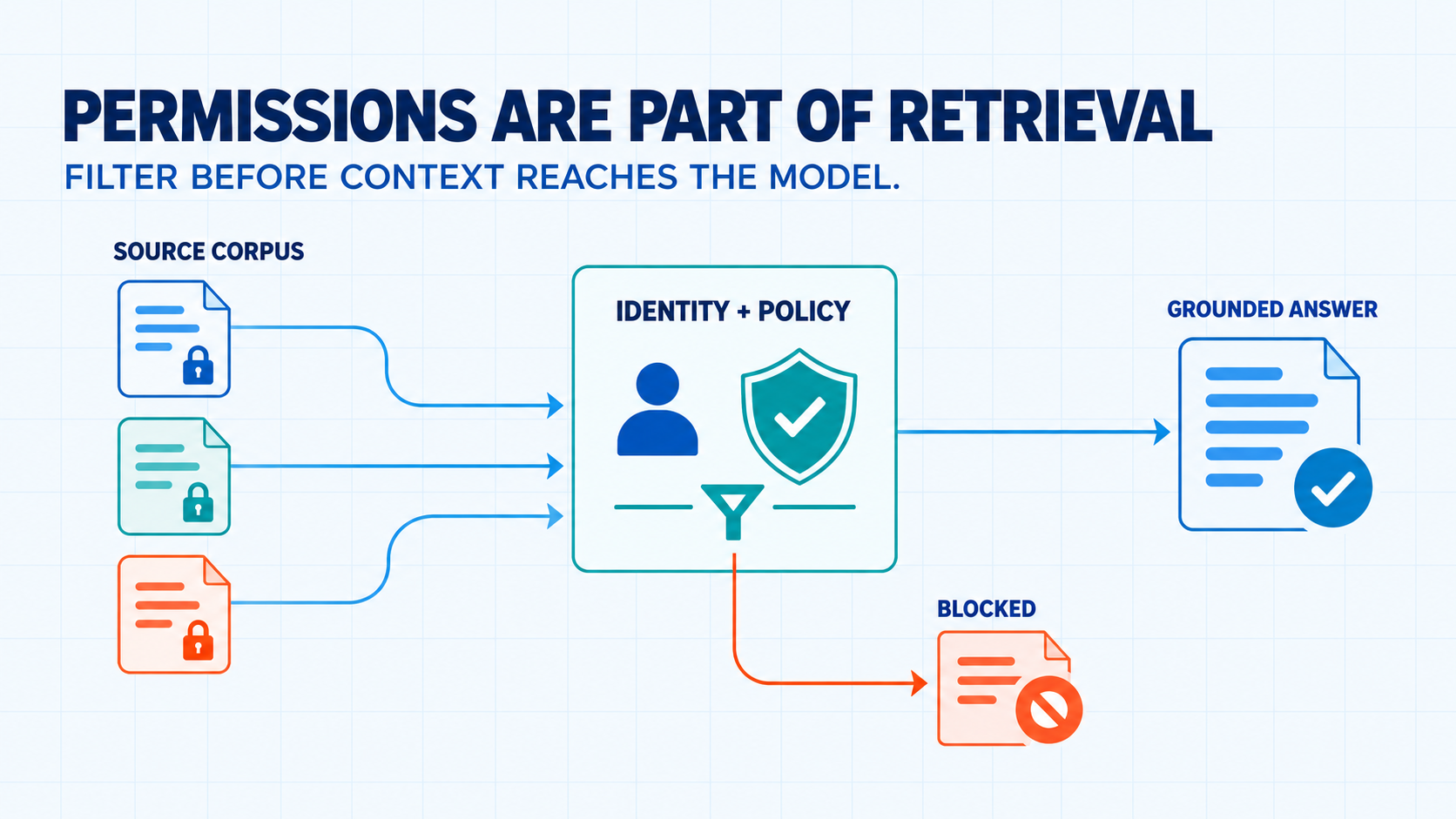
Enforce permissions before or during retrieval, using the authenticated user's identity and the access metadata carried by every chunk. A model should never receive restricted context and then be asked to hide it. Post-generation filtering cannot reliably undo a disclosure that already entered the prompt or influenced the answer.
AWS security guidance describes metadata filtering for department, role, classification, project, tenant, and time-based restrictions. OWASP's RAG security guidance makes the same control explicit at the chunk level: document permissions need to survive chunking and embedding, and query-time boundaries should prevent cross-tenant retrieval.
The minimum permission path is:
- Authenticate the requester and resolve effective roles, tenant, and data scope.
- Translate that identity into retrieval filters or an authorized search namespace.
- Apply the filter before similarity ranking exposes candidates.
- Log the identity, filter, index version, and source identifiers used.
- Re-check source permissions when documents are changed or access is revoked.
- Test cross-tenant and cross-classification queries as negative cases.
The most serious design weakness is a shared flat index with no per-chunk authorization metadata. A system can be accurate and fast while still creating a security failure if it retrieves the wrong person's document.
How Do You Evaluate Enterprise RAG Retrieval and Answers?
Evaluate retrieval and generation as separate but connected systems. First test whether the right evidence was retrieved. Then test whether the answer used that evidence faithfully and answered the question. A single end-to-end score hides the difference between a retriever that missed the source and a model that ignored a source it received.
RAGAS separates three useful dimensions: faithfulness, answer relevance, and context relevance. Its evaluation used 50 Wikipedia pages and reported approximately 95% agreement between annotators for faithfulness and context relevance and approximately 90% for answer relevance. Those figures describe that dataset and annotation setup, not a universal production benchmark.
Build an evaluation set with:
- Common questions from each intended user group
- Exact-identifier and date queries
- Questions with no answer in the corpus
- Conflicting or superseded documents
- Permission-denied queries
- Long documents, tables, and scanned files
- Multi-hop and cross-document questions
- Prompt-injection and poisoned-document cases
- Redacted production failures after launch
Report the dimensions separately. Retrieval recall, context precision, groundedness, answer relevance, citation correctness, refusal behavior, latency, cost, and authorization failures should not be collapsed into one “RAG quality” number. A release gate must state which failures are blocking.
When Is GraphRAG Better Than Baseline RAG?
- Use GraphRAG when the query requires relationships across many documents or a holistic view of a corpus.
- Use baseline vector or hybrid RAG for focused questions that can be answered from a small number of authoritative passages.
GraphRAG can support global sensemaking, but its indexing and maintenance costs make it a query-shape decision, not a default upgrade.
The GraphRAG paper describes a limitation of ordinary retrieval: global questions such as “What are the main themes in this collection?” are not answered well by selecting a few similar snippets. Its approach extracts entities and relationships, builds communities, creates summaries, and uses local or global retrieval modes. The paper reports experiments over corpora in the one-million-token range, where the graph approach improved comprehensiveness and diversity over a naive RAG baseline for global questions.
|
Use baseline RAG when |
Consider GraphRAG when |
|---|---|
|
The answer is a fact in one or a few passages |
The answer needs connected evidence across many sources |
|
Source citations must be direct and easy to inspect |
The user asks for themes, communities, or corpus-wide patterns |
|
Permissions are document or chunk scoped |
Relationships between entities are part of the answer |
|
Index freshness matters more than precomputed summaries |
Query cost is justified by deeper synthesis |
GraphRAG adds extraction errors, graph versioning, summary staleness, and new access-control questions. Add it when the queries require those capabilities, rather than because a graph appears more advanced.
How Do You Handle Freshness, Deletion, and Versioning?
Treat freshness as a data-lifecycle problem, not a prompt instruction. Every indexed chunk should point to a source version and effective date. The ingestion pipeline should detect additions, updates, supersessions, and deletions, then publish an index version only after it passes validation. Serving should be able to reject or quarantine stale content.
A practical lifecycle is:
- Detect a source change or scheduled revalidation.
- Parse the new source and preserve its structure and metadata.
- Create new chunks with a new source version.
- Run permission, parsing, and retrieval checks.
- Build a candidate index without changing the live index.
- Compare candidate retrieval against a regression set.
- Promote the candidate index with an auditable version identifier.
- Retire superseded or deleted chunks and verify they cannot be retrieved.
Deletion deserves a negative test. It is not enough to remove a document from the source folder if an old chunk remains searchable, cached, summarized in a graph, or copied into a downstream store. The system needs a deletion contract that identifies every derived artifact and verifies when each one stopped serving.
How Do You Defend RAG Against Poisoning and Prompt Injection?
Treat retrieved content as untrusted data, not as instructions. RAG can reduce unsupported answers by supplying evidence, but it also gives documents a path into the model context. A malicious or compromised document can contain instructions that alter the model’s behavior, redirect a tool call, or influence a response.
OWASP identifies document poisoning, context-window attacks, access-control inheritance failures, chunk isolation failures, index tampering, and query injection as RAG-specific risks. Its guidance recommends delimiting retrieved content, bounding context, scanning ingestion and retrieval paths, protecting vector-index writes, and testing cross-boundary access.
Use defense in depth:
- Validate and classify sources before ingestion.
- Restrict index writes to controlled ingestion services.
- Carry permissions and provenance into every chunk.
- Apply authorization filters before retrieval results reach the model.
- Delimit retrieved text and state clearly that it is data, not an instruction.
- Limit context size and test the chosen range against the target model.
- Validate citations, structured outputs, and tool arguments after generation.
- Log suspicious documents, queries, retrieval results, and response decisions.
- Run adversarial tests for direct and indirect prompt injection.
Security controls do not replace evaluation. A system must be tested with realistic documents, identities, and tool permissions because a safe answer on a clean benchmark does not establish equivalent behavior on a poisoned enterprise corpus.
What Belongs in an Enterprise RAG Release Gate?
An enterprise RAG release gate is a written decision rule that determines whether a new index, parser, retriever, prompt, model, or policy can serve users. It must include evidence, thresholds, an owner, and a recovery action. Without those fields, evaluation produces a dashboard rather than a control.
|
Gate |
Evidence Required |
Failure Action |
|---|---|---|
|
Source integrity |
Approved source, owner, parser result, version, and deletion state |
Quarantine the ingestion run |
|
Authorization |
Positive and negative permission tests across roles and tenants |
Block promotion and investigate |
|
Retrieval |
Labeled-query retrieval and citation tests |
Tune, revert, or change the retrieval path |
|
Grounding |
Faithfulness and unsupported-claim checks |
Block or require human review |
|
Safety |
Prompt-injection, poisoning, sensitive-data, and tool-boundary tests |
Reject the candidate and isolate the source |
|
Freshness |
Stale, superseded, and deleted-document tests |
Keep the prior index or remove affected content |
|
Operations |
Latency, cost, errors, throttling, and capacity checks |
Roll back, route, or reduce scope |
|
Traceability |
Prompt, model, embedding, index, evaluator, and code versions |
No release without a reproducible record |
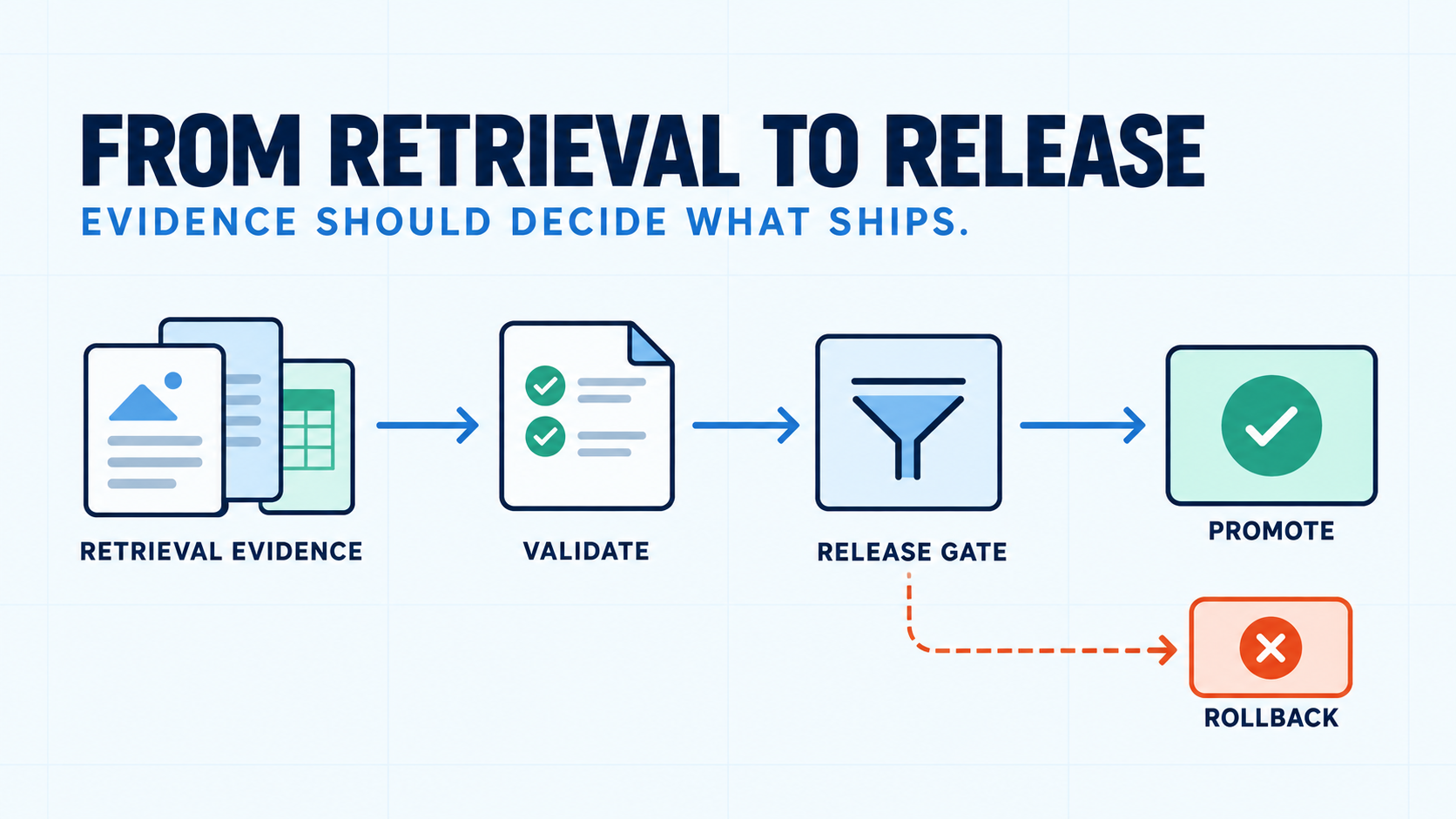
NIST’s Generative AI Profile emphasizes governance, content provenance, pre-deployment testing, and incident disclosure. In an enterprise RAG system, those ideas become concrete artifacts: source ownership, provenance fields, evaluation reports, incident logs, and a rollback path.
Should an Enterprise Use Managed or Custom RAG Architecture?
Choose managed RAG when the priority is a supported path across common sources, identity, indexing, retrieval, and model services. Choose custom RAG when the application needs unusual data sources, a specialized retriever, custom ranking, strict portability, or control over every component. The decision should follow requirements, not a preference for a particular vendor.
|
Choose Managed when |
Choose Custom when |
|---|---|
|
The data sources and permission model fit the service |
The source system or authorization model is unusual |
|
The team values integrated operations and support |
Retrieval, ranking, or graph logic is a core differentiator |
|
The default index and model choices meet evaluation thresholds |
The system requires provider portability or specialized models |
|
The organization wants a smaller platform surface |
The organization can operate ingestion, search, security, and recovery itself |
AWS documents custom RAG as an option when teams need control over the retriever, generator, vector database, or unsupported data sources. That flexibility is useful, but every custom component becomes an operating responsibility. A custom index without monitoring, ownership, deletion handling, and access tests is not an enterprise architecture. It is an unowned dependency.
What Does an Enterprise RAG Architecture Look Like in Practice?
An enterprise RAG architecture should show two flows and one control plane. The ingestion flow moves governed source data into a versioned index. The serving flow authenticates a query, applies retrieval boundaries, selects and reranks evidence, generates a response, and validates the result. The control plane evaluates, traces, audits, and recovers both flows.
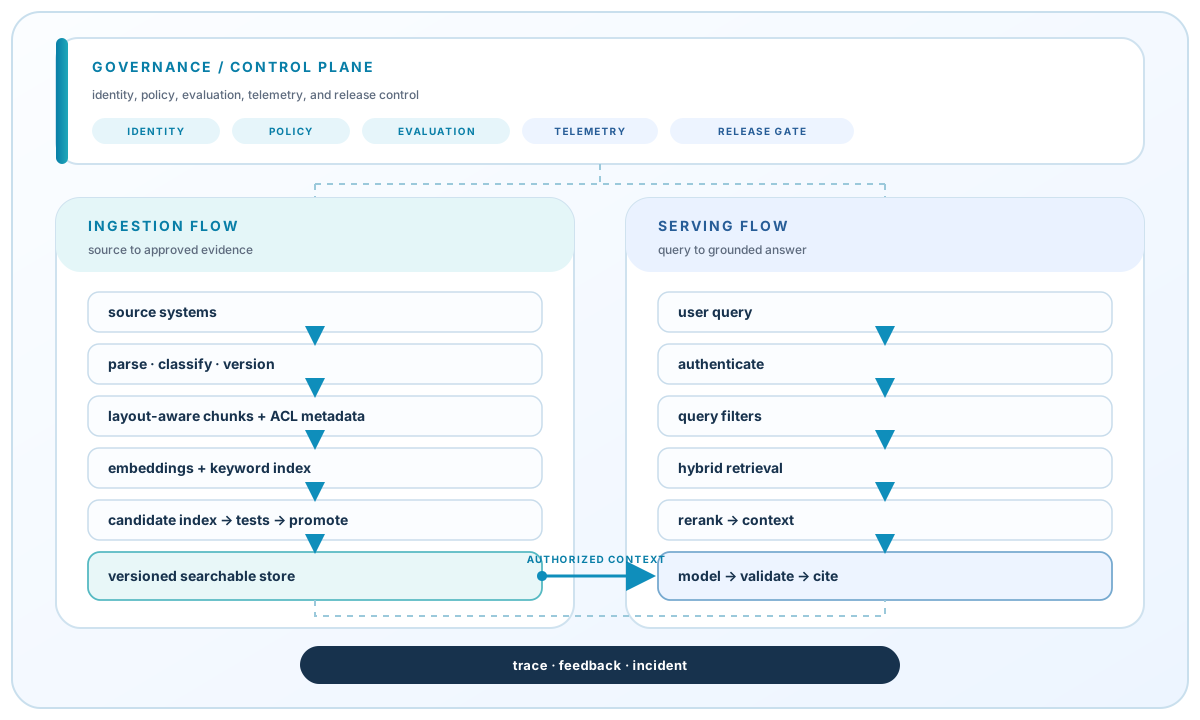
                        GOVERNANCE / CONTROL PLANE
          identity · policy · evaluation · telemetry · release gate
                         │                         │
     ┌───────────────────┴─────────────────────────┴───────────────────┐
     │                                                                  │
     │  INGESTION FLOW                         SERVING FLOW             │
     │  source systems                         user query               │
     │       │                                       │                  │
     │  parse · classify · version              authenticate            │
     │       │                                       │                  │
     │  layout-aware chunks + ACL metadata      query filters           │
     │       │                                       │                  │
     │  embeddings + keyword index              hybrid retrieval        │
     │       │                                       │                  │
     │  candidate index → tests → promote        rerank → context       │
     │       │                                       │                  │
     │  versioned searchable store ───────────► model → validate → cite │
     │                                                                  │
     └────────────────────────── trace · feedback · incident ───────────┘
This architecture does not require one product to own every component. It requires the boundaries to be explicit. When an answer is wrong, the team should be able to locate the earliest incorrect step: source parsing, permission filtering, retrieval, reranking, context construction, model generation, or output validation.
What Does This Mean in Practice?
The production question is not whether a language model can answer from a handful of documents. It is whether the organization can keep the answer grounded as documents change, users have different permissions, retrieval methods evolve, and the model provider changes.
- Build the smallest architecture that can demonstrate those properties.
- Start with authoritative sources, structure-aware ingestion, permission-aware hybrid retrieval, separate retrieval and answer evaluation, traceable releases, and a tested deletion path.
- Add GraphRAG, agents, or custom ranking only when the query patterns and evidence show that baseline retrieval is insufficient.
Frequently Asked Questions
1What is the Difference between Enterprise RAG and Regular RAG?
Regular RAG describes the retrieval-and-generation pattern. Enterprise RAG adds source ownership, access control, metadata, document lifecycle, evaluation, observability, auditability, and recovery. The difference is not the model or vector database. It is the operating contract that makes the system suitable for changing and permissioned company knowledge.
2Is a Vector Database Required for Enterprise RAG?
No. A vector index is common, but enterprise RAG may combine keyword search, vector search, relational filters, graph retrieval, or an existing enterprise search system. The correct design depends on query shape, identifiers, freshness, permissions, and evaluation results. Choose the retrieval path after defining the evidence the application must find.
3Is RAG Better than Fine-Tuning for Enterprise Knowledge?
RAG is often a practical first choice when knowledge changes, must be cited, or must respect document-level permissions. Fine-tuning changes model behavior and can help with style or task patterns, but it is not a substitute for a current, permission-aware knowledge path. Some systems use both, with separate evaluation for each role.
4What is the most Common Enterprise RAG Security Mistake?
A serious mistake is retrieving restricted content and relying on the model or a post-processing filter to hide it. Permissions must be carried into chunk metadata and applied before context reaches the model. Test negative cases across roles, tenants, classifications, deleted documents, and changed permissions.
5How many Chunks should an Enterprise RAG System Retrieve?
There is no universal top-k value. OWASP gives a starting range of three to five chunks and 2,000 to 4,000 total tokens for bounding context, but the correct range depends on the model, document structure, query type, and evidence requirement. Tune it against labeled retrieval and grounding tests, not intuition.
6When should a Team Adopt GraphRAG?
Adopt GraphRAG when users ask global, multi-hop, or relationship-heavy questions that baseline retrieval cannot answer from a few passages. Keep baseline or hybrid RAG for focused fact retrieval. GraphRAG introduces graph extraction, community summaries, access control, freshness, and cost considerations, so it should address a demonstrated query requirement.